

7 Common Myths About Quality School Shoes UK Parents Should Know in 2026
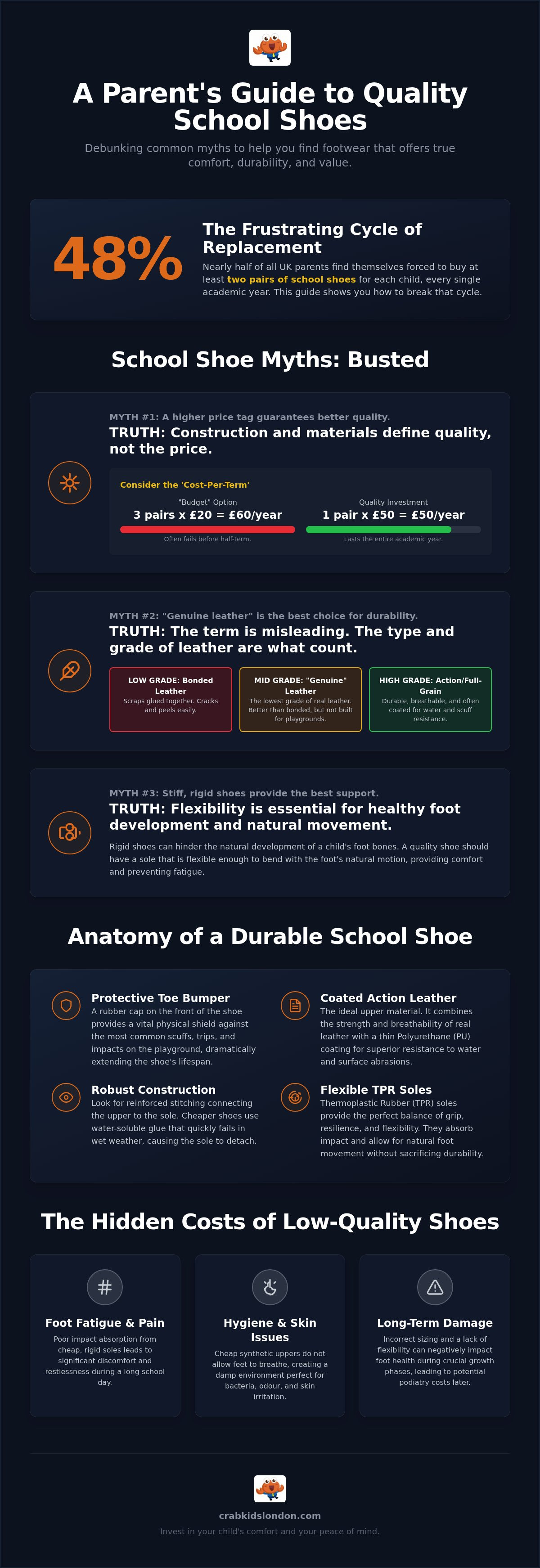
Did you know that 48% of UK parents find themselves buying at least two pairs of school shoes for each child every single year? It's a frustrating cycle of seeing scuff marks appear within days and hearing complaints about blisters before the first half-term ends. Finding genuine quality school shoes UK families can rely on feels like a gamble when expensive pairs often fail just as quickly as budget options. You likely feel that a higher price tag should guarantee a full academic year of wear, yet the reality on the playground often suggests otherwise.
This guide promises to change how you shop by uncovering the truth behind shoe durability, materials, and pricing. We'll debunk seven persistent myths that lead to wasted money and uncomfortable feet. You'll learn the difference between various leather types, how to maintain your investment, and why certain "scuff-proof" claims don't hold up. By the end, you'll have the expert knowledge needed to select footwear that actually lasts from September through to the summer holidays.
Key Takeaways
- Learn why a high price tag doesn't guarantee durability and how to identify quality school shoes UK retailers offer by checking construction rather than just the brand name.
- Discover why "genuine leather" labels can be misleading and how to choose materials that withstand playground rigours without cracking or peeling.
- Understand why stiff, heavy shoes can hinder healthy foot development and why a flexible sole is essential for natural movement and all-day comfort.
- Avoid common sizing pitfalls by learning why excessive "growing room" causes injury and how to navigate inconsistent sizing across different British brands.
- Master simple maintenance routines and shoe care habits that can effectively double the lifespan of your child's leather footwear.
The Price Tag Paradox: Does More Expensive Always Mean Better Quality?
Many parents assume a higher price tag automatically guarantees a better shoe. This isn't always true. Genuine quality school shoes UK families need are defined by three specific pillars: durable materials, robust construction, and a precise anatomical fit. While a premium price can indicate superior craftsmanship, it sometimes merely covers an expensive marketing campaign or a "designer" logo.
Budget shoes often fail because they rely on "bonded" leather. This material consists of shredded leather scraps glued together and coated in a thin layer of plastic. It looks identical to premium leather on the shelf but peels and cracks within weeks of playground activity. These cheaper alternatives also use water-soluble adhesives that quickly fail when exposed to wet British weather. When the glue dissolves, the sole begins to "smile" or detach entirely from the upper.
Consider the "Cost-Per-Term" calculation. Investing £50 in a pair that survives the entire academic year is objectively cheaper than buying three £20 pairs that fall apart. True value lies in the material investment, not the brand markup. You want to pay for the leather and the stitching, not the television advert.
Decoding the 'High Street' vs 'Specialist' Price Gap
Mass-produced fashion shoes usually lack the reinforced stitching required for active playgrounds. They are designed for aesthetics rather than the high-energy reality of school life. Specialist footwear focuses on high-grade leather and thermoplastic rubber (TPR) soles. These materials provide the necessary grip and resilience for daily wear. A look at the history of footwear materials confirms that natural, breathable components have always been essential for longevity. Fast fashion alternatives often use rigid plastics that can hinder the natural development of a child's foot bones during crucial growth phases.
Why 'Cheap' Shoes Often Lead to Hidden Podiatry Costs
Low-quality soles provide poor impact absorption. This leads to significant foot fatigue during a long school day, causing children to become restless or uncomfortable. Cheap synthetic uppers don't allow feet to breathe. This lack of ventilation creates a damp environment, often leading to hygiene issues and skin irritation. Ensuring a proper fit is also vital to prevent long-term damage. Using an accurate shoe size guide is a non-negotiable part of the purchase process to avoid these hidden health costs. Value is the intersection of longevity and foot health.
Material Misconceptions: Is Genuine Leather Always the Superior Choice?
The term "genuine leather" is often a marketing trap. In the industry, it frequently refers to the lowest grade of real leather, made from the remaining layers after the top-quality grain has been stripped away. For quality school shoes UK parents can trust, the material must be matched to the child's activity level. While full-grain leather is supple and breathable, it can be delicate. Many active children benefit more from "Action Leather," which is real leather topped with a thin polyurethane (PU) coating. This hybrid material offers the structural benefits of animal hide with a much higher resistance to water and surface abrasions.
Patent leather is another common source of confusion. It provides a beautiful, high-shine finish that meets strict school uniform codes, but it requires specific care. Without regular cleaning, the glossy coating can crack at the flex points. Breathability is also a critical factor. Natural materials allow moisture to escape, preventing the damp environment where bacteria thrive. Following the Royal College of Podiatry's shoe fitting advice is the best way to ensure you choose materials that support foot health and prevent the dreaded "school shoe smell" by the end of the first term.
Scuff-Resistant vs Scuff-Proof: The Playground Reality
No shoe is truly scuff-proof. A concrete playground acts like industrial-strength sandpaper on any material. However, high-quality coatings and specialised leather treatments make a significant difference. Scuff-resistant shoes use tougher outer layers that prevent deep gouges in the material. Rubber toe-bumpers are a vital feature for extending the life of footwear, as they provide a physical shield against the most common impact points. If your child's shoes do take a hit, knowing how to fix scuffed school shoes can help you restore the finish and protect the leather underneath from further damage.
When Synthetics Outperform Leather
Modern high-tech synthetics have moved far beyond the "plastic" shoes of the past. High-grade microfibres now offer a vegan-friendly alternative that matches the strength of leather whilst providing superior water resistance. These materials are particularly effective in "hybrid" designs, where they are used in high-wear areas to combat wet UK winters. You can explore our new arrivals to see how these advanced material blends are used to create durable, lightweight footwear. Choosing a pair that balances these modern innovations with traditional comfort ensures your child is ready for any weather. For those seeking the ultimate durability, browsing the latest boys' school shoes often reveals the most rugged material combinations available today.
The Support Fallacy: Why Stiff Shoes Might Be Harming Your Child’s Feet
Many parents believe that a heavy, rigid shoe is a sign of durability. They mistake stiffness for "support," assuming that a rock-solid structure protects a growing foot. In reality, the opposite is often true. High-quality school shoes UK children wear must be engineered to mimic natural movement. If a shoe doesn't flex at the ball of the foot, the foot has to work twice as hard to complete a single step. This constant resistance leads to muscle strain and can even alter a child's natural gait over time.
Stiff, inflexible soles are also a primary cause of tripping and "clumsy" playground behaviour. When the sole won't bend, the foot cannot "feel" the ground properly, leading to stumbles during high-energy games. Experts agree that a balance between protection and flexibility is vital. According to APMA guidance on children's shoes, a shoe should be sturdy enough to protect the foot but flexible enough to allow for natural development. For a deeper dive into why movement matters, read our Flexible School Shoes for Kids guide to understand the mechanics of healthy growth.
The Science of the 'First Bell to Last Bell' Comfort
School days are long. Your child is likely on their feet for six hours or more, making cushioned insoles a necessity rather than a luxury. High-density foam or gel-based inserts absorb the shock of hard corridors and concrete playgrounds. This protection is essential because a child's foot contains 26 bones that need room to move naturally. Padded collars are equally important. These soft linings around the ankle prevent the friction that causes heel chafing and painful blisters. When the shoe interior is as well-engineered as the exterior, children can focus on learning rather than their feet.
Weight Matters: The Impact of Heavy Footwear on Fatigue
Traditional heavy boots might look indestructible, but they often contribute to significant "end of day" fatigue. Lifting an extra few hundred grams with every step adds up over thousands of movements. Modern quality school shoes UK brands now utilise lightweight materials like thermoplastic rubber (TPR) to provide the same resilience as heavy rubber without the bulk. Lightweight construction is particularly beneficial for primary school children who are constantly in motion. At Crabkids London, we prioritise these advanced, featherweight materials to ensure kids maintain their energy levels from the morning commute until the final bell. This focus on reduced weight doesn't sacrifice strength; it simply utilises better engineering for a more comfortable experience.
Beyond the Size Number: The Myth That One Measurement Fits All
Standardisation in the UK footwear market is surprisingly rare. A "Size 2" from one high-street retailer might feel like a size 3 from a specialist brand, leading to significant confusion for parents shopping online. Finding quality school shoes UK families can rely on involves more than just picking a number off a box. Length is only one part of the equation; width and instep height are equally critical for a comfortable fit that supports healthy growth.
Many parents fall into the "growing into them" trap. Buying shoes that are a size too big might seem like a cost-saving measure, but it often leads to injury. When a shoe is too large, the foot slides forward with every step. This movement causes the toes to "claw" to maintain grip, which can lead to long-term structural damage and painful blisters. It also means the shoe's flex point won't align with the child's foot, causing the leather to crease and crack prematurely. Using a detailed Crabkids Shoe Size Guide ensures you get the proportions right from the start. Once you have your measurements, you can shop our range of professionally designed school shoes with complete confidence.
How to Measure Growing Feet at Home
Measuring at home is a straightforward process if you follow a methodical approach. It's the best way to ensure a perfect fit without the stress of a busy shop. Follow these steps for accuracy:
- Measure in the afternoon: Feet naturally swell and expand throughout the day. Measuring later ensures the shoes won't be too tight by the final school bell.
- The paper and wall method: Place a piece of paper against a flat wall. Have your child stand on it with their heel touching the wall. Mark the tip of the longest toe.
- The Rule of Thumb: There should be approximately 1 to 1.5 centimetres of space between the end of the toe and the front of the shoe.
- Check the width: Ensure there is no bulging over the side of the sole. The foot should sit centrally on the footbed without pinching.
Signs of a Poor Fit You Might Be Missing
Signs of an ill-fitting shoe are often subtle. Look for curled toes when the shoes are removed or redness on the pinky toe and heel. If a child constantly wants to take their shoes off the moment they get home, it's usually a sign of discomfort. The idea that you need to "break in" new footwear is a total myth. High-quality leather should feel supple and comfortable from day one. Understanding how school shoe fit affects durability will help you spot these issues before they lead to worn-out soles or unhappy children. Proper sizing isn't just about comfort; it's the foundation of a shoe that lasts the whole year.
Investing in Longevity: How to Identify Quality School Shoes That Last
Identifying quality school shoes UK parents can trust involves looking past the brand name to the actual engineering. Our 2026 Quality Checklist focuses on four non-negotiable attributes: high-grade scuff-resistant leather, flexible TPR soles, breathable interior linings, and reinforced pressure points. When these elements align, you aren't just buying footwear; you're securing a pair that will survive the daily rigours of the playground and the classroom alike. Investing in these features upfront prevents the cycle of mid-term replacements that many families face.
The Crabkids Quality Checklist for 2026 includes:
- Premium Action Leather: Selected for its ability to resist deep scuffs and repel water.
- TPR Flex-Soles: Engineered to bend at the ball of the foot for natural movement.
- Padded Collars: Designed to eliminate heel friction and prevent blisters from day one.
- Breathable Linings: Essential for maintaining hygiene and internal material integrity.
The Essential Shoe Care Routine
Longevity is a partnership between the manufacturer and the parent. Regular maintenance can effectively double the lifespan of leather footwear. Use a dedicated Leather Shoe Cleaning Lotion to remove ingrained dirt and salt before applying any polish. Covering up dirt with layers of wax only traps grit that eventually degrades the leather fibres. Additionally, ensure your child wears moisture-wicking school socks to manage perspiration. Rotating shoes when possible allows the internal materials to dry completely, preventing the structural breakdown caused by constant dampness.
Why Crabkids London is the Parent’s Choice for 2026
We design our footwear specifically for active school life. Every pair is playground-tested to ensure it meets our strict standards for resilience and comfort. Whether you are browsing our collections for boys or girls, you'll find shoes engineered for high-energy movement. We understand the stress of the back-to-school season, which is why we offer fast national delivery across the UK. Our goal is to be your reliable partner, providing expert guidance and sturdy products so you can focus on your child's education rather than their footwear. Supporting a brand that understands the unique challenges of the UK school environment makes all the difference.
Invest in durability today. Shop the 2026 Collection at Crabkids London and ensure your child starts the term with the best possible support.
Equipping Your Child for a Successful School Year
Choosing the right footwear means looking beyond the glossy finish and the high price tag. You now know that genuine quality school shoes UK families can rely on require a balance of flexible engineering and robust leather construction. Prioritising natural movement over rigid "support" and ensuring a precise fit rather than buying for growth will protect your child's foot health and your household budget. These small shifts in how you shop ensure that the footwear you buy in September actually lasts until the final summer bell.
At Crabkids London, we take the guesswork out of the back-to-school rush. Our shoes are expertly designed for active children and feature durable leather construction that stands up to the most rigorous playground testing. We provide fast UK-wide delivery to ensure your household is ready for the new term without the stress of high-street queues. Our goal is to provide the resilience your child needs with the ease of service you deserve. Upgrade to Playground-Proof Quality at Crabkids London today and feel confident that your investment is built to last. Your child's comfort is the foundation for a great year of learning.
Frequently Asked Questions
Are leather school shoes always better than synthetic ones?
Leather is generally superior due to its natural breathability and ability to mould to the shape of the foot over time. It provides a healthier environment for feet during long school days. Whilst modern high-quality synthetics offer excellent water resistance and vegan-friendly options, they often lack the same level of ventilation. For most children, leather remains the standard for durability and comfort in the varied British climate.
How much growing room should I leave in new school shoes?
You should aim for approximately 1 to 1.5 centimetres of space between the longest toe and the front of the shoe. This "Rule of Thumb" provides enough space for natural growth without allowing the foot to slide. Excessive growing room is a common mistake that leads to blisters and premature wear. Measuring in the afternoon ensures you account for the foot's natural expansion throughout the day.
Can I wash leather school shoes in the washing machine?
No, you should never put leather footwear in a washing machine. The combination of heat and excessive water destroys the leather's natural oils and weakens the adhesives holding the sole in place. To maintain quality school shoes UK parents should use a damp cloth and specialised cleaning lotion instead. Always allow shoes to air dry naturally away from direct heat sources like radiators to prevent the material from cracking.
What is the most durable type of school shoe for active boys?
The most durable styles feature "Action Leather" uppers and integrated rubber toe-bumpers. These components are specifically designed to withstand the abrasive nature of concrete playgrounds. Look for shoes with thick, thermoplastic rubber soles that offer both grip and flexibility. Sturdy fastenings, such as high-quality hook-and-loop straps, are also essential for keeping the shoes secure during high-energy activities and preventing unnecessary structural strain.
How often should I measure my child's feet for new school shoes?
It is best to measure your child's feet every eight to twelve weeks. Children's feet grow in unpredictable bursts, so regular checks ensure they aren't restricted by footwear that has become too small. Checking the fit before the start of every new term is a vital habit. Consistent measuring helps you identify when it's time to invest in new quality school shoes UK before discomfort or foot health issues arise.
Are expensive school shoes worth the investment?
Expensive shoes are worth the investment if the price reflects premium materials and robust construction. A well-made pair often lasts the entire academic year, whereas budget alternatives frequently require replacing every few months. This makes the "cost-per-term" of a higher-quality shoe much lower in the long run. Focus on identifying features like reinforced stitching and breathable linings rather than simply paying for a well-known fashion logo.
How do I stop school shoes from scuffing so quickly?
Preventing scuffs starts with applying a protective spray or cream before the first wear. This creates a barrier against moisture and surface dirt. Choosing designs with raised toe-guards provides a physical shield against the most common impact points. Regular polishing with a matching colour cream also helps by nourishing the leather and filling in minor grazes before they develop into deep, irreparable cracks in the material.
Should school shoes be stiff to provide better support?
No, school shoes should never be completely rigid. While a firm heel counter is necessary to keep the foot stable, the sole must be flexible at the ball of the foot. Stiff shoes restrict the natural movement of the 26 bones in a child's foot, leading to muscle fatigue and potential gait issues. A truly supportive shoe protects the foot whilst allowing it to bend and move as nature intended.