

How School Shoe Fit Affects Durability: The Parent's Guide to Sizing and Longevity
Buying school shoes a size too big might seem like a smart way to save money, but this common "growth room" strategy often leads to an earlier replacement. When a foot slides around inside a shoe, it creates internal friction and forced creases that compromise the leather's structure. It is incredibly frustrating to spend £50 on quality footwear only to see it scuffed and battered before the first half-term. Understanding how school shoe fit affects durability is the key to making your investment last until the summer holidays.
We know you want shoes that can handle the high-energy reality of the playground without sacrificing your child's comfort. This guide explains the mechanical link between a precise fit and shoe longevity, helping you avoid the "tripped-over toe" dilemma. You will learn how to identify wear patterns caused by poor sizing and how to use our UK size guide to find the perfect balance for growing feet. Let's ensure those sturdy leather shoes stay looking professional whilst providing the support your child needs for an active school day.
Key Takeaways
- Understand the importance of "hinge points" and how aligning the ball of the foot prevents leather from cracking or losing its shape.
- Learn how school shoe fit affects durability by avoiding the common "clown shoe" effect that leads to accelerated toe scuffing and tripped-over toes.
- Use the 10-12mm "Rule of Thumb" to find the precise sweet spot between immediate comfort and necessary growth room for the term ahead.
- Identify what specific wear patterns on the sole or sides indicate about your child’s gait and whether it is time to size up.
- Discover how high-grade leather and reinforced stitching work together to maintain structural support during active playground use.
The Science of Sizing: Why Fit is the Foundation of Durability
Understanding how school shoe fit affects durability starts with viewing a shoe as a piece of precision engineering rather than just a leather covering. Every high-quality school shoe is designed to mirror the natural biomechanics of a child's foot. When the foot is positioned correctly, the shoe distributes weight and pressure evenly across the sole and upper. However, if the fit is incorrect, the foot forces the shoe to work against its own structural design. This creates internal tension and "material stress," where the foot shifts and pushes against the leather in ways the manufacturers never intended.
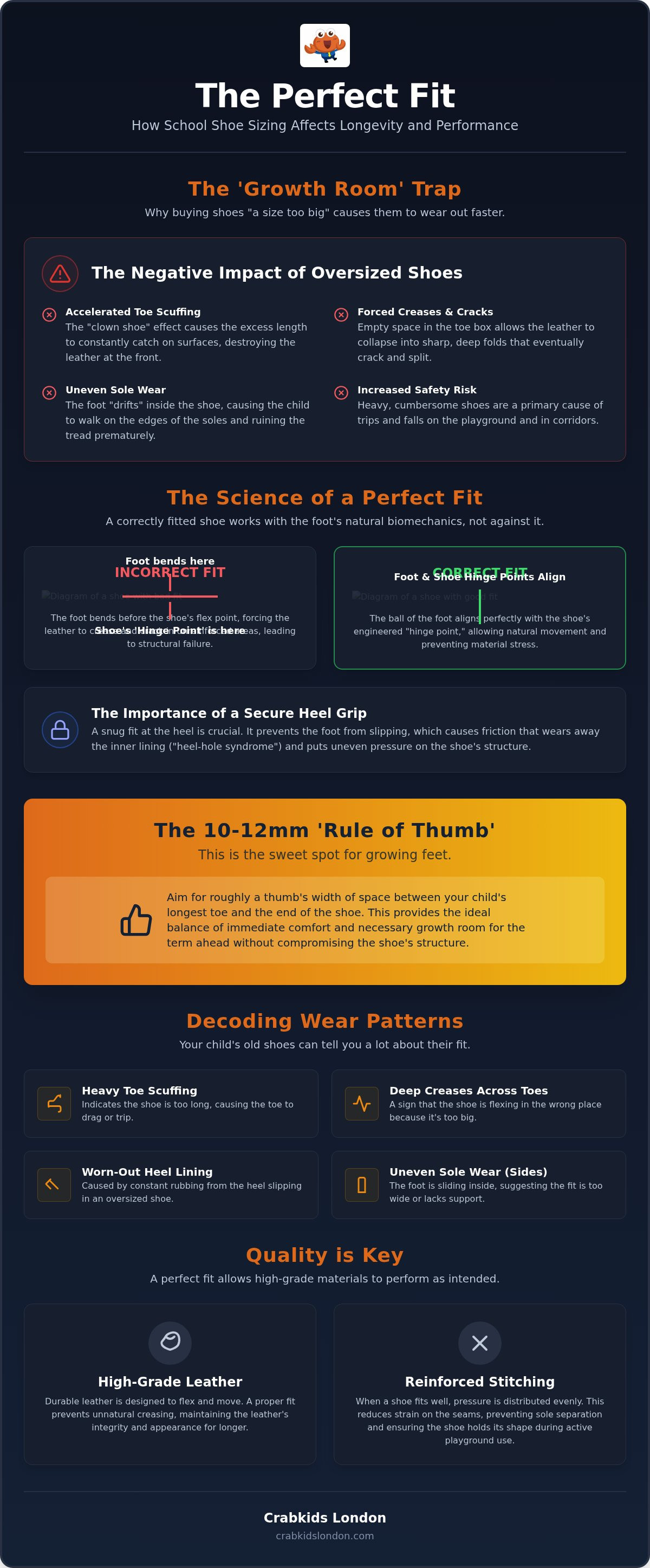
The most critical area of this engineering is the "hinge point," located at the ball of the foot. Shoes are manufactured to flex at this specific wide point to allow for natural movement. If a shoe is too large, the child's foot bends before the shoe's intended flex zone. This forces the leather to crease in thinner, unreinforced areas, leading to deep cracks and structural weakening. Shoe durability is the ability of materials to withstand repetitive flex cycles without structural failure. When these cycles happen at the wrong point, that failure arrives months earlier than it should.
The Role of the Heel Grip in Longevity
A secure heel grip is the anchor of a long-lasting shoe. When a shoe is too large, the heel constantly lifts and rubs against the interior lining with every step. This friction creates "heel-hole syndrome," where the internal fabric and cushioning wear away whilst the exterior still looks relatively new. Beyond internal damage, this constant slippage puts uneven pressure on the external heel counter. This often causes the back of the shoe to collapse or the sole to wear down at an awkward, sharp angle. Keeping the foot locked in place preserves the shoe's silhouette and protects the internal components from grinding down prematurely.
Flex Points and Leather Integrity
Leather is a resilient material, but it has physical limits. Identifying where a shoe bends naturally helps you spot a poor fit before the damage becomes permanent. If you notice heavy creasing across the very top of the toes rather than the ball of the foot, the shoe is likely too long. This misplaced stress causes the leather to pinch and eventually split. Using a shoe size guide ensures the foot sits in the correct position. Proper support ensures the upper and sole move in harmony, preventing the "sole separation" often seen in ill-fitting, over-stressed footwear.
The 'Growth Room' Trap: How Over-Sizing Destroys Shoes Faster
It is a common misconception that purchasing footwear with significant "room to grow" is a cost-effective choice. In reality, this is where we see exactly how school shoe fit affects durability in a negative way. When a shoe is too large, the foot does not align with the internal architecture. This creates a "clown shoe" effect where the excess length at the toe box frequently catches on the pavement or playground surface. Instead of the shoe lasting longer, the front of the leather is subjected to aggressive scuffing and abrasion that would not occur in a well-fitted pair.
Mechanical stress also plays a major role in premature failure. If the child's arch does not sit against the shoe's built-in support, the foot tends to "drift" inside the cabin. This misalignment causes the child to walk on the edges of the soles, leading to uneven wear patterns that can ruin the tread within months. A shoe that is too big is often dragged rather than lifted, putting immense strain on the stitching and the bond between the upper and the sole. Finding a pair that balances growth room with a secure fit is essential for longevity. You can explore our range of resilient girls' school shoes designed to withstand the daily dash whilst maintaining their shape.
The Premature Creasing Problem
Empty space in the toe box is a recipe for structural failure. Without the foot to provide internal volume, the leather collapses into deep, permanent folds with every step. These are not the soft ripples found in well-fitted shoes; they are sharp, aggressive creases that eventually turn into cracks. This is particularly damaging for patent leather styles, as the shiny coating will eventually flake away from the stressed areas. Once the leather surface is breached, moisture can seep in, further weakening the material from the inside out.
Safety and Structural Strain
Oversized shoes are heavy and cumbersome for smaller feet to manage. They significantly increase the risk of trips and falls on the playground, which often results in "toe-stubbing" damage that ruins the shoe's aesthetic. The extra weight of a larger size also puts unnecessary tension on the eyelets and fastenings as the foot struggles to stay secure. If you are unsure if your child's current pair is still providing the right support, read our guide on 5 Signs Kids Need New School Shoes to help you decide when it is time to upgrade.
The UK School Shoe Size Guide: Finding the Sweet Spot
Finding the correct size is the most effective way to protect your investment. In the UK, children's sizes follow a specific scale that parents must navigate carefully. To get the best results, you need to find the "sweet spot" where the foot is secure but has enough room for natural development. Learning how school shoe fit affects durability empowers you to make informed choices that save money over the academic year. A shoe that fits perfectly from day one will always outlast a pair that is either too tight or excessively loose.
The industry standard for growth room is known as the "Rule of Thumb." This suggests leaving approximately 10 to 12mm of space between the longest toe and the front of the shoe. This gap is not just for growth; it provides the necessary clearance for the foot to slide forward slightly during a stride. Without this buffer, the toes constantly strike the front of the shoe, causing the leather to scuff and the internal toe puff to collapse. You can find our specific centimetre-to-size conversions in the Crabkids London Shoe Size Guide to ensure a precise match.
How to Measure for Longevity at Home
Accurate measurement is the foundation of shoe resilience. We recommend the "paper and wall" method for the most reliable results. Place a sheet of paper against a flat skirting board and have your child stand on it with their heel touching the wall. Mark the tip of the longest toe on the paper and measure the distance in centimetres. It is vital to measure both feet, as most children have one foot slightly larger than the other. Always fit to the larger foot to prevent the shoe from being over-stressed. Ensure your child is wearing their usual school socks during this process, as thickness can significantly alter the required size.
Width Fittings and Sole Integrity
Width is just as critical as length for structural durability. If a shoe is too narrow, the foot will naturally push against the sides of the leather upper. This constant pressure forces the leather to stretch beyond its elastic limit, leading to "over-spill" where the foot sits wider than the sole. This misalignment puts extreme tension on the welt and the stitching that bonds the upper to the base. Over time, this leads to the sole peeling away or the leather splitting at the widest point of the foot. For children who require more room, exploring School Shoes for Wide Feet Children can prevent these structural failures whilst ensuring a comfortable, long-lasting fit.
Identifying Wear Patterns: What Your Child's Shoes Are Telling You
Your child’s shoes act as a diagnostic map of their daily movement. By examining the soles and uppers, you can quickly determine how school shoe fit affects durability in real-time. Regular inspections allow you to catch sizing issues before they cause permanent damage to the footwear or discomfort for the wearer. If a shoe is fitted correctly, the wear should be relatively even across the ball of the foot and the heel. Uneven patterns, however, are a clear signal that the shoe is working against the foot's natural mechanics.
A common sign of a shoe that has become too small is the appearance of deep toe imprints on the internal footbed or excessive wear on the internal lining near the pinky toe. On the outside, "scuffing at the tip" often indicates a shoe that is too long, as we explored in the "clown shoe" effect. Conversely, scuffing concentrated on the sides of the toe box suggests the shoe is too narrow, forcing the leather to rub against the ground during turns. These visual cues are your best tool for deciding when it is time to refresh your child's footwear.
Sole Wear and Gait Analysis
The bottom of the shoe provides the most honest feedback on fit. "Inner-edge" wear on the sole often suggests that the shoe lacks sufficient arch support for the child's foot shape, causing the foot to roll inward. This puts extreme pressure on the inner stitching, leading to premature structural failure. On the other hand, "outer-heel" wear is frequently seen in shoes that are too heavy or too large, where the child is forced to drag their heel with every step. This grinding motion thins the rubber sole rapidly, eventually exposing the softer midsole to the elements.
The Scuff Test for Active Kids
It is important to distinguish between "normal" playground scuffing and damage caused by a poor fit. Normal wear usually appears as light abrasions across the general toe area from kneeling or running. "Poor fit" scuffing is deeper and often concentrated on one specific edge, indicating that the shoe's silhouette is not moving in harmony with the foot. Whilst we use high-grade leather to maximise resilience, even the toughest materials struggle when a bad fit creates constant, localised friction. To find footwear designed for the most energetic students, browse our Durable Boys' Leather School Shoes guide. For the best protection against the British school year, shop our playground-proof boys' collection today.
Investing in Quality: How Crabkids London Combines Fit and Resilience
Choosing the right footwear is a strategic decision for any parent. We have explored the science of hinge points and the dangers of the growth room trap, but the final piece of the puzzle is the quality of the shoe itself. Understanding how school shoe fit affects durability is most effective when paired with high-grade materials that can handle the pressure. Crabkids London focuses on high-quality leather construction and robust stitching to ensure our shoes don't just fit well on day one, but maintain their integrity until the final bell of the summer term.
Our engineering process acknowledges that children’s feet are constantly changing. We build our shoes to accommodate natural growth whilst providing the structural support needed to prevent the "over-spill" and "toe-drifting" mentioned earlier. By using premium skins that offer a balance of flexibility and strength, we ensure the leather bends where it should without snapping or cracking. This commitment to craftsmanship makes a precise fit from Crabkids London the ultimate cost-saving measure, reducing the need for mid-term replacements.
Designed for the British Playground
The UK school environment is uniquely demanding, featuring everything from wet autumn commutes to high-impact football games at break time. Our Boys' School Shoes and Girls' School Shoes are selected for their scuff-resistant properties and ability to retain their silhouette. We use reinforced heel counters and sturdy outsoles that resist the uneven wear patterns caused by poor gait. This design philosophy ensures that even as a child reaches the end of their current size, the shoe remains a stable, protective environment for their feet.
Longevity does not stop at the point of purchase. To truly maximise the lifespan of your investment, regular maintenance is essential. Our Leather Shoe Cleaning Lotion serves as the final step in your durability strategy. It cleans away playground grit whilst nourishing the leather, keeping it supple enough to handle thousands of flex cycles without failing. A well-maintained shoe remains water-resistant and professional-looking for much longer than a neglected one.
The Crabkids London Advantage
We understand that busy parents need reliable solutions quickly. Our service provides fast national UK delivery so you can secure the correct size exactly when your child's growth spurt demands it. We offer a curated range that perfectly balances strict British school dress codes with the rugged durability children require. By combining expert sizing knowledge with playground-proof construction, we do the heavy lifting so you don't have to. Protect your child's comfort and your school-year budget by choosing footwear built to last. Shop the full Crabkids London School Shoe collection today and invest in quality that stands up to the test.
Protect Your Investment with the Perfect Fit
Choosing the right size is the most effective way to ensure your child's footwear survives the daily rigours of the playground. By aligning the ball of the foot with the shoe's engineered flex points, you prevent the deep cracking and sole separation caused by a poor fit. We have seen that avoiding the "growth room" trap is essential for maintaining the leather's surface and protecting against aggressive scuffing. Understanding how school shoe fit affects durability turns a simple purchase into a long-term investment in your child's comfort and your own peace of mind.
At Crabkids London, we combine premium leather scuff-resistant designs with the expert knowledge found in our specialist children's shoe size guide UK. We are here to help you navigate the academic year with confidence, providing durable footwear that maintains its shape and support. With our fast UK-wide delivery, you can have the right size on your doorstep exactly when you need it. Ready to upgrade your child's school kit?
Find the perfect, durable fit for the new term at Crabkids London and give your child the sturdy foundation they need for an active school day.
Frequently Asked Questions
How much growth room should I actually leave in school shoes?
The ideal amount of growth room is between 10mm and 12mm. This space, roughly the width of a parent's thumb, allows the foot to slide forward naturally during a stride without striking the front of the shoe. Leaving more than this can lead to trips and heel slippage, whilst leaving less will cause the toes to cramp and the internal lining to wear through prematurely.
Can a shoe that is too big really cause the leather to crack?
Yes, oversized shoes are a primary cause of leather cracking. When there is too much empty space in the toe box, the leather collapses into sharp, aggressive folds rather than gentle ripples. These repeated, deep creases eventually weaken the leather's fibres, leading to structural cracks that let in moisture and ruin the shoe's professional appearance.
How often should I re-measure my child's feet for school shoes?
You should check the fit of your child's shoes every six to eight weeks for primary aged children. Older children in secondary school generally experience slower growth, so a termly check is usually sufficient. Regular measuring ensures you understand how school shoe fit affects durability by catching size changes before the foot starts to stretch the shoe's materials out of shape.
What are the signs that my child's school shoes are too narrow?
The most obvious sign of a narrow fit is "over-spill," where the foot appears to bulge over the edge of the sole. You might also notice the leather stretching excessively at the widest part of the foot or the stitching beginning to fray at the welt. If the leather looks strained or "pulled" across the bridge of the foot, the shoe is too tight and will likely fail at the seams.
Does the weight of a school shoe affect its durability?
Weight has a significant impact on how a shoe wears down over time. Shoes that are too heavy for a child's current strength often lead to a "shuffling" gait where the heels are dragged across the ground. This constant abrasion thins the rubber soles rapidly. Choosing a lightweight but sturdy leather shoe helps maintain a natural walking pattern and preserves the tread for much longer.
Why do the heels of my child's shoes wear down so quickly?
Rapid heel wear is usually caused by heel slippage or an incorrect gait. When a shoe is too large, the heel lifts out of the cup with every step, creating friction that destroys the internal lining. Externally, this slippage often causes the child to strike the ground at an awkward angle, grinding the outer corner of the heel down. A secure, snug fit is the best defence against this damage.
Is it better to buy half-sizes for better longevity?
Half-sizes are excellent for achieving a precise fit that maximises the lifespan of the shoe. Because how school shoe fit affects durability depends on the alignment of the foot with the shoe's flex points, a half-size can provide that extra 5mm needed for comfort without the risks of a full-size jump. This precision prevents the premature creasing and scuffing associated with oversized footwear.
How can I tell if the scuffing is due to poor fit or just active play?
Location is the key indicator for diagnosing scuffs. Normal playground wear usually appears as light, scattered marks across the front of the shoe. If the scuffing is concentrated heavily on the very tip of the toe or the extreme sides, it suggests the shoe is either too long or too narrow. These localised "stress scuffs" are a sign that the shoe is striking the ground in ways it was not designed to handle.