

Why Your Child Complains School Shoes Are Uncomfortable: A Parent's Troubleshooting Guide
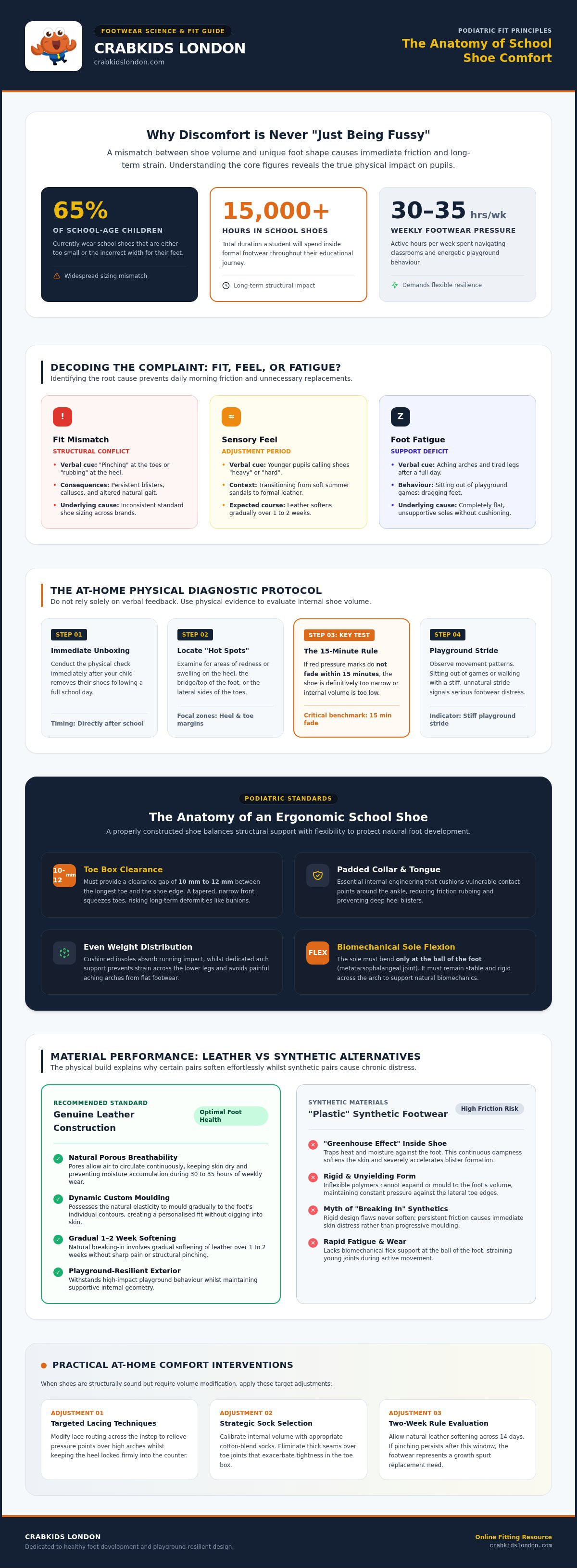
Did you know that approximately 65% of school-age children are currently wearing footwear that's either too small or the wrong width? It's a staggering figure. A student will spend over 15,000 hours in their school shoes throughout their education. If your child complains school shoes are uncomfortable, it's rarely a case of them being "fussy." Instead, it's often a sign of a genuine mismatch between the shoe's volume and the foot's unique shape.
We understand the frustration of investing in quality leather only to face daily morning tears or reports of painful blisters. You want a solution that protects their long-term foot health without wasting more money on the wrong brands. This guide identifies the root causes of footwear distress and provides practical solutions to keep your child pain-free. We'll show you how to perform a reliable fit test at home, explain why the "breaking in" period is often a myth, and help you choose durable replacements that actually support active playground behaviour.
Key Takeaways
- Distinguish between the natural softening of quality leather and structural design flaws that cause immediate distress.
- Identify the root causes when your child complains school shoes are uncomfortable, focusing on toe box clearance and material breathability.
- Apply the two-week rule to evaluate new footwear and learn how to recognise when a sudden growth spurt requires a replacement.
- Discover practical at-home adjustments, including specific lacing techniques and sock selections, to improve fit and internal volume.
- Understand why investing in resilient, professional-grade materials helps shoes withstand the rigours of daily playground behaviour.
Decoding the Complaint: Is it Fit, Feel, or Fatigue?
When a child complains school shoes are uncomfortable, parents often face a dilemma. Is the footwear actually faulty, or is the child simply adjusting to a firmer structure after a summer spent in soft sandals? Distinguishing between these scenarios is vital for long-term foot health. High-quality leather shoes naturally require a short "breaking in" period, typically lasting between one and two weeks. During this time, the material softens and begins to mould to the foot's unique contours. However, this process should involve a gradual softening of the leather, not sharp pain or skin damage.
Ignoring early reports of discomfort can lead to more than just a grumpy morning. Persistent friction causes painful blisters and calluses, whilst restrictive designs can even alter a child's natural gait. Because many brands utilise different standardized shoe sizing systems, a "size 2" in one shop may feel significantly tighter than in another. This inconsistency often leaves parents confused and children in distress. Identifying whether the issue is a matter of fit, feel, or fatigue is the first step toward a solution.
The Psychology of New Shoes
Children describe discomfort in varied ways depending on their age. A younger child might say their shoes feel "heavy" or "hard" because they aren't used to the sturdy construction of a formal leather shoe. This is often a sensory adjustment rather than a fit issue. Older pupils might be more specific, pointing to "pinching" at the toes or "rubbing" at the heel. It is also worth considering if a child's preference for a different style is influencing their perception of comfort. A "Practical Specialist" approach involves listening to these cues whilst checking for physical evidence to back them up.
Physical Signs of Poor Fit
Don't rely solely on verbal feedback. Perform the "red mark" test by checking your child's feet immediately after they take their shoes off following a full school day. Look for "hot spots"—areas of redness or swelling on the heel, the top of the foot, or the sides of the toes. Persistent marks that don't fade within fifteen minutes suggest the shoe is too narrow or the volume is too low. You should also observe their behaviour on the playground; if they are sitting out of games or walking with a stiff, unnatural stride, the shoes are likely the culprit. To ensure the measurements are accurate from the start, consult our shoe size guide to verify the current length and width requirements.
The Anatomy of Comfort: Why Materials and Design Matter
The secret to a pain-free school day isn't just the right size; it's the right construction. When a child complains school shoes are uncomfortable, the culprit is frequently a lack of breathability or a rigid sole that fights against their natural movement. High-quality footwear must balance structural support with flexibility to accommodate the high-energy reality of the playground. Understanding the physical build of a shoe helps parents identify why certain pairs cause distress whilst others feel effortless.
The Benefits of Genuine Leather
Synthetic materials often trap heat and moisture, creating a "greenhouse effect" inside the shoe. This leads to skin softening and painful friction. In contrast, genuine leather offers natural pores that allow air to circulate. This breathability is essential for maintaining foot health over the 30 to 35 hours children spend in their shoes each week. Leather also possesses a unique ability to mould to the foot's volume, providing a customised fit that synthetic "plastic" alternatives simply cannot match. It offers a resilient exterior that handles playground behaviour whilst remaining soft enough to prevent digging into the skin.
Designers must also prioritise the toe box. Podiatric standards suggest a clearance gap of 10 mm to 12 mm between the longest toe and the shoe's edge. A narrow, tapered front squeezes the toes, potentially leading to long-term deformities like bunions. For more detailed advice, parents should consult official guidelines on children's foot development and footwear to understand how anatomy influences shoe choice.
Internal Support Structures
Internal support is equally vital for preventing "tired" feet. A quality shoe features a padded collar and tongue to reduce ankle rubbing, alongside a cushioned insole to absorb the impact of running. Many children experience aching arches when wearing completely flat, unsupportive shoes. Proper arch support helps distribute weight evenly, reducing strain on the lower legs. The sole itself must be flexible, bending only at the ball of the foot, the metatarsophalangeal joint, rather than across the arch. This ensures the shoe supports the foot's biomechanical flex point during activity. If you're looking for footwear that combines these professional standards with resilience, exploring a range of durable leather school shoes is a sensible starting point.
Breaking In vs. Outgrown: When to Keep and When to Replace
Parents often struggle to tell if a shoe just needs "wearing in" or if it's fundamentally the wrong size. When a child complains school shoes are uncomfortable shortly after purchase, the two-week rule is a helpful benchmark. High-quality leather is a natural material that requires a short period of activity to soften and flex. If the discomfort persists beyond ten to fourteen days of regular wear, the issue is likely structural rather than a simple case of new-shoe stiffness. It is vital to monitor this period closely to avoid the development of blisters or gait distortions.
The most reliable home check is the "Thumb Test." Whilst your child is standing, press down firmly at the tip of the shoe. You should find a gap of approximately 10 mm to 12 mm between the end of their longest toe and the shoe wall. This space allows for the natural expansion of the foot during movement and accounts for growth. Following American Academy of Pediatrics fitting recommendations ensures you don't wait until physical pain starts before considering an upgrade.
The 'Break-In' Checklist
To safely soften new leather without compromising its structure, start with short-wear sessions. Have your child wear the shoes around the house for thirty minutes at a time whilst wearing thick socks. This helps stretch the material gently. Applying a quality leather cleaning lotion can also assist in maintaining the suppleness of the material. This makes the leather more pliable and significantly reduces the risk of initial rubbing during the first week of term.
Identifying an Outgrown Shoe
Children's feet grow in unpredictable spurts. A shoe that fits perfectly in September can easily become restrictive by November. You should perform the "Width Test" regularly; look for any visible bulging at the sides of the leather. If the foot appears to be straining against the shoe's boundaries, the internal volume is no longer sufficient. Heel pinching is another critical red flag. Whilst a slight heel slip might suggest the shoe is too large or requires tighter lacing, a sharp pinch usually indicates the foot has reached the limit of the shoe's internal length. Regular checks using our Shoe Size Guide will help you stay ahead of these growth cycles and ensure continued comfort.
Practical Home Solutions for Immediate Comfort
If a child complains school shoes are uncomfortable, you don't always need to rush back to the shop for a replacement. Before assuming the size is wrong, consider that minor adjustments to the shoe's internal environment can often alleviate pressure. Because children's feet vary in volume, high arches or narrow heels can create specific "pinch points" that standard sizing doesn't always account for. Simple, parent-led fixes can often bridge the gap between a new shoe and a perfectly moulded one.
Adjusting the Fit with Laces and Straps
Lacing is a powerful tool for volume management rather than just a way to keep shoes on. For children with high arches, "window lacing" provides immediate relief. By skipping a crossover in the middle of the eyelets, you create a gap that removes direct pressure from the sensitive top of the foot. This allows the leather to flex more naturally without digging in.
If the primary issue is heel rubbing, a "heel lock" or "runner's loop" technique is highly effective. This method creates extra tension at the top of the shoe, securing the foot firmly against the back counter. It stops the micro-movements that lead to friction and blisters. For younger pupils, ensure their adjustable rip-tape straps are pulled taut enough to prevent the foot from sliding forward into the toe box, but not so tight that they restrict circulation. Finding this balance is key to all-day comfort.
The Importance of Hosiery
The layer between the skin and the leather is just as critical as the shoe itself. Choosing quality school socks can transform the fit and feel of a new pair. Cotton-rich blends are essential because they manage moisture whilst reducing skin-to-leather friction. Synthetic, thin socks often allow the foot to slide, which is a major cause of "tired" feet by the end of the school day.
You must also match sock thickness to the current fit. A thick winter sock in a perfectly fitted shoe can suddenly make the toe box feel cramped and restrictive. Always ensure socks are pulled taut before putting on shoes to prevent "bunching" at the toes. This small fold of fabric is often the hidden culprit when a child reports a "pinch" at the front of their shoe. For footwear designed to provide consistent comfort from the first bell, browse our range of resilient school shoes.
Volume Management and Stretching
If a shoe is slightly too large or the heel is slipping despite tight lacing, a cushioned insole can reduce excess volume and provide a more secure fit. Conversely, if a specific spot feels slightly tight, have your child wear the shoes at home with two pairs of socks for short intervals. Walking for twenty minutes in this way gently stretches the leather in the specific areas where the foot needs more room. This "active stretching" is far safer for the shoe's structure than using heat or mechanical stretchers.
Investing in Long-Term Comfort with Crabkids London
If you have tried lacing adjustments and verified the size, yet your child complains school shoes are uncomfortable, the problem often lies in the shoe's fundamental construction. Many mass-produced alternatives utilise stiff, low-grade materials that fail to adapt to a child's movement. Crabkids London takes a different approach. We prioritise the high-energy reality of childhood by using only professional-grade, supple leather. This ensures the shoe works with the foot rather than against it, providing a resilient barrier that still allows for natural expansion and breathability.
Our collections are divided into specifically engineered Boys' School Shoes and Girls' School Shoes, each designed to withstand the daily rigours of term time. We understand that once a parent identifies a fit issue, they need a solution immediately. That's why we offer fast UK-wide delivery. This service ensures you can replace outgrown or uncomfortable footwear before it causes lasting damage to your child's feet or affects their concentration in class.
Built for the Playground
A school shoe isn't just for the classroom; it's for football at break time and tag on the asphalt. Our design process includes scuff-resistant features that maintain the shoe's integrity even during the most active playground behaviour. The soles are expertly crafted to provide a balance of grip and flexibility, bending exactly where a growing foot needs to flex. You can explore our New Arrivals to find the latest comfort-first designs that combine this durability with a professional aesthetic.
The Complete School Kit
Walking comfort isn't just about what's on the feet; it's also about the load on the back. Pairing ergonomic footwear with well-designed School Bags helps maintain a balanced gait. A rucksack that distributes weight evenly prevents the child from leaning forward, which can often cause them to push their toes into the front of their shoes. This postural alignment is a frequently overlooked factor in footwear comfort. For a deeper look at how the right fit impacts the lifecycle of your purchase, read our guide on How School Shoe Fit Affects Durability. By choosing a partner that understands the rigours of the school day, you're doing the heavy lifting so your child doesn't have to.
Ensure Pain-Free Steps for the Term Ahead
Finding the right balance between durability and comfort is essential for your child's daily school life. We have explored how to distinguish between temporary stiffness and structural fit issues, the importance of breathable leather, and practical lacing hacks to relieve pressure. When your child complains school shoes are uncomfortable, taking immediate action prevents long-term foot damage and ensures they can focus on their learning rather than their feet.
By prioritising high-quality construction and regular size monitoring, you can alleviate morning stress and provide the support your child needs for active playground behaviour. Our footwear is specifically designed for active British school life, using supple genuine leather for a natural fit that adapts to growing feet. We understand the urgency of finding the right fit, which is why we offer fast UK-wide delivery for stress-free shopping.
If it is time for a replacement that lasts, Shop Durable, Comfortable School Shoes at Crabkids London today. Investing in professional-grade materials ensures your child stays supported from the first bell to the final whistle. Give them the confidence to move freely and stay pain-free throughout the school year.
Frequently Asked Questions
How do I know if my child's school shoes are too small?
Check for physical signs like redness on the toes or heels immediately after they remove their footwear. Perform the "Thumb Test" whilst they stand; if there is no gap at the front, they are too small. Look for bulging at the sides of the leather. If a child complains school shoes are uncomfortable, specifically mentioning pinching, it is a clear indicator that the internal volume is insufficient for their current foot size.
Is it normal for new leather school shoes to hurt at first?
A degree of stiffness is normal as high-quality leather requires time to soften. This "breaking in" period usually lasts one to two weeks. However, the shoes should never cause sharp pain or bleeding. If the leather is too rigid, you can use a dedicated shoe care lotion to maintain suppleness. If the pain persists beyond the first fortnight, the fit is likely incorrect rather than just a case of new-shoe stiffness.
Can I stretch school shoes that are too tight?
You can gently stretch leather shoes at home using thick socks. Have your child wear the shoes with two pairs of socks for short twenty-minute sessions around the house. This encourages the natural fibres to expand slightly in specific pressure areas. Avoid using heat or mechanical stretchers, as these can damage the structural integrity of the shoe. If the shoes are significantly too small, stretching will not provide a long-term solution for comfort.
What should I do if my child has blisters from their school shoes?
Stop using the shoes immediately until the skin heals. Clean the area and apply a protective plaster to prevent further friction. Once healed, identify the cause of the rubbing; it is often due to heel slippage or a rough internal seam. You might need to adjust the lacing technique or check if the shoes have been outgrown. Persistent blisters are a sign that the shoe design or size is not compatible with their foot.
How much room should be at the end of a child's school shoe?
There should be a clearance gap of 10 mm to 12 mm between the tip of the longest toe and the inside edge of the shoe. This is roughly the width of an adult's thumb. This space allows for natural foot elongation during walking and provides enough room for growth spurts. Anything less than 10 mm suggests the shoe is reaching the end of its wearable life and needs replacing.
Why are my child's feet always sore after school?
Soreness is often caused by a lack of internal support or poor breathability. If the shoes are too flat or lack a cushioned insole, the arches become fatigued after 30 to 35 hours of weekly wear. Additionally, synthetic materials trap heat, leading to swelling and discomfort. If your child complains school shoes are uncomfortable after a full day, ensure the footwear features flexible soles and supportive construction designed for active playground behaviour.
Does the type of sock affect how comfortable school shoes feel?
Yes, hosiery plays a vital role in footwear comfort. Cotton-rich socks are preferred because they manage moisture and reduce friction against the leather. Avoid thin, synthetic socks that allow the foot to slide inside the shoe, as this leads to bunching and toe irritation. Ensure the sock thickness matches the shoe's volume; a thick winter sock can make a perfectly fitted shoe feel restrictive and tight during the school day.
How often should I check my child's school shoe size?
You should measure your child's feet every three months, or at the midpoint of every school term. Children aged four and older experience unpredictable growth spurts that can quickly render a well-fitted shoe too small. Regular checks using comprehensive online sizing tools help you identify when a replacement is needed before physical discomfort begins. Frequent monitoring ensures their feet develop correctly without being restricted by outgrown or poorly fitting footwear.