

Velcro vs Lace-Up School Shoes for Boys: The 2026 Parent’s Guide
Could the traditional choice of lace-up shoes actually be the reason your son's footwear looks battered by half-term? When deciding between velcro vs lace up school shoes for boys, most parents assume laces automatically equal durability, but the reality on the playground often tells a different story. You need a pair that survives a game of football at break-time whilst still meeting the strict uniform standards of 2026.
It's exhausting to replace shoes because the velcro has lost its grip or the laces keep snapping during the morning rush. We agree that school footwear should be a reliable partner that stays polished and supports independent dressing. This guide promises to help you master the balance between school uniform compliance and playground resilience, ensuring you get the maximum longevity for your investment.
We will examine how each fastening impacts foot health and daily maintenance. You'll learn which style suits your son's age and activity level, helping you make a confident choice that lasts the entire school year.
Key Takeaways
- Navigate 2026 UK uniform codes by selecting polished leather styles that balance formal requirements with playground-ready durability.
- Decide between velcro vs lace up school shoes for boys based on age-appropriate independence and the specific activity levels of your child.
- Look for hidden reinforcements like internal toe bumpers and high-stitch density to ensure the soles don't separate during high-energy games.
- Apply the "Rule of Thumb" sizing technique to provide enough growth room whilst maintaining the structural support required for healthy foot development.
- Extend the life of your investment by several months using a simple weekly maintenance routine and avoiding common drying mistakes that damage leather.
Defining the Smart School Shoe for Modern UK Uniform Codes
Most UK schools operate with a specific definition of "smart" footwear. It usually means a shoe constructed from black leather, featuring a matching black sole and zero visible branding. This strict requirement often complicates the choice of velcro vs lace up school shoes for boys, as parents must find a fastening that looks formal enough for the classroom whilst remaining resilient enough for the playground.
The traditional image of a school shoe was a stiff, heavy brogue that took weeks to "wear in". Modern school life demands more. With the average primary school boy taking over 1,000 steps during a single lunch break, the industry has shifted toward flexible, ergonomic designs. These modern smart shoes prioritise movement, ensuring that a child can transition from an assembly to a game of tag without needing to change their footwear.
Leather vs Synthetic: The Smart Choice
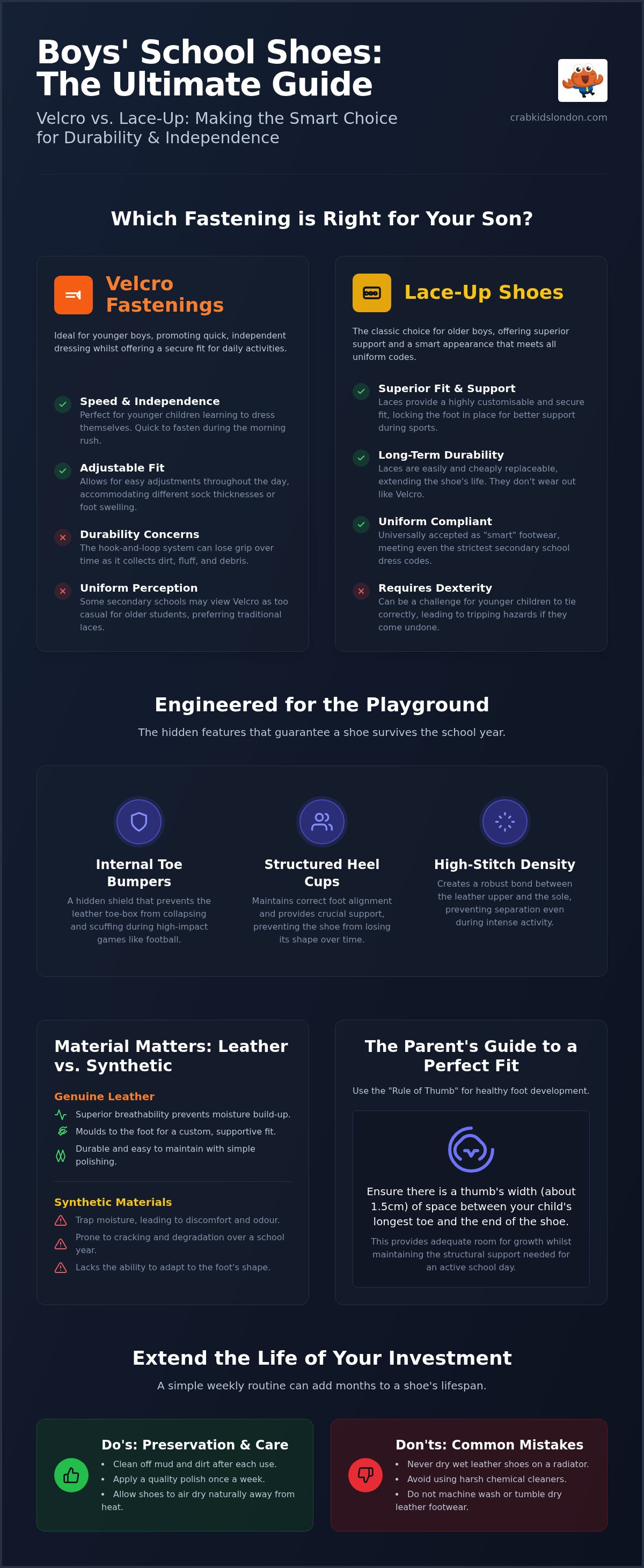
UK schools prioritise genuine leather for several practical reasons. Leather offers superior breathability compared to synthetic alternatives, which is essential for feet trapped in shoes for seven hours a day. Synthetic materials tend to trap moisture, leading to discomfort and quicker material degradation. They don't just feel hotter; they lack the longevity required for the school year. Genuine leather also possesses a unique ability to mould to the individual foot shape. This provides a custom level of support whilst maintaining the shoe's formal structure. To see how these materials perform under pressure, browse our collection of boys' school shoes built for active use.
Navigating Uniform Compliance
Staying within the lines of a school’s dress code requires an eye for detail. Many institutions now enforce "no-trainer" policies that specifically target shoes with visible mesh, white soles, or designer logos. "Hybrid" styles have become a popular solution. These shoes feature the internal cushioning of a trainer but use a polished leather upper to satisfy uniform inspectors.
When selecting a pair, avoid common pitfalls like contrasting stitching or heavy branding. Most schools require black thread that blends into the leather. Whilst the history of Velcro fasteners proves their utility in high-performance environments, some secondary schools still view them as too casual for older students. Always check if your school specifies laces for older year groups to avoid a mid-term replacement. Matte finishes are usually the most practical choice. They hide scuffs better than patent leather and it's easy to keep them looking fresh with regular polishing.
Engineering Durability: How Smart Shoes Survive the Playground
School shoes face a daily gauntlet of concrete playgrounds and high-energy break-times. Whether you are weighing up the pros of velcro vs lace up school shoes for boys, the internal architecture of the footwear determines its lifespan. True durability starts with hidden reinforcements. Internal toe bumpers prevent the leather from collapsing after repeated impact, whilst structured heel cups maintain foot alignment. These features prevent the "slumping" look that often plagues cheaper alternatives after just a few weeks of use.
We prioritise high-stitch density to prevent sole separation. When a boy sprints or climbs, the bond between the upper leather and the sole unit undergoes intense stress. Using more stitches per inch creates a robust connection that resists pulling apart. Whilst UK school uniform guidance focuses on affordability and branding, parents must look deeper at these construction details to ensure their investment lasts the full academic year. High-quality engineering allows a shoe to remain smart on the outside whilst functioning like a performance trainer on the inside.
The Vulnerability of the Toe-Box
The toe-box is the primary failure point for most boys' footwear. Constant scuffing against playground surfaces quickly strips the finish off standard leather. To combat this, we use dense leather grains treated with scuff-resistant coatings. These specialised finishes protect the surface amongst rough playground behaviour, making it easier to buff out minor marks. Some of our most resilient designs incorporate reinforced rubberised toes. These are integrated into the smart aesthetic to satisfy school rules whilst providing a physical barrier against the concrete.
Sole Construction and Grip
Sole material is critical for the UK’s unpredictable weather. We favour Thermoplastic Rubber (TPR) soles over traditional leather or hard plastic. TPR provides exceptional grip on wet playground surfaces, reducing the risk of slips during autumn and winter. It's essential that these soles are non-marking to protect school hall floors. Flexibility at the ball of the foot is equally vital. A stiff sole forces the foot to work harder, leading to fatigue and potential damage to the shoe's upper. A flexible, high-grip sole supports natural movement and ensures the velcro vs lace up school shoes for boys you choose can keep up with every jump and sprint. You can find these high-performance features across our full range of boys' school shoes, designed to withstand the rigours of the modern school day.
Velcro vs Lace-Up: Selecting the Best Fastening for Every Age
Choosing between velcro vs lace up school shoes for boys often marks a specific developmental milestone. It's a decision that balances morning efficiency with the structural support required for growing feet. Whilst younger children benefit from the simplicity of riptape, older students often require the precision of laces to meet stricter secondary school uniform codes. The fastening you select doesn't just affect how quickly your son can get out of the door; it dictates the shoe's overall stability and its ability to maintain a smart silhouette over several months of wear.
Fastening durability is a common concern for parents. Riptape can sometimes lose its "stick" if playground debris or carpet fibres become trapped in the hook-and-loop mechanism. Conversely, laces can snap or become frayed if they aren't handled with care. Understanding the specific benefits of each system allows you to match the shoe to your son's daily routine and his ability to manage his own footwear.
Riptape for Independence and Speed
Riptape fastenings are the gold standard for primary school pupils. They allow younger boys to master independent dressing, removing the stress of the morning rush. Beyond speed, riptape offers excellent adjustability. This is particularly useful for children with high insteps or those requiring a wider fit. The straps can be tightened or loosened across the bridge of the foot to create a secure fit without the complexity of knots.
To maintain the effectiveness of these fastenings, we recommend a quick weekly check to clear away any accumulated fluff from the straps. This simple habit ensures the shoe stays firmly on the foot during high-energy activities. You can explore our latest riptape designs in the New Arrivals collection, where we've engineered straps with reinforced stitching to prevent the material from curling or lifting over time.
The Secure Fit of Lace-Up Shoes
As boys move into Year 5 and beyond, the transition to laces begins. Lace-up shoes provide the most customised and secure fit possible. By adjusting the tension at each eyelet, the shoe can be tailored to the exact contours of the foot. This prevents the heel from slipping, which is a common cause of blisters and premature wear in the internal heel lining.
Older boys often prefer the "grown-up" aesthetic that laces provide. They align better with the formal requirements of secondary school blazers and tailored trousers. To keep these shoes looking smart, replace the laces at the first sign of fraying. Fresh, clean laces can instantly revive the appearance of the leather, ensuring your son remains compliant with even the strictest school dress codes.
The Parent’s Guide to Measuring and Fitting at Home
Sizing is the most critical factor in determining how long a pair of shoes will last. If a shoe is too small, the foot pushes against the leather, causing seams to burst and toes to scuff. If it's too large, the foot slides internally, creating friction that destroys the lining and causes blisters. Whether you choose velcro vs lace up school shoes for boys, the fastening can only compensate for an incorrect size to a limited degree. Use the "Rule of Thumb" to ensure a proper fit. There should be approximately 1cm to 1.5cm of space between the end of the longest toe and the front of the shoe. This allows for natural growth without compromising structural support.
Watch for signs of a poor fit. Heel slippage often indicates the shoe is too wide or too long, which leads to painful blisters and ruined socks. Conversely, pinching at the sides suggests your son may need a wide-fit option. Choosing the correct width prevents the leather from over-stretching and failing prematurely. Look for unusual wear patterns on the sole; wear concentrated on the inner or outer edges often signals that the shoe isn't providing the correct alignment for your son's gait.
Measuring at Home with Confidence
You don't need professional equipment to get an accurate measurement. Place a piece of paper against a wall on a hard floor. Have your son stand on the paper with his heel touching the wall. Mark the longest point of the foot with a pencil. Repeat for the other foot, as one is often slightly larger. Use a ruler to measure the distance in millimetres. Feet must be measured whilst standing to account for weight-bearing spread. Accurate measurements ensure that the velcro vs lace up school shoes for boys you select provide the intended level of support. Once you have the measurements, consult the Crabkids London Shoe Size Guide for precise conversions.
Supporting Foot Development
Durability isn't just about the outer leather. A firm heel counter is essential for ankle stability, especially when boys are carrying heavy rucksacks on active commutes. This rigid part at the back of the shoe prevents the heel from rolling inward. Cushioned insoles are equally vital. They absorb the impact of thousands of steps taken during the school day, protecting growing joints and ensuring the shoe remains comfortable until the final bell. To understand more about the relationship between fit and longevity, read our guide on How School Shoe Fit Affects Durability.
Preservation and Care: Maintaining the Polished Look All Year
Maintaining the smart appearance of school footwear is a continuous task rather than a one-off event. A simple 5-minute weekly routine can extend the life of the leather by several months, ensuring your investment pays off. When deciding between velcro vs lace up school shoes for boys, maintenance requirements are often overlooked. Riptape straps need regular checks to clear out playground grit, whilst laces require occasional replacement to prevent a frayed, untidy look. Both styles rely on the health of the leather to remain structurally sound and uniform-compliant.
UK winters are notoriously wet, making moisture management a priority. If shoes come home soaked, never dry them on a radiator. High heat causes leather to become brittle and crack, leading to permanent structural damage and a loss of suppleness. Instead, use shoe trees or stuff the shoes with newspaper to absorb moisture whilst preserving the smart silhouette. This slow, natural drying process maintains the material's integrity and prevents the soles from warping over time.
Cleaning and Polishing Essentials
Always remove surface grit with a soft brush or damp cloth before applying any nourishing products. Applying polish over trapped dirt creates an abrasive paste that can scratch the leather finish. To restore a professional, deep-black shine, use Leather Shoe Cleaning Lotion. This product feeds the material, keeping it flexible and improving its natural resistance to scuffs. Regular polishing doesn't just look better; it creates a protective barrier against the elements. For a detailed breakdown of the best tools for the job, consult our Expert Guide to Kids Shoe Care Products.
Odour Control and Hygiene
Odour control is vital for active boys who spend seven hours a day in the same footwear. Rotating between two pairs of shoes is the most effective way to allow the leather to breathe and dry out fully. The choice of Quality School Socks also plays a significant role in overall hygiene. Breathable, moisture-wicking fabrics help keep feet dry and reduce the friction that leads to internal wear. Simple home remedies, such as placing dry tea bags inside the shoes overnight, can help freshen the interior after a particularly active day on the playground. These small habits ensure the shoes stay comfortable and hygienic until they are eventually outgrown.
Equipping Your Son for a Successful Academic Year
Selecting the right footwear involves balancing strict uniform codes with the high-energy reality of the playground. The choice of velcro vs lace up school shoes for boys often comes down to a mix of age-appropriate independence and the need for a customised, secure fit. By prioritising premium leather construction and ensuring a precise fit through home measurement, you can significantly reduce the stress of mid-term replacements.
Remember that a simple weekly maintenance routine and proper drying techniques will keep those shoes looking polished whilst protecting the material's integrity. Our playground-tested durable leather designs are trusted by parents across the country for their resilience and uniform-compliant style. We provide fast UK-wide delivery to ensure you are fully prepared for the busy back-to-school season, no matter which fastening you choose.
Shop the Durable Boys School Shoe Collection and invest in quality that lasts until the final bell rings. We are here to help you navigate every school day with footwear you can rely on with total confidence.
Frequently Asked Questions
How do I know if my boys school shoes are uniform compliant?
Check your school's specific dress code policy, which is usually published on their official website. Most UK schools require plain black leather with no visible logos, mesh, or contrasting stitching. Soles must be entirely black and should not be chunky like a standard trainer. When comparing velcro vs lace up school shoes for boys, both are usually accepted as long as the upper material remains formal and polished.
Can smart leather school shoes be used for playing football at lunch?
High-quality leather shoes can handle casual play if they are engineered with reinforced toe bumpers. Standard smart shoes might scuff quickly, so look for playground-tested styles with rubberised protection at the front. Whilst they aren't a replacement for football boots, shoes with high-stitch density and Thermoplastic Rubber soles provide the grip and flexibility needed for quick movements during a lunch break without falling apart mid-term.
How often should I polish my child’s school shoes to keep them smart?
Aim to polish your son's shoes once a week as part of a regular maintenance routine. This frequency ensures the leather stays supple and maintains its scuff-resistant barrier. Regular treatment with a nourishing lotion prevents the material from drying out and cracking, especially during the winter months. A quick weekly buff takes less than five minutes but can add several months to the lifespan of the footwear by keeping the finish looking professional.
What is the best way to dry wet leather school shoes without damaging them?
The most effective method is to stuff the shoes with dry newspaper and let them air dry naturally in a well-ventilated room. Never place leather shoes on a radiator or near a direct heat source. Intense heat makes the leather brittle and causes it to crack, which permanently ruins the structural integrity. Change the newspaper every few hours if the shoes are particularly soaked to speed up the moisture absorption safely.
Should I buy school shoes a size bigger to allow for growth room?
Buying shoes that are too large is a common mistake that leads to blisters and premature wear. Stick to the "Rule of Thumb" by allowing 1cm to 1.5cm of space at the toe for natural growth. Excessive room causes the foot to slide internally, which destroys the lining and puts unnecessary strain on the fastenings. Correct sizing is essential whether you are choosing velcro vs lace up school shoes for boys for the new term.
Are trainer-style school shoes allowed in most UK secondary schools?
Most UK secondary schools have strict policies that ban mesh panels, air bubbles, and prominent sports branding. However, many hybrid styles are now available that offer the internal cushioning of a trainer with a formal leather exterior. These are generally acceptable if the sole is black and the design is understated. Always verify with your school's specific guidance before purchasing to avoid the cost of an avoidable replacement pair.
What are the most durable materials for boys school shoes for active play?
Full-grain leather is the most durable choice for the uppers because it resists tearing and moulds to the foot. For the soles, Thermoplastic Rubber (TPR) is superior to hard plastic as it offers better grip and flexibility on wet surfaces. Look for shoes with internal reinforcements like heel cups and toe bumpers. These hidden engineering features ensure the shoe maintains its shape even during the most high-energy games of tag or football.
How can I stop school shoes from smelling after a long day at school?
Prevent odours by ensuring the shoes dry out completely between wears, ideally by rotating two pairs of footwear. Using high-quality school socks made from breathable, moisture-wicking materials also helps keep feet dry. You can use simple home remedies like placing dry tea bags or specialised charcoal inserts inside the shoes overnight to absorb lingering moisture. Maintaining good foot hygiene and replacing socks daily are the most effective ways to keep footwear fresh.