

School Uniform Shoe Regulations UK: The Parent’s 2026 Compliance Guide
That pair of "triple black" trainers might look smart on the shelf, but it's often the fastest way to a phone call from the headteacher. Many parents find themselves caught out by increasingly strict school uniform shoe regulations UK, wasting money on footwear that is rejected on the first day of term. It's a stressful start to the year that nobody needs. You're looking for a reliable balance between a shoe that your child actually finds comfortable and one that meets the rigid, polishable leather criteria enforced across the country.
We understand the frustration of seeing a perfectly good pair of shoes branded as non-compliant simply because of a rubber toe cap or a tiny stitched logo. This 2026 compliance guide provides the clarity you need to shop with certainty. We'll explain the latest Department for Education guidance on branded items, clarify the difference between formal shoes and trainer-style hybrids, and help you select durable footwear that lasts the full academic year. By the end of this guide, you'll know exactly what to look for to ensure your child stays both comfortable and compliant whilst remaining active from September through to July.
Key Takeaways
- Understand how the 2026 DfE statutory guidance on branded items helps you prioritise affordability without sacrificing quality.
- Identify the specific silhouette requirements that separate a formal shoe from a black trainer to avoid common policy breaches.
- Navigate the essential school uniform shoe regulations UK including the "polishable leather" rule to ensure your purchase is always inspection-ready.
- Use our step-by-step checklist to verify school-specific rules and measure feet accurately for a fit that lasts the full academic year.
- Discover why selecting durable, logo-free footwear provides the best balance of playground resilience and classroom compliance.
Understanding UK Government Guidance on School Uniform Footwear
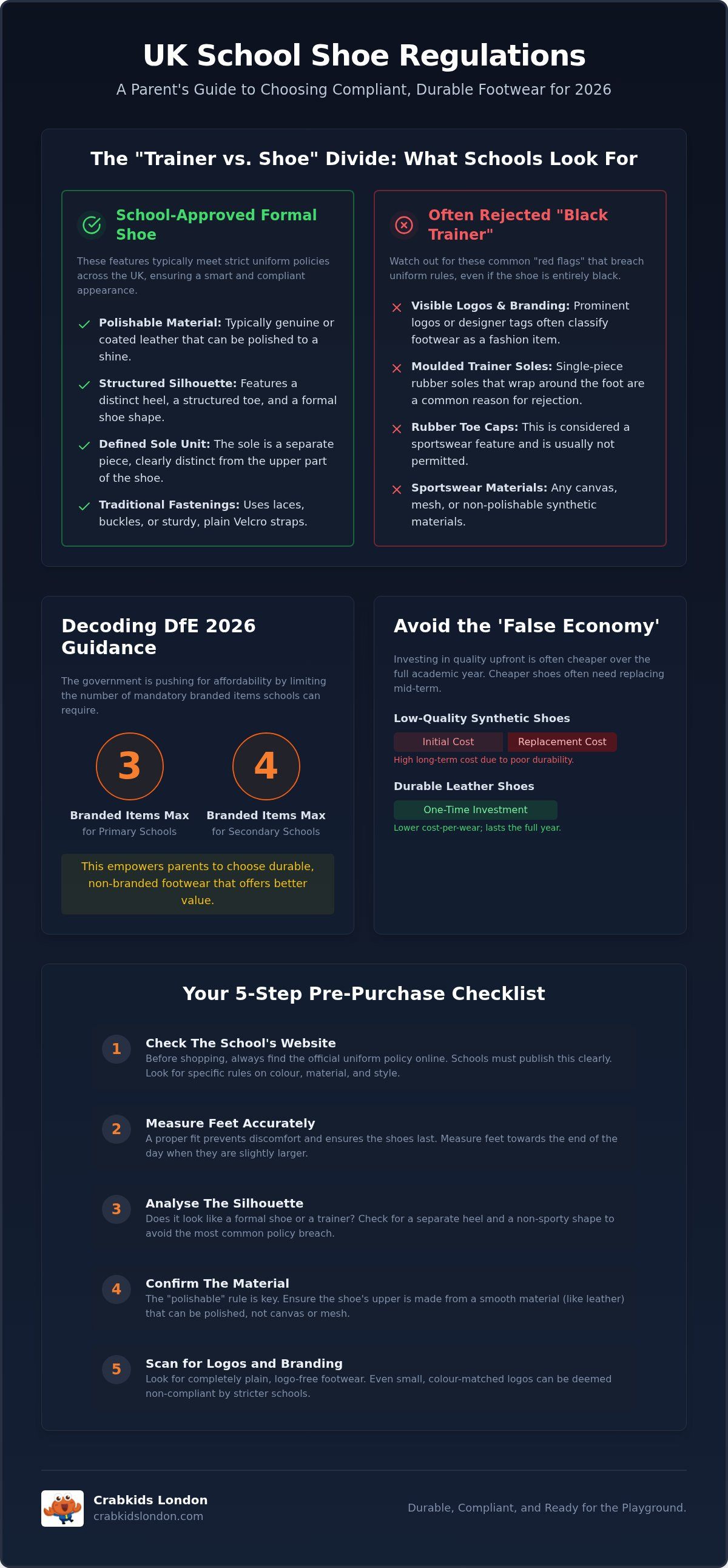
The landscape of school uniform shoe regulations UK shifted significantly following the 2021 Act, with updated statutory guidance coming into full force for September 2026. Primary schools are now limited to just three branded items, whilst secondary schools are capped at four. This push for affordability means schools must move away from mandating expensive designer footwear. It allows parents to choose high-quality alternatives from independent retailers rather than being tied to a single, high-cost supplier. This regulation supports parental choice, ensuring you can find shoes that fit your budget without compromising on school standards.
This new focus on affordability does not mean a drop in expectations. Instead, it empowers parents to select shoes that offer the best value for money throughout the academic year. By reducing the reliance on exclusive contracts, the 2026 regulations encourage schools to accept generic, high-quality footwear available from various high-street and online sources. You now have the freedom to prioritise durability and comfort over a specific brand name.
The Legal Framework for School Uniforms
In the UK, school governors hold the legal authority to define and enforce a dress code. This includes setting specific rules for footwear silhouettes, colours, and materials. However, this power is balanced by the Equality Act 2010. This legislation ensures schools make reasonable adjustments for students with specific medical needs or religious requirements. For instance, if a child requires orthopaedic support that does not perfectly match the standard policy, the school must accommodate this.
The History of English School Uniforms shows that whilst styles have evolved, the requirement for a smart, cohesive appearance remains a priority for most headteachers. To keep these standards fair, the DfE mandates that all uniform policies must be inclusive, affordable, and clearly accessible on the school's website. The Department for Education states that school uniform policies must be designed to ensure that no student is discouraged from participating in school life due to the cost of their clothing or footwear.
Cost vs. Quality: The Parent’s Dilemma
Choosing the cheapest option often leads to a "false economy." A pair of synthetic shoes might seem like a bargain in August, but they frequently fail the cost-per-wear test by the October half-term. When soles split or synthetic coatings peel, you end up buying a second pair within months. Investing in quality materials from the start is often the more affordable path over the long term.
The DfE guidance on value actually supports the purchase of durable leather. Genuine leather provides the breathability and resilience needed for the playground whilst meeting the strict "polishable" criteria found in most school uniform shoe regulations UK. You can find robust options in our boys' school shoe collection that focus on longevity rather than labels. To avoid potential issues or fines, look for shoes that lack overt external branding. Avoiding large logos or contrasting designer tags ensures the footwear remains a uniform item rather than a fashion statement, keeping your child compliant and your bank balance protected.
The "Trainer vs Shoe" Debate: Navigating Silhouettes and Styles
Distinguishing between a formal shoe and a black trainer is the most common hurdle for parents during the back-to-school rush. Even if a shoe is entirely black, it may still fail to meet the professional appearance standards outlined in the UK Government Guidance on School Uniform. Schools typically define a "formal shoe" by its construction rather than just its colour. This distinction is vital for maintaining a smart environment and avoiding unnecessary replacement costs.
A compliant silhouette usually features a distinct heel unit, a structured toe box, and traditional fastenings such as laces, buckles, or sturdy Velcro. The primary point of failure is often the sole. Traditional shoes have a separate, defined sole unit. In contrast, trainers often use a single moulded piece of rubber that wraps around the sides of the foot. These trainer-style shoes are the leading cause of uniform policy breaches because they lean towards sportswear rather than formal attire.
When shopping, you must identify and avoid specific "banned" features that trigger school uniform shoe regulations UK. Look out for the following red flags:
- Visible Logos: Even small, embossed branding or designer tabs can result in a rejection.
- Coloured Stitching: Contrast threads in white, grey, or brand-specific colours are often prohibited.
- Chunky "Bubble" Soles: Air pockets and thick, athletic soles are almost always restricted to PE.
The rise of the "hybrid" shoe has added to the confusion. These styles attempt to blend trainer-like comfort with a leather upper. However, if the sole is heavily textured or looks like it belongs on a basketball court, it will likely be rejected. You can find styles that balance this comfort with a legal silhouette in our range of durable school footwear.
Commonly Banned Footwear Styles
Canvas shoes, such as plimsolls or skate shoes, are generally restricted to PE lessons. They lack the protection and formal appearance required for the classroom. High-top styles are also frequently banned as they are associated with streetwear. Additionally, materials like suede and nubuck often fall foul of rules because they cannot be polished to a shine, which is a core requirement in most UK secondary schools.
Silhouettes That Pass the Test
For boys, the classic Derby or Oxford styles remain the safest choices. These offer a clean, professional look that satisfies the strictest headteachers. Girls’ primary and secondary wear is typically dominated by Mary Janes or T-bar shoes, which provide a secure fit and a traditional aesthetic. Senior students often prefer loafers or slip-ons. These are generally acceptable provided they are plain leather and lack excessive metal hardware or decorative chains.
Material and Colour Standards: What Defines a "Formal" School Shoe?
The "Polishable Leather" rule is a cornerstone of school uniform shoe regulations UK. Most headteachers insist on this material because it maintains a professional standard that fabrics simply cannot match. Suede, nubuck, and canvas are typically prohibited because they trap dirt and cannot be restored to a smart finish once scuffed. A pair of genuine leather shoes, however, can be brought back to life with a quick buff. This ensures your child remains compliant even after a busy week on the playground.
Genuine leather also offers a significant functional advantage over synthetic "leather-look" alternatives. Whilst synthetic shoes are often more affordable, they lack the natural breathability required for all-day wear. Over time, synthetic coatings tend to peel or crack at the flex points of the foot. This makes the shoes look untidy and eventually non-compliant. High-quality leather is sturdy and adapts to the child's foot shape, providing a balance of comfort and longevity that meets government value recommendations.
Patent leather occupies a unique space in school dress codes. It's a favourite for primary-aged children because the high-shine finish is remarkably easy to wipe clean. Many secondary schools, however, view patent leather as a fashion choice rather than a uniform staple. They may restrict its use in favour of a more traditional matte finish. If your child is moving into Year 7, it's usually best to opt for a standard grain leather to avoid any early-term issues during inspections.
The Importance of Black Footwear
Black remains the universal standard for UK school footwear. Whilst some schools might allow very dark brown in specific circumstances, it's rare. You should avoid "off-black" or charcoal shades, as these often look mismatched against black trousers or tights. Choosing a matte or semi-gloss finish is the safest bet for compliance because it looks smart without drawing undue attention.
Maintenance for Compliance
A pair of shoes that looks scruffy or neglected can often be mistaken for a banned trainer style during quick morning inspections. Regular cleaning is the best way to prevent this. Using a dedicated shoe care product helps maintain the "polishable" look that schools demand. It also extends the life of the leather by preventing it from drying out and cracking. For more detailed advice on keeping your child's footwear in top condition, read our Expert Guide to Kids’ Shoe Care Products. Maintaining a smart appearance is a simple way to ensure your child passes uniform checks without a second thought.
Practical Checklist for Buying Compliant School Shoes
Shopping for footwear shouldn't feel like a gamble. By following a methodical checklist, you can avoid the frustration of term-time rejections and ensure your purchase meets every requirement. Most schools publish their specific requirements online, so always start by reviewing their latest handbook. This ensures you are working with the most current version of their school uniform shoe regulations UK.
- Consult the Policy: Obtain the specific school’s uniform guide from their website. Rules can change annually, especially regarding trainer-hybrid styles.
- Measure with Socks: Measure feet accurately whilst your child is wearing their thick school socks. This prevents the shoes from being too tight or causing blisters on the first day.
- Perform the "Logo Check": Look for any branding on the heel, tongue, and sides. If you can see a logo clearly from a distance, the school likely will too.
- The "Sole Test": Ensure the sole is a sturdy, traditional unit. Avoid any sports-style "air" units or chunky, wrap-around rubber soles that mimic athletic trainers.
- Material Check: Confirm the material is 100% polishable leather or high-grade faux leather. Avoid suede, nubuck, or canvas, as these are rarely permitted for classroom wear.
Measuring for Success
A poor fit is more than just uncomfortable. It often leads to excessive "toe-scuffing" which violates the smart-dress codes schools work hard to maintain. When shoes are too big, children tend to drag their feet, ruining the leather finish within weeks. Use our shoe size guide to ensure accuracy at home before you order. Getting the size right is the first step in ensuring longevity and compliance. You can learn more about how this impacts your purchase by reading How School Shoe Fit Affects Durability.
The Senior School Transition
The move from Primary to Secondary school often brings a much stricter enforcement of footwear rules. Whilst primary schools might overlook a small logo or a slightly casual sole, secondary headteachers rarely do. Navigating the conflict between teenage fashion trends and school rules is a common challenge for many parents. It helps to involve your child in the process by choosing smart leather shoes for boys that look mature but remain fully compliant. Selecting a classic silhouette satisfies the school's professional standards whilst helping your child feel confident in their new environment. You can browse our full range of compliant school shoes to find a pair that ticks every box for the new term.
Why Crabkids London Footwear Meets UK School Regulations
Crabkids London operates with a clear, compliance-first mindset. We understand that parents need a reliable partner who does the heavy lifting of vetting styles against strict school uniform shoe regulations UK. Every pair in our collection is designed to bypass the common pitfalls of uniform inspections. By removing overt external branding and avoiding contrasting logos, we ensure our footwear remains a professional part of the uniform rather than a point of contention with school staff. This no-nonsense approach allows your child to focus on learning rather than dress code violations.
Longevity is at the heart of our design process. We use high-grade, durable leather that meets the essential polishable requirement discussed earlier in this guide. This choice of material ensures the shoes stay breathable throughout a long school day whilst maintaining the smart finish headteachers expect. Our silhouettes are carefully crafted to bridge the gap between traditional formal styles and the high-energy reality of the playground. You get the structured support of a formal shoe with the resilience of a product built for activity. We also offer fast UK delivery, providing a stress-free solution for those last-minute term preparations.
Built for the British School Day
UK weather and playground activities put immense pressure on footwear. Our shoes feature scuff-resistant materials, specifically chosen to keep the leather looking new for longer despite daily wear and tear. We prioritise comfort features like cushioned insoles and padded collars. These additions prevent the need for parents to seek out non-compliant trainer-style alternatives for the sake of their child's foot health. You can explore our latest compliant styles in the New Arrivals section to find a pair that balances these functional benefits perfectly.
The Crabkids Guarantee of Quality
Our commitment to sturdy craftsmanship has made our leather school shoes for girls and boys a staple in households across the country. We align our production with the Department for Education’s value-for-money principles. This means providing footwear that lasts the full academic year, reducing the need for mid-term replacements that drive up annual costs. We focus on sturdy construction and classic silhouettes that remain compliant from the first day of primary school through to the senior years. Shop the full range of compliant school shoes at Crabkids London to secure footwear that stays smart, comfortable, and within the rules.
Secure Your Child’s Academic Year with Confidence
Understanding school uniform shoe regulations UK is the best way to avoid wasted time and money during the back-to-school rush. By focusing on the three essential pillars of compliance; silhouette, material finish, and the absence of branding; you can select footwear that satisfies even the strictest headteachers. Prioritising 100% durable leather ensures your purchase meets the "polishable" requirement whilst providing the resilience needed for active playground life. The 2026 DfE guidance empowers you to choose high-quality, non-branded options that offer genuine long-term value for your family.
We simplify the process by offering footwear that is expertly designed for UK school codes. Our collections focus on sturdy construction and classic styles that stay inspection-ready from September through to July. With fast UK-wide delivery and 100% durable leather options, we ensure your child stays comfortable and compliant throughout the year. Investing in the right pair now prevents the stress of mid-term replacements later.
Browse Compliant & Durable School Shoes at Crabkids London and secure the perfect pair today. You've now got the tools to shop with absolute certainty. Here's to a brilliant and compliant start to the new academic term.
Frequently Asked Questions
Can my child wear black leather trainers to school?
Black leather trainers are the most common cause of non-compliance. Whilst some schools are relaxing rules, most still mandate a formal silhouette with a distinct heel. Even if the upper is leather, a flat, rubber, or "bubble" sole usually classifies the footwear as a trainer. Always check your specific school's policy before purchasing, as many headteachers view trainer-style shoes as a breach of professional dress standards.
What happens if my child’s shoes do not meet the school uniform regulations?
Schools typically follow a staged disciplinary process for uniform breaches. Initially, your child might receive a verbal warning or a letter home. Some schools keep a stock of compliant "spare" shoes for students to wear during the day. Persistent failure to follow school uniform shoe regulations UK can lead to internal exclusion or detentions. It's always best to contact the school immediately if there is a genuine reason for the non-compliance.
Are Kickers shoes allowed in UK schools?
Kickers are a traditional choice, but their suitability depends on individual school rules regarding branding. The 2026 DfE guidance limits the number of compulsory branded items to reduce costs for families. Large logos, coloured tabs, or prominent branding might be rejected by schools with strict "no-logo" policies. If your school allows branded footwear, ensure the style is a formal shoe rather than a casual boot or trainer hybrid.
Does the UK government provide help with the cost of school shoes?
Financial support is available through the School Uniform Grant in certain parts of the UK. Local authorities manage these grants; eligibility is usually tied to household income or specific benefits like Income Support. However, not every council in England offers this scheme. You should check the "School Uniform" section of your local council's website to see if you qualify for help with footwear and clothing costs.
Is patent leather usually allowed in secondary school shoe policies?
Patent leather is frequently accepted in primary schools because it is resilient and easy to maintain. However, many secondary schools prohibit high-shine finishes for older students. They often prefer a matte or semi-gloss leather that looks more traditional. If you are unsure, opting for a standard grain leather is the safest choice to ensure your child remains compliant throughout their transition into secondary education.
How can I tell if a shoe is "polishable leather"?
Polishable leather has a smooth, treated surface that can be maintained with wax or cream. You can identify it by its slight sheen and the way it reacts to cleaning. If the material is fuzzy, like suede, or has a velvety texture, like nubuck, it is not polishable. High-quality grain leather allows for regular buffing, which helps the shoes meet the smart-dress requirements enforced by most UK schools.
What should I do if my child needs specific shoes for medical reasons?
You should obtain a supporting letter from a GP or podiatrist to present to the school's leadership team. Under the Equality Act 2010, schools must make reasonable adjustments for students with disabilities or medical conditions. This includes allowing specialised footwear that provides necessary support or accommodates orthotics. Communicating with the school early prevents any misunderstandings during morning uniform inspections and ensures your child stays comfortable.
Are Dr. Martens boots generally accepted as school shoes?
Dr. Martens shoes are widely accepted, but their boots are often prohibited. Most school policies specify shoes rather than boots for safety and uniformity reasons. Additionally, the iconic yellow stitching found on many Dr. Martens styles is frequently banned. If you choose this brand, look for the "all-black" versions with black stitching and black soles to ensure they meet the formal criteria required for a compliant school day.