

School shoes: choose a comfortable, supportive fit
A smart-looking shoe isn’t necessarily comfortable. What makes a good quality school shoe is a sturdy, flexible sole with grip, a secure heel and enough room for toes to move. It should feel comfortable when your child walks, not just look right on the shelf.
Choosing school shoes can feel like a balancing act: they need to handle busy days, fit well and allow movement. Shoes that are too tight can rub, while oversized pairs may feel unstable. Give comfort and fit as much attention as durability.
This guide explains how to assess grip, sole flexibility, materials and wear, then check support, toe room and overall fit. Use these practical checks to compare school shoes for everyday school life.
Key Takeaways
- Look for a sturdy, flexible sole with a tread pattern that helps provide grip during active school days.
- Check shoes regularly for worn soles, damaged uppers and loose joins between the upper and sole.
- A supportive heel and cushioned insole can help keep the foot comfortably in place.
- Choose a shape that follows the foot, with room for toes to move freely.
- Check the fit as well as the size, and watch for rubbing or signs your child is uncomfortable.
1. Sole flexibility, durability and grip
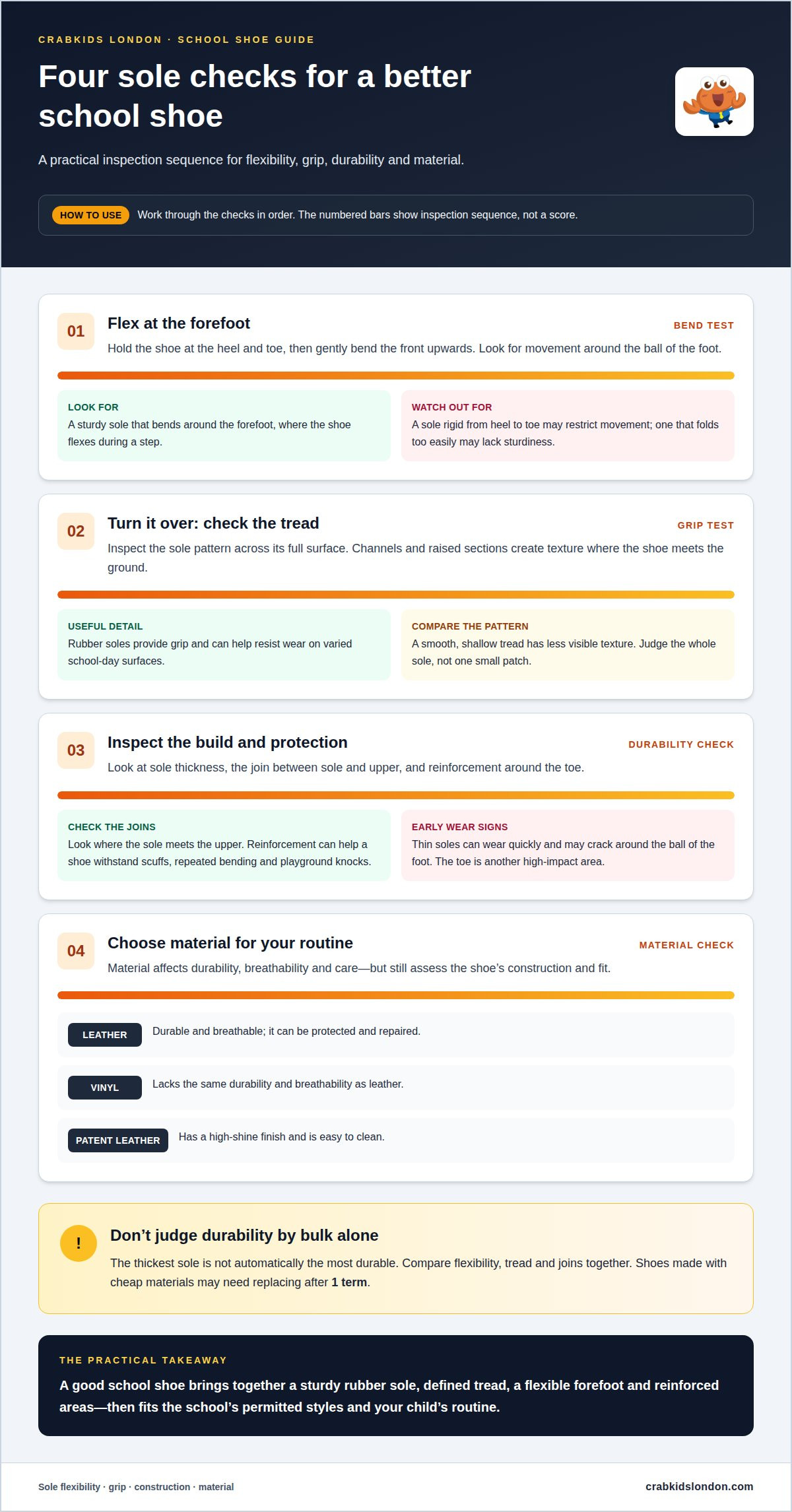
A school shoe’s sole needs to handle repeated movement throughout the week. Children run across playgrounds, walk over concrete and cross grassy or slippery verges. Look for sturdy construction with enough flexibility around the forefoot to move naturally. If you’re wondering what makes a good quality school shoe, start by checking where and how the sole bends.
Try a simple hands-on check before buying. Hold the shoe at the heel and toe, then gently bend the front upwards. Look for movement around the ball of the foot, where the shoe flexes during a step. A sole that feels rigid from heel to toe may restrict movement; one that folds too easily may lack the sturdiness needed for regular wear.
Grip matters on changing surfaces. Turn the shoe over and inspect the tread. Channels and raised sections add texture where the sole meets the ground. Rubber soles provide grip and can help resist wear. A smooth, shallow tread has less visible texture, so compare the pattern across the sole rather than judging from one small section.
Durability also depends on the sole’s thickness and construction. Thin soles can wear quickly and may crack around the ball of the foot. Check where the sole meets the upper, and look for reinforcement around the toe and sole. These details can help a shoe withstand scuffs, repeated bending and playground knocks.
Material is another factor. Leather is durable and breathable, and it can be protected and repaired. Vinyl lacks the same durability and breathability. Patent leather has a high-shine finish and is easy to clean. Choose a material that suits your school routine, but still check the shoe’s construction and fit.
Children use school shoes throughout the school week, so repeated wear puts pressure on the sole. Shoes made with cheap materials may need replacing after 1 term. That doesn’t mean the thickest sole is automatically the most durable. Compare flexibility, tread and joins together instead of judging by bulk alone.
Look closely at the toe, too. Reinforcement can help protect this high-impact area when children kick a ball or catch a toe on a step. Trainers may have a different shape, but the same practical checks apply: inspect the tread, feel how the forefoot bends and examine the sole-to-upper join.
What makes a good quality school shoe is the way its construction, tread and flexibility work together. Check your school’s permitted styles, then compare suitable pairs using these simple tests. A sturdy rubber sole, defined tread, flexible forefoot and reinforced areas each serve a practical purpose on varied school-day surfaces.
2. Checking shoes for wear and damage
A quick inspection can show whether school shoes still protect and support your child’s feet. Check them at the end of each school term, or sooner if your child complains of rubbing or discomfort. Compare both shoes, as wear can differ between left and right. Look for unevenly worn soles, splits or damage to the uppers, and loose joins. Also check for signs the shoes no longer keep out water.
Fit changes as children grow, even when the shoes still look presentable. Recheck shoe size every 3-6 months, and pay attention to whether your child’s toes feel cramped or the heel slips. Don’t buy shoes that are too large simply to leave extra growing room. An oversized pair can move around on the foot, and a child may curl their toes to grip if the shoes have stretched from another wearer.
This matters when considering second-hand school shoes. A worn pair may have moulded to another child’s feet, so its shape and fit may not suit your child. Sharing footwear can also carry hygiene risks, including athlete’s foot and verrucas. If you’re considering a used pair, inspect the inside and outside carefully, then check that it sits securely and comfortably on both feet.
Barefoot-style shoes need the same individual fit check as any other pair. Focus on the toe box, not just the label: the widest part of the shoe should match the widest part of your child’s foot, with room for toes to spread and move. Ask your child to stand and walk in the shoes. A broad-looking toe area won’t help if the sides press against their toes or the heel shifts with each step.
New shoes can feel unfamiliar, but they shouldn’t cause pain before they feel wearable. In the days before school starts, let your child wear them at home for a couple of hours a day. A short walk across the carpet can reveal slipping, pinching or rubbing before a full day in uniform. Afterwards, check your child’s feet for red marks or irritated areas.
Use your child’s feedback alongside what you can see. Ask where the shoe feels tight, then look for marks around the heel, toes and sides. Notice whether they walk naturally or keep adjusting their steps. If there’s visible damage or the fit has changed, don’t rely on appearance alone. A tidy upper can conceal a worn interior, while a scuffed surface may still feel comfortable and secure.
These checks help you decide whether a pair needs replacing or a closer fit assessment. Note when you last checked the size and any recurring pressure points. At the next fitting, share that information and watch your child walk in each pair. Comparing the shoes in motion can reveal slipping or rubbing that a quick look while seated might miss.
3. Arch support and cushioned insoles
Support inside a school shoe should feel steady, not stiff or intrusive. Check how the insole sits beneath the arch and whether the heel stays centred as your child walks. A pronounced arch shape isn’t automatically better. The shoe should support the foot comfortably without creating pressure beneath the middle of the sole.
Start with the heel cup. Press it gently from the sides: it should feel firm enough to help hold the heel in place, without being so rigid that it digs in. Then ask your child to walk in both shoes. Notice whether the heel lifts, slides sideways or feels secure with each step.
A padded heel counter can add comfort around the back of the foot, where stiff edges may otherwise rub. Feel inside the shoe for seams, raised edges or rough patches near the heel. A cushioned insole should feel even beneath the foot. If your child shifts weight away from one side, check for a fold or uneven area.
Arch support and cushioning do different jobs. The arch area helps the shoe feel supportive beneath the middle of the foot, while cushioning softens contact under the heel and forefoot. Try the shoes with the socks your child wears for school. Ask whether any area feels noticeably harder or more pressured during ordinary walking.
Some shoes have a removable insole. If yours does, lift it carefully and check that it lies flat, without curled edges or compressed patches. Put it back before your child tries the shoe again. A removable insole makes inspection easier, but it must sit securely; a shifting insole can bunch beneath the foot during activity.
An “antibacterial” description relates to a different feature from arch support or padding. Don’t use that label as a shortcut for judging comfort. Check the insole’s feel, fit and care instructions, then look for signs of wear such as flattened cushioning or a rough surface. Replace or reassess footwear if the insert no longer sits smoothly.
Finally, compare how each shoe feels after several minutes of walking, not just while your child is seated. Ask where they feel pressure, then check the heel and insole again. A good fit should hold the heel comfortably, provide gentle support beneath the arch and cushion each step without distracting your child from classroom activities.
4. Forefoot flexibility and room to move
A child’s foot needs space to move inside a school shoe, especially around the toes. The shoe should follow the foot’s outline, with its widest part matching the foot’s widest area. A pointed shape can press the toes together, even if the length seems right. During a fitting, ask your child to wiggle their toes and say whether any side feels tight.
Check movement as well as shape. Ask your child to walk, turn and crouch in the shoes. Notice whether the forefoot bends naturally with each step or the shoe seems to resist movement. A flexible sole at the front moves with the foot; a cushioned insole adds a soft layer beneath it. These features do different jobs, so assess each separately.
For a practical comparison, have your child try on both shoes and walk across the fitting area. Notice whether their steps look easy and balanced, then ask if they feel pressure beneath the toes or across the ball of the foot. A sole that bends at the forefoot can support natural movement, but the shoe should still feel secure around the rest of the foot.
Room to move doesn’t mean buying shoes that are too large. The foot should sit comfortably inside, without toes being squeezed or sliding sideways. Compare the widest point of the foot with the shoe’s widest section. If the upper presses against the toes, try a wider shape rather than simply choosing extra length.
Check the collar as well as the forefoot. Padding around the opening can soften contact where the shoe meets the ankle. During fitting, make sure it lies smoothly and doesn’t bunch against the skin. Ask your child to walk and bend their ankle; a collar that rubs with each step may become distracting during the school day.
Materials can affect how a shoe feels as it moves. Leather is durable and breathable, but the finished shoe still needs to flex comfortably at the forefoot. Don’t judge flexibility by the material name alone. Hold the shoe at the heel and toe, gently bend the front, and compare how the upper and sole move together.
Choosing a school shoe is about finding a practical balance, not chasing a perfect-looking shape. Check toe space, width, forefoot movement, insole feel and collar comfort during the same fitting. A child who can walk naturally, move their toes and wear the shoe without pressure has passed useful comfort checks. Reassess any pair that pinches or changes their stride.
5. School shoe comfort and fit
School uniform policies differ, so check your child’s rules before shopping. Classic black school shoes are generally acceptable under most dress codes, while trainers may not be permitted. The school’s policy determines suitable colours and styles, so a smart appearance alone isn’t enough.
A comfortable fit should hold the heel securely and leave the toes free to move. According to NHS, aim for approximately 1cm of space between a child’s toes and the end of the shoe. Toes should not press against the sides either, so check width as well as length.
Measure both feet while your child is standing, and use the larger foot to guide the fit. Repeat the check whenever you buy new school shoes, as children’s feet grow and one foot may be larger. Bring the socks they’ll wear with their uniform, since sock thickness can affect how the shoe feels.
When trying shoes, have your child put on both and fasten them as they would for school. Check that the heel feels snug, without a gap or slipping as they walk. Ask whether their toes feel cramped or the upper presses across the foot. A shoe can look the right length and still be too narrow.
Next, ask your child to walk and skip in the pair. Watch for shortened steps, toe gripping or repeated attempts to adjust the shoe. These signs can point to an uncomfortable fit. Check their feet afterwards, too, and look for red marks around the heel, toes or sides.
Fastenings help keep shoes secure as children move. Choose a style that adjusts across the top of the foot, such as a buckle, hook-and-loop strap or laces. Younger children may find riptape easier to manage independently. A secure fastening should hold the heel without needing to pull the shoe tight.
Breathable materials can help air circulate around the foot during a long school day. Consider how the lining feels against the skin, and check for seams that may rub. If your child uses orthotics, take them along when choosing shoes, then check that the insole and fastening still sit comfortably.
Use the school shoe size guide as a practical reference during your fit check. The best choice balances the school’s permitted styles with secure fastening, toe room and comfortable movement. Recheck the fit as your child grows, rather than relying on the size printed inside the shoe.
Permitted shoe styles and colours vary by school, so follow the uniform rules. Black is commonly accepted, but trainers may be excluded.
Crabkids London: Boys' School Shoes
Crabkids London offers boys’ school shoes for families choosing footwear for everyday school life. Its range also includes girls’ school shoes, giving parents options to compare after checking their child’s fit, comfort and school requirements. The shoes are designed to be durable and comfortable for active school days.
Use the checks in this guide as you browse: consider the shape, fastening and space for toes to move, then judge each pair by how it feels on your child’s feet. Crabkids London also offers socks and backpacks for school essentials.
For a closer look at school shoe options, visit crabkidslondon.com.
Make the next school-shoe choice with confidence
A shoe can look right on the shelf but feel different after a full day of lessons, play and walking. Treat your child’s comfort as part of the decision, not an afterthought. Ask them to describe how each pair feels, and take their comments seriously. A small pressure point during a short try-on can become distracting during a busy school day.
Understanding what makes a good quality school shoe gives you a clearer way to compare options. Use your fit checks alongside your child’s feedback, then choose a pair that suits their feet and school routine. Don’t compromise comfort for appearance or the hope that a shoe will last longer.
If you’re ready to explore school footwear for your child, Contact Crabkids London today. Take a calm, practical approach to the choice, and help your child start each school day feeling comfortable and ready to move.
Frequently Asked Questions
What Makes a Good School Shoe?
A good school shoe balances comfort, secure fastening and construction suited to regular wear. Check that the upper sits smoothly, the shoe holds its shape and the closure stays secure during movement. Then consider your child’s routine: a younger pupil may value a fastening they can manage independently, while an active child needs shoes that feel stable during playground breaks as well as classroom time.
What should I look for in a children’s shoe?
Look at the whole shoe, not just its length or appearance. Check inside for rough seams, the heel for a secure hold and the fastening for easy adjustment. Ask your child to describe any pressure they feel, and observe their steps after putting on the shoes. Compare left and right, as a child’s feet may differ in size or shape.
What features make a school shoe comfortable and supportive for daily wear?
A comfortable school shoe should feel secure without pinching, rubbing or forcing your child to change their natural stride. A stable heel, smoothly finished interior and adjustable fastening can all contribute. During a try-on, ask your child to walk, turn and stand still. Notice whether they keep shifting their weight or loosening the fastening.
Which materials make school shoes durable and breathable?
Leather is durable and breathable, and it can be protected and repaired. Material matters, but so does construction: inspect the seams, edges and areas that bend repeatedly. Patent leather has a high-shine finish and is easy to clean. Whatever the material, consider how it feels against the foot and whether its care needs suit your family’s routine.
Are leather or synthetic school shoes better for durability and comfort?
Leather is a durable, breathable choice that can be maintained and repaired. Vinyl is less durable and doesn’t let feet breathe as well. “Synthetic” covers different materials, so don’t assume every synthetic upper behaves alike. Compare the actual material and construction, then check that the shoe feels comfortable on your child’s foot. A material label alone can’t establish fit.
What sole and tread features provide grip and flexibility in school shoes?
Choose a sole with visible tread rather than a smooth surface, and check that the front bends around the ball of the foot. The tread should remain defined across the areas that meet the ground. Compare both shoes: unevenly worn sections or a flattened pattern can indicate reduced grip.
How much do good-quality school shoes cost in the UK?
There isn’t one fixed UK price for a good-quality pair. Cost varies with materials, construction and design, so compare similar styles rather than judging by price alone. Look at how the upper and sole are joined, what material is used and whether the fit suits your child. A higher price by itself doesn’t establish comfort or durability.
Are specialist fitting services or measuring tools useful when buying children's school shoes?
Yes. A trained fitter can assess length and width together, while a measuring guide can help you take a consistent measurement at home. Measure both feet with your child standing, and use the socks they’ll wear with the shoes. Treat the measurement as a starting point: your child should still try on the pair and walk in it before you decide.