

Lightweight Girls School Shoes: The Ultimate 2026 Guide to Comfort and Agility
Imagine your daughter returning from a long school day and immediately complaining about heavy, aching legs or painful blisters. It is a common frustration for parents who want to support their child's energy but find most formal footwear feels like a lead weight. You likely believe that a shoe must be chunky and stiff to survive the rigours of a British playground. However, the heaviest option is rarely the healthiest for growing feet.
We understand that you need a reliable partner to help balance school dress codes with the high-energy reality of childhood. This guide will help you discover how to choose lightweight girls school shoes that feel as agile as a trainer but maintain a polished, formal appearance. We promise to show you how to prioritise natural movement without sacrificing the durability needed for daily activity. We will explore the latest 2026 design trends, including reinforced toe caps and flexible soles, ensuring you find a pair that lasts the entire school year whilst keeping your daughter comfortable and confident.
Key Takeaways
- Learn how advanced polymers and supple leather provide structural strength without the heavy density of traditional school footwear.
- Understand how modern bonding techniques like vulcanisation create an unbreakable seal, ensuring your shoes survive the rigours of the playground.
- Explore the most popular 2026 styles and learn why the Mary Jane is often the best choice for those seeking the most lightweight girls school shoes.
- Discover how to use accurate measuring and the Crabkids size guide to prevent the leg fatigue caused by ill-fitting or oversized shoes.
Why Weight Matters: The Benefits of Lightweight Girls School Shoes
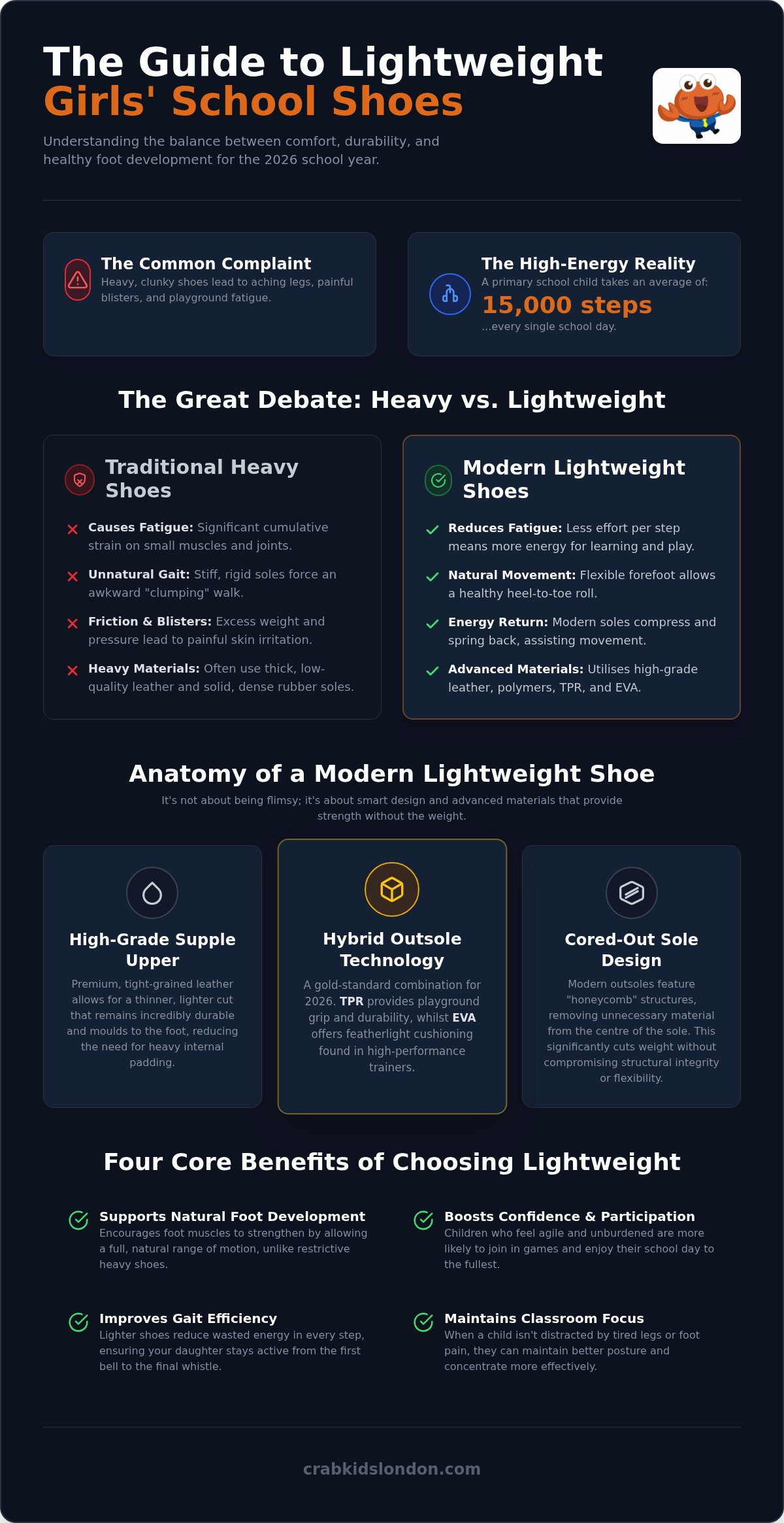
In the busy world of primary education, a child takes an average of 15,000 steps every single day. If those steps are taken in heavy, clunky footwear, the cumulative strain on small muscles is significant. When we talk about lightweight girls school shoes, we aren't referring to flimsy or disposable products. Instead, we mean shoes engineered with advanced polymers and high-grade leather. These materials reduce unnecessary bulk whilst maintaining the structural integrity required for the rigours of the British playground.
Understanding the history of footwear materials shows us that we've moved far beyond the heavy, rigid designs of the past. Modern construction allows for a shoe that supports the foot without acting like an anchor. This reduction in weight directly correlates to lower levels of leg fatigue. When a child isn't fighting against the weight of their own feet, they maintain better posture and focus more effectively in the classroom. The psychological benefit is clear; children who feel agile are more likely to participate in games and enjoy their school day.
Supporting Natural Foot Development
Heavy, rigid soles often force younger girls into an unnatural "clumping" gait. This happens because the shoe is too stiff to allow the foot to roll naturally from heel to toe. Choosing lightweight girls school shoes ensures the forefoot remains flexible, allowing for a healthy range of motion. It's a delicate balance. High-quality school shoes for growing feet must provide enough structural support to protect the arch whilst remaining light enough to permit natural growth patterns. A flexible, light shoe encourages the foot muscles to strengthen through movement rather than being restricted by a heavy casing.
Reducing Playground Fatigue and Blisters
Excess weight in a shoe doesn't just cause tiredness; it creates friction. Every time a heavy shoe lifts, it exerts more pressure on the heel and Achilles, often leading to painful blisters. Modern, lighter sole units offer a distinct "energy return" benefit. These soles compress and spring back, assisting the foot during active play rather than hindering it. Gait efficiency refers to the ability of a child to move with the least amount of wasted energy. By reducing the physical effort required for every step, you ensure your daughter remains active from the first bell to the final whistle.
The weight of a school shoe isn't just a single number; it's the result of how mass is distributed across the upper, midsole, and outsole. Achieving the perfect balance in lightweight girls school shoes requires a "top-down" approach to design. By using high-grade, supple leather for the upper, manufacturers can strip away the bulk of stiff, low-quality hides. This choice reduces the overall mass of the shoe whilst ensuring the foot remains protected. Inside, breathable linings manage heat and moisture, preventing the shoe from becoming "heavy" with sweat during active play. For 2026, the gold standard for soles involves a combination of Thermoplastic Rubber (TPR) and Ethylene Vinyl Acetate (EVA). TPR provides the necessary grip and durability for the playground, whilst EVA offers the featherlight cushioning typically found in high-performance trainers. This hybrid approach ensures the shoe feels light on the foot but stands up to the daily grind.The Role of Advanced Outsole Design
Modern outsoles often feature "honeycomb" or cored-out structures. These designs remove material from the centre of the sole where it isn't needed for support, significantly cutting weight without compromising the shoe's structure. Understanding the biomechanics of children's feet is essential here; the sole must remain flexible enough to bend with the foot's natural movement. Whilst traditional rubber soles are notoriously heavy, modern composites provide the same slip resistance with a fraction of the mass. These designs are a hallmark of high-quality lightweight girls school shoes in 2026, ensuring your daughter stays safe on wet pavements without feeling weighed down.
Leather Quality and Suppleness
It's a common misconception that thicker leather is automatically better. In reality, premium leather is often lighter because it possesses a tighter grain and greater natural strength. This allows for a thinner cut that remains incredibly durable. Because this quality leather is so supple, it moulds to the foot quickly, reducing the need for heavy internal padding or stiffeners. To keep these materials performing at their best, regular leather shoe care is vital. Keeping the leather hydrated prevents it from hardening and becoming brittle, which preserves the lightweight, flexible feel for the duration of the term. If you're looking for a pair that balances these technical benefits with classic style, you can explore the Crabkids London girls' school shoe range for the latest durable designs.
Durability vs. Weight: Debunking the Myth of "Flimsy" Light Shoes
The most common concern for parents is that lightweight girls school shoes will simply fall apart under the pressure of the playground. It's a logical worry; we've been conditioned to believe that "heavy" equals "sturdy". However, weight is often a sign of low-grade materials rather than strength. Many clunky shoes use thick, stiff leather and solid rubber soles to hide poor construction. In reality, these materials are prone to cracking and separating because they don't move with the child's foot. Modern footwear engineering has flipped this narrative, proving that agility and resilience can coexist.
Unbreakable seals are now achieved through advanced bonding techniques. Whilst traditional stitching can rot or fray over time, processes like vulcanisation use heat to fuse the sole directly to the upper. This creates a seamless, featherlight bond that is incredibly difficult to pull apart. By removing the need for heavy welts and thick threads, we reduce the weight whilst actually increasing the shoe's lifespan. A high-quality lightweight shoe will often outlast a heavy, cheaply made alternative because it is built to absorb impact rather than just resist it.
Playground-Proof Engineering
School life involves constant running, jumping, and climbing. To survive this, shoes must undergo rigorous stress testing. One of the most effective ways to protect a lighter shoe is through the use of reinforced toe caps. These provide a durable barrier against scuffs during football or tag, without adding the bulk of a traditional "safety" design. Scuff-resistant finishes also play a vital role. These specialised coatings are applied to the leather to provide a tough exterior whilst remaining paper-thin. Our focus on durable girls’ leather school shoes ensures that every component is chosen for its performance-to-weight ratio, giving you peace of mind throughout the winter term.
The Long-Term Value for Parents
There is a hidden psychological element to shoe durability. A child who is comfortable is far more likely to treat their footwear with respect. When shoes cause blisters or fatigue, children often drag their feet or kick at walls, accelerating wear and tear. Lightweight girls school shoes made from premium leather also resist "creasing" much better than stiff, low-grade options. Stiff leather develops deep cracks at the natural bend points, which eventually split. You can verify a shoe's quality by checking the "flex point". Hold the shoe and bend the toe upwards; it should flex easily at the ball of the foot. If the shoe is too rigid to bend, it will eventually fail at the seams.
Selecting the right style for the 2026 school term involves balancing strict uniform policies with your daughter's preference for comfort. Whilst the "chunky" trend remains popular, parents often worry that these styles will be too heavy for daily wear. Modern lightweight girls school shoes allow for a bold aesthetic without the physical strain. The three most prevalent styles for the upcoming year are Mary Janes, brogues, and loafers. Each offers a different level of coverage and weight distribution. The Mary Jane is traditionally the lightest option available. Because the upper design is minimal, it uses less leather than a full-coverage brogue, naturally reducing the shoe's mass. For younger children, hook-and-loop fastenings are essential for morning speed and independence. As girls move into secondary school, the transition to laces provides a more professional look. Laces also allow for a more precise, secure fit. This ensures the shoe stays snug during long walks between classrooms, which is vital for maintaining that agile feel.The Classic Mary Jane and T-Bar
The Mary Jane and T-Bar styles remain the favourite choice for primary school girls. These designs offer an excellent balance of breathability and protection. The open-top nature of the shoe allows for better air circulation, which helps manage heat during active play. Adjustable straps are a key feature here; they ensure the foot is held securely in place, preventing the heel from slipping. A secure fit is a prerequisite for a lightweight feel, as it allows the shoe to move as one with the foot. You can find several durable examples of these styles in our girls collection, designed to withstand daily playground activity.
Smart Loafers and Brogues for Teens
Secondary school requirements often demand a more formal, professional appearance. This is where loafers and brogues become the standard. In 2026, the trend for "chunky" soles continues, but the technology has evolved. These looks are now achieved using lightweight cleated soles made from modern composites. This means your daughter can enjoy the fashionable, heavy-duty look without the actual weight of traditional rubber. High-shine patent finishes are also a major trend for 2026, providing a sharp look that is easy to wipe clean. Whether she prefers a slip-on loafer or a traditional lace-up brogue, the focus should remain on a sole that flexes easily. To find the perfect balance of style and agility, browse the full Crabkids London school shoe range for the latest 2026 arrivals.
Shopping for Success: Ensuring the Perfect Fit with Crabkids London
Finding the right pair of lightweight girls school shoes is only half the battle; ensuring a precise fit is what guarantees long-term comfort. When a shoe is too large, the foot slides forward, causing the heel to rub and making the shoe feel significantly heavier than it is. This "clunky" sensation often leads parents to believe the shoe is poorly designed, when in fact, it's simply the wrong size. By taking accurate measurements at home, you can confidently order online and avoid the stress of last-minute returns.
Measuring at Home with Confidence
Measuring your child's feet doesn't require professional equipment. You can achieve high levels of accuracy using a few household items. It's best to measure in the evening, as feet naturally swell throughout the day. Follow this quick 3-step checklist to get it right:
- Place a piece of paper against a flat wall and have your daughter stand on it with her heel touching the wall.
- Mark the longest point of the foot (usually the big toe) and measure the distance in millimetres.
- Repeat the process for both feet, as one is often slightly larger than the other.
Once you have the measurement, apply the "thumb rule". There should be approximately 1cm of growth room between the end of the toe and the front of the shoe. Any more than this, and the shoe will feel unstable. For a detailed breakdown of how these measurements translate to our specific lasts, consult our comprehensive shoe size guide before you checkout.
Preparation is key for a smooth school term. Along with footwear, you can streamline your morning routine by using a "one-stop" approach. Picking up high-quality school socks and durable backpacks at the same time ensures everything arrives in a single, organised package. This saves time and reduces the carbon footprint of multiple deliveries.
The Crabkids Difference: Quality and Service
We pride ourselves on being a "Practical Specialist" for busy UK parents. We know that the final weeks of August can be hectic, so we've optimised our service to be as reliable as our shoes. Our lightweight girls school shoes are stocked and ready for immediate dispatch, with fast delivery options available across the United Kingdom. This means you don't have to sacrifice quality for speed when shopping for the 2026 term. Our goal is to do the heavy lifting for you, providing a product that supports your daughter's agility from day one. To secure your favourite styles before the rush, explore our latest new arrivals today.
Preparing for a High-Energy 2026 School Term
Choosing the right footwear shouldn't be a trade-off between comfort and longevity. By prioritising lightweight girls school shoes made with premium leather and advanced sole technology, you ensure your daughter stays active without the burden of heavy, clunky designs. We've explored how modern materials like TPR and EVA provide the agility of a trainer whilst maintaining a polished, school-ready appearance that meets strict uniform standards.
Reliability is at the heart of our range. Every pair is expertly designed for active school life, featuring durable leather and scuff-resistant finishes to survive even the most energetic playground sessions. We handle the logistical heavy lifting with fast UK-wide delivery, ensuring your order arrives exactly when you need it for the new term. It's about providing the quiet confidence that her shoes will last from the first day to the final bell.
Browse the Crabkids Collection of Lightweight Girls School Shoes to find the perfect blend of style and substance.
Investing in quality footwear is a simple way to support your child's daily focus and physical health. We're here to help you make this term her most comfortable one yet.
Frequently Asked Questions
Are lightweight school shoes as durable as heavier ones?
Durability depends on material quality and bonding techniques rather than mass. Modern lightweight designs use vulcanised seals and high-grade leather to ensure longevity. Heavy shoes often use thick, low-quality rubber that cracks easily. By contrast, lightweight composites like TPR are engineered to absorb impact and resist separation. This ensures the shoes survive the daily rigours of the playground whilst keeping the child comfortable throughout the long school day.
Which material is best for lightweight girls school shoes?
High-grade, supple leather paired with a TPR or EVA sole is the best material combination for lightweight girls school shoes. Premium leather is naturally stronger and thinner than cheaper alternatives, allowing for a lighter upper. EVA midsoles provide the cushioning of a trainer, whilst TPR outsoles offer essential grip. These materials work together to reduce leg fatigue during the 15,000 steps a child typically takes every single day.
Can lightweight shoes provide enough support for girls with flat feet?
Lightweight shoes can provide excellent support if they feature a structured heel cup and a contoured insole. Weight is not a metric for support; a heavy shoe can still be flat and unsupportive inside. Look for designs that offer arch reinforcement and a firm back-counter. These features stabilise the foot during movement without adding unnecessary bulk. This ensures girls with flat feet stay comfortable during long school hours.
How often should I check the fit of my daughter’s school shoes?
You should check the fit of your daughter's shoes every eight to twelve weeks. Children's feet can grow in spurts, often increasing by half a size in just a few months. Use the "thumb rule" to ensure there is at least 1cm of space at the toe. If the shoe feels tight or causes redness, it's time to measure again. Regular checks prevent the discomfort and blisters associated with outgrown footwear.
Are Mary Jane styles lighter than school boots?
Mary Jane styles are almost always lighter than school boots because they use significantly less material. The low-cut upper and minimal strap design reduce the overall mass of the shoe. Boots require more leather and heavier reinforcements around the ankle, which adds weight. For parents seeking the most lightweight girls school shoes, the Mary Jane remains the most agile choice for primary and secondary school environments alike.
What is the best way to clean lightweight leather school shoes?
Use a damp cloth to remove surface dirt and apply a specialised leather cleaning lotion to maintain suppleness. Avoid soaking the shoes or using harsh detergents, as these can damage the lightweight bonding agents. Regular conditioning prevents the leather from becoming stiff and brittle, which preserves the flexible feel. Once clean, allow them to dry naturally away from direct heat sources like radiators to prevent the leather from cracking.
Do lightweight soles wear down faster on concrete playgrounds?
Modern lightweight soles made from Thermoplastic Rubber (TPR) are specifically designed for high-friction surfaces like concrete. These soles are abrasion-resistant and offer the same lifespan as traditional heavy rubber. The key is the density of the material rather than its weight. High-quality composites maintain their grip and structure over hundreds of miles of playground activity, ensuring the shoes last for the duration of the full school term.
Is there a difference in weight between patent leather and matte leather?
There is no significant difference in weight between patent and matte leather. Patent leather is simply standard leather with a thin, high-shine coating applied to the surface. This coating adds negligible mass whilst providing excellent scuff resistance and water protection. Both finishes can be used to create agile footwear. Your choice should depend on your school's uniform policy and your daughter's personal style preference rather than any weight concerns.