

Kids' school shoes with arch support, fitted for comfort
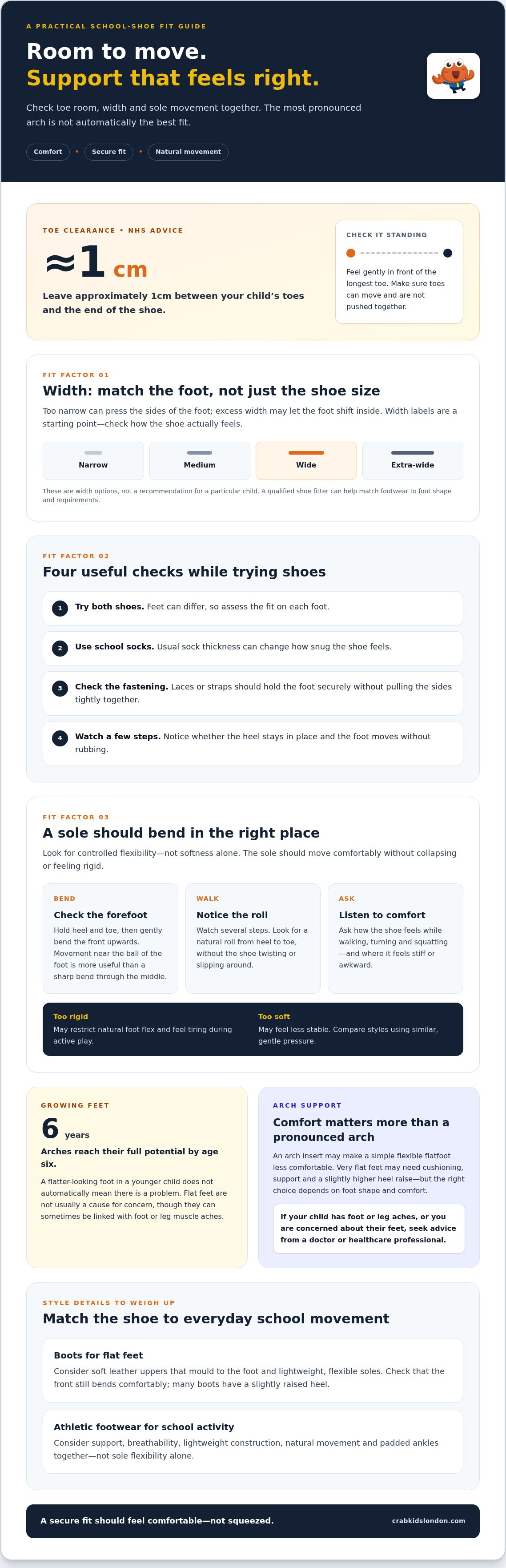
The shoe with the most arch support isn’t automatically the best fit. For school shoes with arch support for kids, start with comfort and room to move: leave approximately 1cm between your child’s toes and the end of the shoe, according to the NHS. A suitable style should feel secure without squeezing the foot.
Choosing school shoes can feel like a balancing act: they need to suit your child’s feet, meet school expectations and stand up to a busy day. Looking beyond appearance helps narrow the options, whether you’re comparing fastening styles, looking for a wider fit or weighing up how flexible the sole should feel.
This guide explains how width, toe room and sole flexibility affect fit, and what to consider across different school shoe styles. It also covers when arch support or an insole may not feel comfortable, helping you make a practical choice for your child.
Key Takeaways
- Compare shoe width with your child’s foot shape so the fit feels secure without squeezing.
- Look for a sole that bends comfortably with the foot, supporting natural movement through the school day.
- Leave approximately 1cm between the toes and shoe end, as advised by the NHS.
- Choose a school shoe style that balances school requirements, comfort and everyday practicality.
- An arch insert may make a simple flexible flatfoot less comfortable; consider the child’s comfort when deciding whether to use one.
Foot width and shoe fittings
School shoes with arch support may suit a child with foot pain, but pain alone doesn’t show which shoe feature is needed. If your child has foot or leg aches, or you’re concerned about their feet, seek advice from a doctor or healthcare professional.
Width matters as much as length. A shoe that is too narrow can press against the sides of the foot, whilst excess width may let the foot shift inside. A qualified shoe fitter can match a child’s foot shape and requirements to a suitable footwear design. That helps you assess more than the number printed on the shoe.
School shoes are available in narrow, medium, wide and extra-wide widths. Treat those labels as a starting point, not a substitute for checking the fit. A child whose toes spread comfortably when standing, for example, may need a different width from one who feels squeezed at the sides.
- Try both shoes: feet can differ, so assess the fit on each foot rather than relying on one.
- Use school socks: the usual sock thickness can change how snug the shoe feels.
- Check the fastening: laces or straps should hold the foot securely without pulling the sides together tightly.
- Watch a few steps: notice whether the heel stays in place and the foot moves without rubbing.
Arch shape changes as children grow. Babies are born with flat feet and a fleshy pad where the inner arch will develop. By toddlerhood, arches can become more evident as those pads begin to disappear. Children’s arches reach their full potential by age six, so a flatter-looking foot in a younger child doesn’t automatically mean there’s a problem.
Flat feet can result from a mix of genetic and environmental influences, and they’re not usually a cause for concern. However, they can sometimes be linked with aches in the foot or leg muscles. Very flat feet may need footwear with cushioning, support and a slightly higher heel raise. The right choice depends on your child’s foot shape and comfort, not simply on finding the most pronounced arch.
When choosing school shoes with arch support for kids, assess width, shape and comfort together. A supportive design shouldn’t squeeze the foot to create a feeling of support. If your child has pain, professional advice can help identify suitable footwear.
Flexible soles and foot movement
A school shoe sole needs to bend enough for comfortable movement without collapsing under the foot. Check how it responds as your child walks, climbs stairs and kneels to fasten a shoe. A sole that feels rigid during these movements may restrict the foot’s natural flex, while one that folds too easily may feel unstable. Look for controlled flexibility, not softness alone.
Try a simple flexibility check with the shoe off your child’s foot. Hold the heel and toe, then gently bend the forefoot upwards. Notice where the sole gives: movement near the ball of the foot is more useful than a shoe bending sharply through its middle. This is a practical comparison, not a formal measurement. Compare styles side by side using similar pressure each time.
Then watch your child take several steps in each pair. Look for a natural roll from heel to toe, without the shoe twisting or slipping around. Ask whether the sole feels comfortable as they walk, turn and squat. A stiff sole may feel tiring during active play, while excessive softness can make each step feel less secure. Your child’s movement gives useful context.
For children with flat feet, boots can be worth considering. Boots for flat feet should have soft leather uppers that mould to the foot and lightweight, flexible soles. Soft uppers can adapt around the foot, while a lighter sole avoids adding unnecessary weight. Flexibility helps the shoe move with the foot instead of forcing each step into a rigid shape.
Compare a boot’s structure with the activities your child does at school. Walking between classrooms, sitting at a desk and playing outside place different demands on footwear. A boot can provide all-round protection, and many have a slightly raised heel. Check that the sole still bends comfortably at the front rather than assuming every boot allows the same movement.
- Bend gently: assess where the forefoot flexes, not just how soft the whole sole feels.
- Twist lightly: notice whether the shoe keeps its shape without feeling like a rigid board.
- Walk and turn: look for steady steps and comfortable movement in each style.
- Compare after wearing: ask your child where the shoe feels stiff or awkward.
These checks help you assess school shoes with arch support for kids as complete footwear, rather than choosing by arch shape alone. A supportive shoe still needs a sole that lets the foot move naturally through everyday school activities.
Children’s athletic footwear should support the feet, be breathable and lightweight, allow natural movement and have padded ankles. When considering an athletic style for school activity, assess these features together rather than focusing only on sole flexibility. A shoe can bend easily but still needs to support the feet and feel lightweight. Check that movement feels natural and comfortable, and that the breathable design and padded ankles suit your child during activity.
School shoe fit and toe clearance
For comfortable, durable school shoes, check toe room, heel hold, fastenings and areas likely to rub. According to the NHS, leave approximately 1cm of space between a child’s toes and the end of the shoe. Check the fit with your child standing, as their toes need room to spread under body weight.
To assess toe room, ask your child to stand in both shoes and gently feel in front of the longest toe. Don’t rely only on pressing the shoe’s upper, which may give a misleading impression. Check that the toes can move and aren’t pushed together. If the foot slides forwards when your child walks, the apparent gap may not provide useful room during movement.
Next, check how the shoe holds the foot. The heel should stay in place during ordinary walking, without rubbing or lifting markedly at each step. Fasten laces or straps so the shoe feels stable across the instep, but not tight. If tightening a strap causes pressure across the top of the foot, for example, reassess the fit rather than pulling it harder.
- Check both shoes: compare how each foot sits, since one shoe may feel tighter than the other.
- Use the usual school socks: try the pair your child will wear, so fabric doesn’t change the fit later.
- Walk and turn: watch for slipping, rubbing or toes pressing against the front.
- Inspect the inside: feel for rough seams or raised edges where the foot could be irritated.
Durability also contributes to a comfortable fit. Look for a secure join between the sole and upper, and check that the edges don’t lift when the shoe bends. Examine the toe area, which can take knocks during school play, for firm construction that doesn’t pinch. A shoe that looks sound still needs to feel comfortable while walking, not just while your child is sitting.
Ask your child to describe any pressure clearly: “Does it rub at the heel?” or “Can you wiggle your toes?” A specific answer can help distinguish a loose heel from cramped toes. Check again after walking, when a hidden rub point may be easier to notice. Arch support is no substitute for adequate space or a stable fit.
Children grow, and a shoe that once fitted comfortably may later feel tight. Repeat the standing and walking checks when choosing another pair. If the toes touch the front, the heel slips or the shoe causes rubbing, reassess the size or shape. A well-fitting pair should feel secure without squeezing and remain comfortable during ordinary school activities.
School shoe styles and brands
Yes, a UK school’s uniform policy may restrict acceptable shoe colours, fastenings or decorative details. Read the current policy before comparing styles, then use its requirements to narrow your options.
Once you know the school’s rules, compare shape and fastening. A lace-up shoe offers adjustable fastening across the instep, while a strap style can be simpler for a child to manage independently. A slip-on may suit some children, but it still needs to stay securely on the foot when walking. These are style differences, not proof that one design provides better arch support.
For example, a plain black lace-up may meet one school’s expectations, while another may permit a simple strap fastening. A Mary Jane-style shoe is another familiar shape, but its appearance alone tells you little about the sole, fit or internal support. Check each pair against the policy and your child’s comfort instead of choosing by style name alone.
Brand names can help you find familiar ranges, but they don’t replace checking the individual shoe. One brand may offer designs with different shapes, fastenings and sole construction. Assess the actual pair: does it hold the foot comfortably, allow natural movement and suit your child’s everyday activities? Consider a label such as “supportive” alongside how the shoe fits.
Children spend upwards of 35 hours a week in school shoes, according to the collection information in the market research. That makes practical details worth weighing alongside appearance. A shoe worn through lessons and play needs to feel suitable across those activities, not only look smart when first tried on.
- Check the policy first: note required colour and any restrictions on fastenings or decoration.
- Compare the construction: look at the sole, upper and fastening on the exact pair.
- Match the child: consider whether laces, a strap or another fastening works for them.
- Try movement: have your child walk and turn in the chosen style.
For children with flat feet, boots can provide all-round protection, and many have a slightly raised heel. However, a boot is only one style to consider. Choose according to comfort, school requirements and how your child moves. Don’t assume a particular brand or shape automatically suits every foot.
Use the school policy as your first filter, then compare suitable styles by construction and fit. A shoe that meets the rules must still feel comfortable and stable for your child’s school day.
Can insoles add arch support to standard school shoes?
An insole can add a raised contour inside a school shoe, changing how the sole of the foot meets its base. But an insert doesn’t automatically make a standard shoe more comfortable. It also takes up space, so reassess the fit with it in place. A shoe that felt roomy without an insert may feel tight across the toes or instep afterwards.
Start by identifying why you’re considering an insert. If your child has foot pain, discomfort alone doesn’t tell you whether extra arch support is suitable. Note when the pain occurs, such as during a walk or after school, and whether a particular shoe causes rubbing. These details can help you explain the problem clearly to a healthcare professional.
There’s also a reason to avoid adding support just because a child’s feet look flat. According to the NHS, an arch insert can make a child with a simple flexible flatfoot less comfortable. A visible low arch doesn’t, by itself, mean an insert will improve how a shoe feels. Comfort and the child’s needs matter more than the appearance of the insole.
If you’re comparing an insert with a shoe that has built-in support, assess each option separately. Check that the heel remains seated, the toes have room and the shoe doesn’t press across the instep. Then ask your child to walk and turn. A new pressure point, slipping or a changed stride may signal that the combination doesn’t feel right.
- Check the insole shape: note whether its raised section presses against the arch.
- Assess the whole shoe: look for reduced room at the toes or pressure over the top.
- Try ordinary movement: ask your child to walk, turn and climb a step.
- Ask for a clear description: find out whether the insert feels supportive, uncomfortable or simply different.
Try these checks with the actual school shoes your child will wear. An insert that sits flat in a roomy shoe, for example, may make a closer-fitting shoe feel cramped. Avoid trimming or repositioning an insert if that leaves a raised edge or uneven surface. A secure, level position helps the shoe feel consistent underfoot.
Don’t choose an insert solely to create a stronger arch beneath the foot. Your child’s comfort in the complete shoe matters more than the height of its contour. If an insert causes pressure or discomfort, remove it and reassess the shoe. If pain is why you’re considering one, discuss the symptoms with a healthcare professional rather than relying on an insert alone.
Crabkids London: Boys' School Shoes
Crabkids London offers boys’ and girls’ school shoes for everyday wear. After comparing width, toe room, sole movement and school rules, browse the available styles and assess each pair against your child’s needs. A supportive fit depends on the whole shoe, not just its appearance or brand name.
Explore boys’ school shoes alongside the fit points in this guide. Crabkids London also offers backpacks and socks for school-day essentials. Choose shoes by checking the individual style, then use the comfort and movement checks described above to help narrow your options.
For a closer look at the range, visit crabkidslondon.com.
Choose the next pair with confidence
Make your child’s next shoe choice practical: consider how they’ll use the pair throughout the school day, alongside school requirements and personal comfort. Priorities may change as your child grows, so focus on their current needs rather than relying on what suited them before.
Crabkids London offers boys’ and girls’ school shoes, plus BackPacks for school-day essentials. Browse the range with your child’s preferences in mind, then use the fit checks in this guide as you compare options. For school shoe enquiries, contact Crabkids London.
Choosing school shoes with arch support for kids means finding a pair that works for your child as a whole, not simply selecting the strongest-looking arch. Consider fit, movement and comfort together to make a thoughtful choice for the school days ahead.
Frequently Asked Questions
What different types of school shoes are available?
Common choices include lace-up shoes, strap-fastened styles, slip-ons and boots. The best option depends on school rules and how your child manages fastenings. Laces allow adjustment across the instep, for instance, while a strap may be easier to fasten independently. Brands offer different shapes and constructions, so compare each shoe rather than assuming a style name guarantees support or comfort.
When can you tell if your child has flat feet?
A child’s arch may become more visible as they grow. Babies have a fleshy pad beneath the foot, and arches can become clearer during toddlerhood as it reduces. Children’s arches reach their full potential by age six. A flatter-looking foot alone isn’t usually a reason for concern, but seek advice from a doctor or healthcare professional if your child has foot or leg aches.
How should you measure a child's feet for school shoes with arch support?
Measure both feet while your child is standing and wearing the socks they’ll use for school. Place each foot on paper, mark the heel and longest toe, then measure between those marks. Also note the widest part of each foot. Use the larger measurements as a starting point when comparing size information, then assess the shoe during movement, since measurements alone can’t establish a comfortable fit.
How much room should there be at the toes in children's school shoes?
According to the NHS, leave approximately 1cm between a child’s toes and the end of the shoe. Check with your child standing, and use their longest toe as the reference point. Ask them to wiggle their toes, then walk in the shoes. If a toe presses against the front during movement, or the foot slides forwards, reassess the shoe’s length and shape.
What features provide good arch support in children's school shoes?
For very flat feet, footwear with cushioning, support and a slightly higher heel raise may help. It should fit securely without squeezing, with a comfortably flexible sole and enough room for the toes.