

Hard-Wearing School Shoes: The Ultimate Parent’s Guide to Longevity and Value in 2026
A "durable" label means nothing when soles peel away before the first half-term break. Most parents have felt that sting of disappointment, watching expensive footwear fail against the daily rigours of the playground. Finding genuine hard wearing school shoes shouldn't feel like a seasonal gamble. You want a pair that survives the football matches and the wet walks home without sacrificing comfort or breaking the bank. It's about finding that balance between a smart appearance and a build that can handle high-energy children.
It's frustrating to waste money on shoes that look sturdy but lack the construction to last. This guide reveals exactly what makes a school shoe truly resilient so you can stop the cycle of constant replacements. We'll examine high-grade leather quality, playground-tested designs, and the specific features that offer the best value for your family in 2026. From understanding scuff-resistance to identifying reinforced soles, you'll gain the expert knowledge needed to make a smart, long-lasting investment.
Key Takeaways
- Learn why full-grain leather provides the essential balance of flexibility and strength needed for active school days.
- Understand the critical difference between cosmetic scuff-resistance and the structural build of genuine hard wearing school shoes.
- Identify the specific construction details, like reinforced double-stitching, that stop footwear from falling apart at the seams.
- Discover how a precise fit prevents uneven wear patterns and protects the structural integrity of the toe box.
- Recognise the value of playground-tested designs that focus on resilience and comfort rather than temporary fashion trends.
The Anatomy of Hard-Wearing School Shoes: Why Materials Matter
True hard wearing school shoes aren't simply rigid; they represent a precise balance of tensile strength and functional flexibility. A shoe that is too stiff causes discomfort and eventually cracks under the pressure of constant movement. Conversely, a shoe that is too soft loses its shape and fails to protect the foot. Resilience starts with the raw materials chosen during the Shoemaking process, where every layer contributes to the final lifespan of the product.
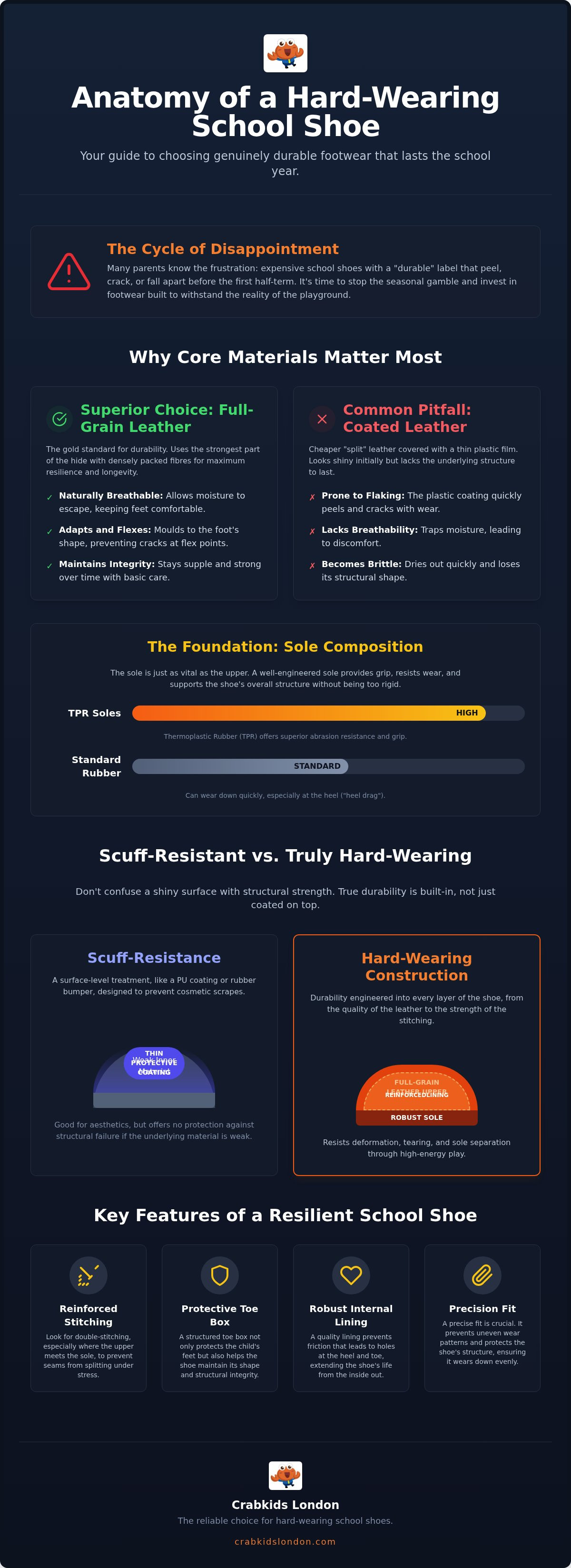
Full-grain leather remains the gold standard for school footwear. It provides natural breathability, allowing moisture to escape whilst maintaining a tough exterior. Unlike synthetic alternatives that often crack at the flex points, genuine leather adapts to the unique shape of a child's foot. This organic "give" prevents the material from snapping, ensuring the uppers remain intact through months of running and climbing. High-quality lining materials are equally essential. A robust lining prevents internal wear and tear, stopping the friction that leads to holes at the heel or toe.
Full-Grain Leather vs Coated Leather
The primary difference between leather grades is fibre density. Full-grain leather uses the strongest part of the hide, where the fibres are most tightly packed and resilient. Cheaper, coated leathers often use "split" leather covered in a thin plastic film to mimic a premium finish. Whilst these look shiny initially, the lack of natural oils causes the coating to flake and peel away within weeks. Full-grain leather is the most durable tier of footwear material, retaining its integrity because it remains supple over time. To keep these fibres from drying out, regular maintenance with a leather shoe cleaning lotion is a simple way to extend the shoe's life.
The Impact of Sole Composition
When selecting hard wearing school shoes, the sole composition is just as vital as the upper leather. Thermoplastic Rubber (TPR) is frequently superior to standard rubber because it offers better grip and higher resistance to abrasion. This material helps prevent "heel drag" wear, which is a common cause of premature replacement. Sole thickness also plays a role in longevity. A thicker sole provides more material to wear through, but it must be engineered for flexibility. If a sole is too rigid, it forces the upper leather to crease excessively every time the child steps, leading to structural failure at the toe box. A well-balanced sole protects both the child's comfort and the parent's investment.
Scuff-Resistant vs Hard-Wearing: Understanding the Difference
A glossy, polished finish often masks a lack of structural integrity. Many parents fall into the trap of believing a shiny shoe is a durable one, only to find the material peeling away within weeks. Whilst scuff-resistance is a valuable feature, it's frequently just a superficial treatment rather than a sign of a robust build. True hard wearing school shoes rely on "built-in" durability that extends through every layer of the footwear, from the thickness of the leather to the strength of the internal supports.
The "playground test" is the ultimate decider of a shoe's quality. Different activities place unique stresses on footwear; football matches test the toe box, whilst climbing frames strain the bond between the sole and the upper. A Systematic Review on Children's Footwear highlights that quality characteristics, such as material resilience and ergonomic construction, are vital for both foot health and product longevity. Without these foundational elements, a shoe might stay looking "new" on the surface whilst the structure underneath begins to fail.
What is Scuff-Resistance?
Scuff-resistance typically involves applying a polyurethane (PU) coating to the leather or adding rubber toe bumpers to high-impact areas. These features are excellent for younger children who spend time crawling or playing on abrasive tarmac. They protect the aesthetic of the shoe, preventing the "grey toe" look that occurs when leather is scraped away. However, these surface-level protections have limits. If the underlying material is weak, a scuff-resistant coating won't stop the shoe from losing its shape or the lining from collapsing. It's a secondary defence, not a replacement for high-grade construction.
The Longevity Comparison
When comparing surface protection against structural integrity, parents should look for a "double-threat" approach. A shoe that combines a naturally tough full-grain leather with targeted protective features will always outperform a shoe that relies on coatings alone. Crabkids London focuses on this dual strategy, ensuring that the base material can withstand the rigours of the school day whilst protective details keep the shoes looking smart. This approach addresses the technical needs of active kids without compromising on the professional appearance required by school uniform policies. For more detail on specific protective features, read Why Scuff-Proof School Shoes are a Parent's Best Friend. If you're ready to upgrade your child's footwear, explore our resilient boys' school shoes designed for maximum endurance.
Construction Features That Prevent Premature Wear
Resilience is built from the inside out. Whilst premium materials provide the foundation, the construction methods used to join them determine how long the footwear actually lasts. For hard wearing school shoes, construction acts as the skeletal support that prevents the shoe from deforming or splitting under the pressure of daily activity. High-quality assembly ensures that the investment you make in August continues to provide value well into the following year.
Reinforced stitching is a non-negotiable feature for active children. Double-stitching in high-stress areas, such as the heel and the vamp where the shoe creases, prevents the seams from bursting during football matches or playground games. Similarly, padded collars serve a dual purpose. They provide immediate comfort and reduce internal friction. This prevents the lining from wearing away and stops the back of the shoe from collapsing, which is a common cause of premature failure in cheaper models. Toe bumpers and heel guards act as the armour, absorbing the impact of scrapes against tarmac and protecting the leather uppers from direct damage.
Stitched vs Cemented Soles
Most high-street footwear relies on "cemented" construction, which simply means the sole is glued to the upper. Whilst this process creates a lightweight shoe, the adhesive often fails at the flex points, leading to gaping at the toe box. Stitched soles, often featuring sidewall stitching, provide a mechanical bond that glue alone cannot match. This technique ensures the sole remains firmly attached even after thousands of flex cycles. Modern designs now combine this traditional structural security with lightweight TPR materials, offering the durability of a boot with the agility of a trainer.
Fastenings and Hardware
Fastenings are frequently the first point of failure in a school shoe. For younger children, the quality of rip-tape (Velcro) is vital. Industrial-grade rip-tape maintains its "grip" for longer, whereas cheaper versions quickly lose their effectiveness as the hooks flatten out. For older children wearing smart lace-ups, reinforced metal eyelets are essential. These prevent the laces from tearing through the leather uppers when pulled tight. These small, often overlooked details significantly extend the overall lifespan of the footwear. For more specific advice on selecting high-endurance styles, see our Durable Boys' Leather School Shoes: The 2026 Buying Guide. If you need to refresh your child's accessories, we also offer a range of school socks designed for comfort and durability.
The Secret to Longevity: Precision Fit and Proactive Care
Even the most resilient hard wearing school shoes will fail prematurely if the fit is incorrect. An ill-fitting shoe forces the foot to move unnaturally, creating uneven wear patterns on the sole. This concentrated pressure grinds down specific areas of the rubber faster than intended. Precision fit ensures that weight is distributed evenly across the entire surface of the sole, preventing the accelerated "heel drag" that often ruins otherwise perfectly good footwear.
The relationship between "toe-room" and structural integrity is often overlooked. If a shoe is too tight, the constant pressure from the toes can cause the internal lining to collapse or the leather to stretch out of shape. Conversely, buying shoes that are significantly too large leads to excessive creasing across the vamp. These deep folds eventually become cracks, compromising the water resistance and strength of the leather. Proper sizing protects the shoe's shape as much as it protects the child's feet.
Managing moisture is another critical factor in longevity. Wet leather is significantly more prone to stretching and scuffing than dry leather. If your child's shoes get soaked on the walk home, they should be dried naturally away from direct heat sources like radiators. High heat makes leather brittle and prone to snapping. Rotating between two pairs or using cedar shoe trees helps the material maintain its shape and allows moisture to evaporate fully, which can effectively double the lifespan of the footwear.
Sizing as a Durability Strategy
Many parents fall into the "buying too big" trap to save money, but this often backfires. Oversized shoes cause the child to shuffle, which increases the rate of scuffing on the toe box and edges. You can learn more about how school shoe fit affects durability in our detailed guide. To ensure a perfect match from the comfort of home, use the Crabkids Shoe Size Guide before placing your next order.
Maintenance for the Long Term
A simple three-minute weekly routine can significantly extend the life of hard wearing school shoes. Start by removing surface dirt with a damp cloth, then apply a high-quality polish. Polishing isn't just for aesthetics; it feeds the leather and keeps the fibres supple to prevent cracking. Using a specialised Leather Shoe Cleaning Lotion is essential for maintaining this flexibility over a long school term. This proactive care keeps the material resilient against the elements and daily playground activity.
Ready to invest in footwear that truly lasts? Shop our collection of playground-tested school shoes today.
Why Crabkids London is the Reliable Choice for Hard-Wearing Shoes
Choosing the right partner for the school year means looking beyond the initial purchase. Crabkids London operates as a "Practical Specialist," focusing on the high-energy reality of the playground rather than fleeting fashion trends. We understand that hard wearing school shoes must perform under pressure every single day. By prioritising resilience and ease of maintenance, we aim to alleviate parental stress and provide a product that survives the entire school term without fail.
Many retailers focus on character-branded footwear or temporary fads that often distract from structural weaknesses. Whilst a cartoon logo might appeal to a child, it does nothing to prevent the sole from splitting or the leather from peeling. We reject these distractions in favour of "quiet confidence" in our product longevity. Every design undergoes testing to ensure it meets the rigorous standards required for active UK school life, maintaining a professional retail register that parents can trust.
Built for Active British School Life
A common industry oversight is the assumption that only boys' footwear requires high levels of durability. At Crabkids London, we recognise that girls are just as active on the playground. Our Girls' Collection combines smart, formal aesthetics with the same toughness found in our Boys' Collection. This commitment to quality ensures that every child has access to hard wearing school shoes that reduce the need for mid-term replacements. Our boys' range features specific scuff-resistant details designed to handle abrasive surfaces without losing their professional appearance, providing a robust solution for the most energetic students.
The Full Back-to-School Solution
Reliability extends beyond footwear. To complement our shoes, we offer Durable School Bags that mirror our commitment to material strength and longevity. Managing foot health and protecting the internal structure of your shoes also requires high-quality School Socks. These socks reduce the friction that leads to lining wear, further extending the lifecycle of your investment. With fast UK-wide shipping and a focus on consistent quality, we do the heavy lifting so you don't have to. We pride ourselves on being a dependable mainstay that values craftsmanship over fast fashion.
Stop the cycle of seasonal replacements and choose footwear built for the long haul. Shop the latest hard-wearing arrivals at Crabkids London and prepare your child for a successful, comfortable school year.
Invest in Resilience for the Year Ahead
Choosing hard wearing school shoes is a strategic decision that pays off through every term. You've discovered that true durability relies on high-quality materials and structural integrity rather than just cosmetic coatings. By focusing on full-grain leather and robust construction, you ensure your child's footwear remains smart and supportive through every playground challenge. Combining this knowledge with proactive care and a precision fit means you can finally stop the cycle of mid-term replacements.
Crabkids London acts as your reliable partner, providing footwear that handles the high-energy reality of childhood with ease. Our collection features playground-tested durability and is expertly designed for growing feet, ensuring comfort doesn't take a back seat to resilience. With fast UK delivery, getting prepared for the new term is straightforward and efficient. We do the heavy lifting so you can focus on the school year ahead.
Invest in shoes that last: Browse the Crabkids London Collection
Step into the new term with the peace of mind that comes from quality craftsmanship and dependable design.
Frequently Asked Questions
How long should a pair of hard-wearing school shoes actually last?
A pair of high-quality school shoes should ideally last for a full academic year of 190 days. Whilst children often outgrow their footwear before it wears out, the structural integrity should remain intact through daily playground use. If you find yourself replacing shoes every half-term, it's usually a sign of poor material quality or weak construction rather than excessive activity from your child.
Are leather school shoes more durable than synthetic ones?
Genuine leather is significantly more durable than synthetic alternatives. Full-grain leather possesses natural fibres that flex without cracking, whereas synthetic materials often fail at the flex points across the toes. Leather also adapts to the foot's shape over time, providing a custom fit that reduces internal friction and prevents the lining from wearing away prematurely.
What are the best features to look for in shoes for active boys?
For active boys, prioritise reinforced toe bumpers and double-stitched seams. These features act as armour against the abrasive surfaces of the playground. Look for shoes with high-grip soles and industrial-grade fastenings to ensure the footwear stays secure during football matches and climbing. Choosing hard wearing school shoes with these specific reinforcements significantly reduces the risk of structural failure.
Can I make school shoes last longer with specific care products?
Regular maintenance with specialised care products can effectively double the lifespan of leather footwear. Using a dedicated cleaning lotion keeps the leather supple and prevents it from becoming brittle. Applying a quality polish adds a protective layer that repels water and fills in minor scuffs, ensuring the material remains resilient against the elements throughout the school term.
Is it worth paying more for 'scuff-resistant' school shoes?
Investing in scuff-resistant features is worthwhile if they provide physical protection, such as rubber toe guards. These additions prevent the leather from being scraped away during high-impact activities. However, ensure the shoe also has a strong internal build. A scuff-resistant coating on a weak shoe won't prevent the sole from peeling or the structure from collapsing.
How do I know if my child’s shoes are worn out or just need a polish?
Check the soles and internal linings to determine if shoes are truly worn out. If the tread has smoothed over or the heel has worn down significantly, the shoes no longer provide adequate support. Seams that have burst or soles that have started to gape indicate structural failure. Surface scuffs and a dull appearance are merely aesthetic issues that a good polish can easily resolve.
Do you offer fast delivery for last-minute back-to-school shopping?
We provide fast UK-wide shipping to support parents during the busy back-to-school period. We understand that last-minute growth spurts often require a quick turnaround on new footwear. Our efficient delivery service ensures that your hard wearing school shoes arrive promptly, allowing your child to start the new term with comfortable, resilient footwear without the stress of long waiting times.
What is the most durable sole material for school playground use?
Thermoplastic Rubber (TPR) is widely considered the most durable sole material for the playground. It offers a superior blend of abrasion resistance and flexibility compared to standard PVC or rubber. TPR provides excellent grip on wet tarmac and handles the constant friction of running and jumping without wearing thin as quickly as softer materials.