

Fixing Scuffed Leather School Shoes: Parent's Guide 2026
It’s 7:45 am on a Tuesday, and you’ve just spotted a deep, jagged graze across the toe of your child’s footwear. We understand the frustration when a quality pair looks battered after only a few days on the playground. You shouldn't have to face the cost of a replacement every term. Learning how to fix scuffed leather school shoes is a practical skill that saves money and eliminates the stress of messy morning routines. Most scuffs are purely cosmetic and can be managed effectively at home with the right tools.
We agree that keeping footwear smart amidst the high-energy reality of childhood feels like a constant battle. This guide provides the professional techniques and simple home hacks you need to restore a "like-new" appearance and ensure those shoes last the entire academic year. You will learn how to use specialised leather lotions, colour-matched polishes, and clever preventative measures to maintain footwear resilience. We'll show you how to handle everything from minor scrapes to deep gouges, keeping your child looking sharp and your budget intact.
Key Takeaways
- Recognise the difference between cosmetic surface scuffs and structural leather damage to choose the most effective repair strategy.
- Follow a methodical guide on how to fix scuffed leather school shoes by properly preparing the surface and applying colour-matched pigments.
- Evaluate the effectiveness of home hacks like the permanent marker trick versus professional leather care products for long-term results.
- Implement a consistent five-minute maintenance routine to prevent permanent damage and keep shoes looking smart throughout the academic year.
- Learn which physical features, such as reinforced toe bumpers, provide the best protection against the daily rigours of the school playground.
Assessing the Damage: Can Your Child's Leather School Shoes Be Saved?
Before reaching for the bin, take a closer look at that battered footwear. Most playground damage looks far worse than it actually is. Understanding the extent of the wear is the first step in learning how to fix scuffed leather school shoes effectively. You need to distinguish between a mark that needs a quick wipe and a gouge that requires a more intensive restoration process. Saving a pair of quality shoes doesn't just save money; it also reduces the waste generated by the "throwaway" culture of cheap synthetics.
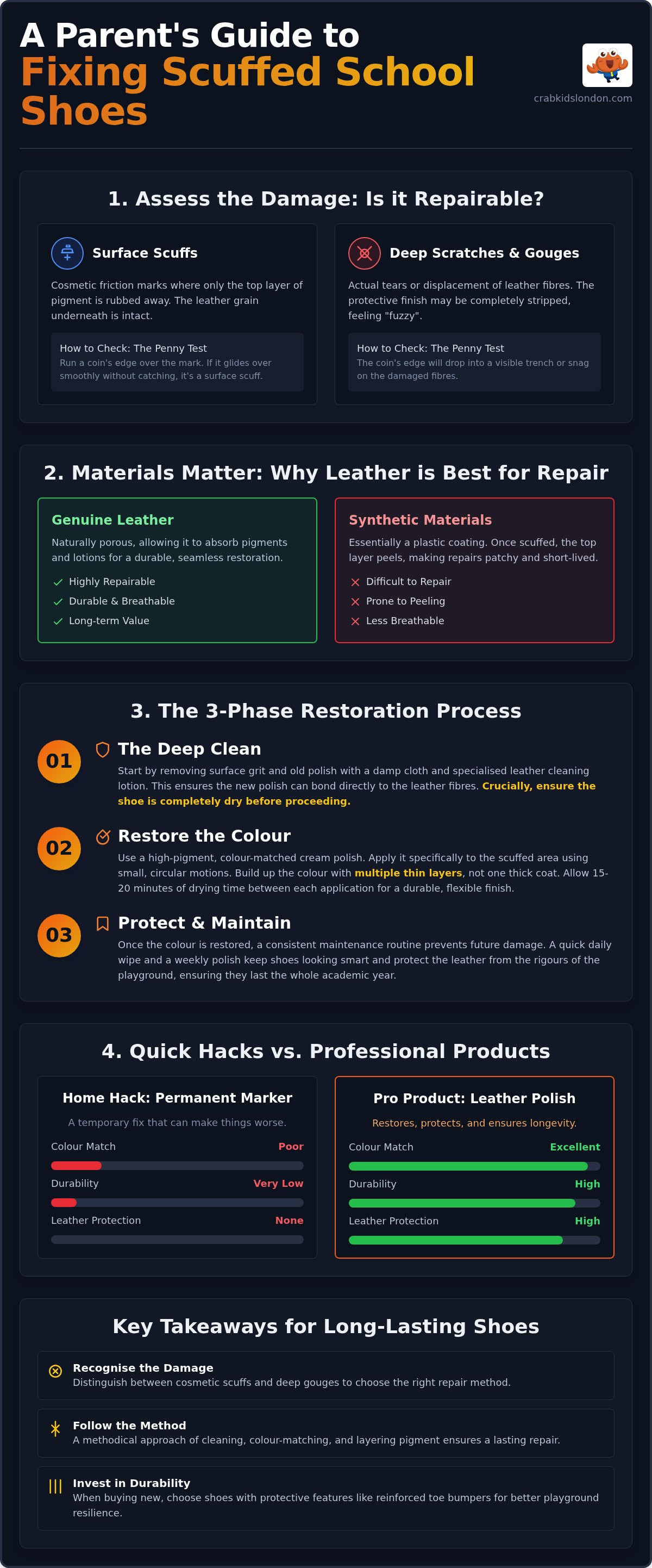
Use the "Penny Test" to gauge the depth of the damage. Take a small coin and run the edge gently along the affected area. If the coin drops into a visible trench or snag, you're dealing with a deep scratch. If it glides over a discoloured patch without catching, it's a surface scuff. Polish alone will usually fix the latter. However, you must also check for structural failure. If the sole is peeling away from the upper, known as sole separation, or if the stitching has completely unravelled, no amount of aesthetic restoration will make the shoe safe for the school day. At this point, the shoe's integrity is compromised.
Surface Scuffs vs. Deep Scratches
Surface scuffs are essentially friction marks. They occur when the top layer of pigment is rubbed away, but the leather grain underneath remains intact. These are typical results of carpet burn or light playground contact. Deep scratches are different. They are actual gouges where the leather fibres have been torn or displaced. These require a "filling" stage before you can apply any colour. Principles of leather conservation and restoration suggest that keeping the material clean and hydrated is vital before assessing these deeper wounds. If the protective factory finish is completely stripped, the leather will look dull and feel "fuzzy" to the touch.
Materials Matter: Leather vs. Synthetic
Genuine leather is the most resilient material for school footwear because it's naturally porous. This allows it to absorb pigments and specialised leather shoe cleaning lotion, making restoration possible. Synthetic materials are essentially plastic coatings over fabric. Once a synthetic shoe is scuffed, the plastic often peels away in sheets. This leaves a repair that looks patchy and rarely lasts more than a few days.
Most durable school shoes use "corrected grain" leather. This material is buffed to remove natural imperfections and then coated with a sturdy, uniform finish. It's designed to withstand the rigours of the playground whilst remaining easy to clean. Patent leather, whilst popular, uses a thick lacquer for its high shine. If this finish cracks or scuffs, it requires a different approach involving specialised restorers rather than standard wax polishes. Identifying these materials early ensures you use the correct products for a professional finish.
Step-by-Step Guide: How to Fix Scuffed Leather School Shoes
Restoring footwear requires a methodical approach rather than a quick cover-up. If you want to know how to fix scuffed leather school shoes so the repair actually lasts, you must follow a specific sequence. This process ensures the pigment adheres properly and the leather remains supple. It's not just about hiding the mark; it's about reinforcing the material against future playground wear.
Phase 1: The Deep Clean
Start by removing surface grit and old wax build-up that accumulates during a busy week. Use a damp cloth followed by a specialised leather shoe cleaning lotion to clear the area thoroughly. Residual dirt creates a barrier that prevents polish from bonding to the leather fibres. Ensure the shoes are bone dry before moving to the next stage. Moisture trapped under a new layer of polish can lead to leather degradation over time.
Phase 2: Restoring the Colour
Choosing the right pigment is vital for a seamless finish. While black shoes are straightforward, brown leather comes in a vast spectrum from tan to dark chocolate. Test a small amount of polish on a discreet area, like the tongue, to verify the match. Apply a high-pigment cream specifically to the scuffed area using a soft brush or microfibre cloth. Use small, circular motions to push the pigment into the damaged grain.
Aim for thin, even layers. One thick coat often peels or cracks, whereas multiple thin applications build a durable, flexible finish. Allow at least 15 to 20 minutes of drying time between layers. Patience is the key to a professional-looking finish that mirrors the Basic Preservation of Leather Artifacts, where gradual care is always preferred over aggressive cosmetic fixes. Don't rush the process; let the leather absorb the nutrients in the cream.
Phase 3: Buffing for Shine
Forget the "spit and polish" myth. Saliva contains enzymes that can actually damage the finish of the leather. Instead, use a clean, dry buffing cloth once the final layer of cream is completely matte. Use brisk, firm strokes to generate a small amount of heat. This heat helps the wax in the polish set into a protective, uniform shine across the entire shoe.
Once you're satisfied with the appearance, apply a water-repellent spray to lock in the repair. This final seal protects your hard work from the next lunchtime kickabout or a sudden British downpour. Keeping a small kit of durable shoe care essentials handy makes these weekly touch-ups much faster and keeps your child's footwear in peak condition.
Effective Scuff Repairs: Home Hacks vs. Professional Products
Monday morning often brings the sudden realisation that Sunday's shoe maintenance was forgotten. When you need to know how to fix scuffed leather school shoes in under sixty seconds, kitchen cupboard hacks are incredibly tempting. These quick fixes serve a purpose during the morning rush, but they rarely offer the long-term protection your child's footwear needs. Understanding when to use a shortcut and when to invest in professional care is vital for maintaining shoe health.
Professional shoe creams and specialised lotions win on durability every time. These products contain high concentrations of pigment and natural waxes that bond deeply with the leather fibres. Expert Leather Care Tips suggest that maintaining moisture balance is the most important factor in preventing the drying and cracking that leads to permanent damage. For parents of children wearing white leather trainers, non-gel white toothpaste can act as a mild abrasive to lift surface marks. However, for traditional black or brown leather, professional-grade products remain the gold standard.
When to Use the Felt-Tip Hack
The permanent marker trick is a classic parental shortcut. It's best reserved for small nicks on the toe cap where standard polish might struggle to "stick" to a smooth, damaged surface. You must always apply a layer of wax polish over the marker once the ink dries. If you skip this step, the ink can develop a strange purple or blue tint under bright school hall lights. Remember that marker pens contain alcohol and lack the essential oils needed to nourish the material. They hide the problem without solving the underlying dryness of the leather.
The Reality of Household Remedies
Petroleum jelly is frequently suggested as a way to restore shine. Whilst it provides an instant gloss and softens the leather temporarily, it's not a permanent fix. The jelly remains tacky on the surface, which means it actively attracts playground dust, sand, and grit. This debris then grinds into the leather grain as your child runs, causing more micro-abrasions over time. You should also be cautious with household oils; many can darken light-coloured leather permanently or leave greasy marks that are impossible to remove. Whilst a professional leather shoe cleaning lotion involves an initial cost, its ability to extend a shoe's life makes it significantly cheaper per wear than repeated, ineffective home hacks. Investing in the right tools ensures the footwear survives the full academic year instead of failing by half-term.
Beyond the Quick Fix: Maintaining School Footwear for Longevity
Knowing how to fix scuffed leather school shoes is a vital skill, but preventing the damage in the first place is the ultimate time-saver. A consistent maintenance routine stops minor friction marks from developing into deep, irreparable gouges. Adopting a five-minute "Sunday Night Ritual" allows you to catch issues early, ensuring the leather remains resilient against the upcoming week of playground activity. It's much easier to buff out a fresh surface mark than it is to restore a week's worth of neglected damage.
Leather is a natural, porous material that requires moisture balance to stay flexible. When leather dries out, it becomes brittle and far more susceptible to tearing. Rotating between two pairs of shoes, where possible, gives the material a full day to "breathe" and release the moisture absorbed during the school day. This simple habit prevents the internal fibres from breaking down and significantly extends the lifespan of the footwear.
The Connection Between Fit and Scuffs
Oversized shoes are a primary cause of premature wear. When a shoe is too large, the child's gait changes, often resulting in "toe dragging" as they compensate for the loose fit. This constant friction against the pavement strips the protective finish from the toe cap within weeks. Referencing the Crabkids Shoe Size Guide is the best way to ensure a scuff-minimising fit from the start of the term.
A loose heel also impacts the overall gait, causing the foot to slide forward and put unnecessary pressure on the front of the shoe. This misalignment makes trips and stumbles more likely, leading to more frequent impact scuffs. For a deeper insight into how correct measurements protect your investment, read our guide on How School Shoe Fit Affects Durability. Proper sizing ensures the child moves naturally, keeping the toe caps away from the tarmac.
A Weekly Maintenance Checklist
Consistency is the secret to playground-proof footwear. Follow this checklist to keep shoes in peak condition:
- Brush off mud: Remove dried mud immediately whilst it's brittle. Mud acts like a sponge, drawing essential oils out of the leather and leaving it prone to cracking.
- Inspect the laces: Check for fraying or thinning. Damaged laces are often a sign of overall shoe neglect and can cause tripping hazards that lead to fresh scuffs.
- Apply nourishment: Use a high-quality lotion twice a month to keep the grain supple. This maintains the leather's natural elasticity, making it harder for sharp objects to snag the surface.
If you need footwear that can handle the daily rigours of school life, browse our collection of durable leather school shoes designed for maximum longevity.
Invest in Durability: Choosing Scuff-Resistant School Shoes
While mastering how to fix scuffed leather school shoes saves money mid-term, the most effective long-term strategy begins in the shop. Selecting footwear with specific "playground-proof" features significantly reduces the time you spend on Sunday night restorations. At Crabkids London, we focus on construction techniques that prioritise resilience without compromising on the formal requirements of the school environment. Investing in thicker, high-quality leather provides a deeper buffer against the inevitable scrapes of the school day.
Consider the finish of the leather before you buy. High-shine or patent finishes look smart for the first week, but they show every minor abrasion and are notoriously difficult to repair. For active children, a matte or corrected-grain finish is often the more practical choice. These surfaces absorb shoe creams more effectively, making it much simpler to maintain a uniform, professional appearance throughout the year. Choosing the right material from the start makes the task of learning how to fix scuffed leather school shoes much more rewarding.
Features of Scuff-Proof Footwear
Look for shoes with rubberised toe caps or reinforced bumpers. These provide a physical barrier between the leather and the tarmac, acting as the ultimate defence for football fans and climbers alike. Double-stitched seams are another hallmark of durability, preventing the leather from "grinning" or pulling apart at high-stress scuff points. Unlike synthetic alternatives that peel and flake when damaged, genuine leather maintains its structural integrity, allowing you to buff away surface marks repeatedly without the material disintegrating.
Ready for a Fresh Start?
There comes a point where even the most expert restoration cannot save a pair of shoes. If the internal support has collapsed or the heel counter has lost its shape, no amount of polish will provide the stability your child needs. Continuing to wear footwear with structural failure can impact foot development and increase the risk of trips. Recognising when it's time for a fresh start ensures your child remains comfortable and safe during their daily activities.
When repairs are no longer enough, browse our latest Boys' School Shoes and Girls' School Shoes collections. Our designs are built to withstand the rigours of 2026 school life, featuring the durable materials and reinforced points discussed in this guide. National UK delivery ensures you can replace worn-out footwear quickly and without the stress of a last-minute shopping trip. Choosing quality from the outset means you'll spend less time worrying about damage and more time confident in the longevity of your child's footwear.
Keep Your Child's Footwear Playground-Ready
Maintaining smart school shoes doesn't have to be a source of daily stress. By mastering how to fix scuffed leather school shoes, you can extend the life of your investment and keep your child looking sharp throughout the academic year. The key lies in distinguishing between surface scuffs and structural damage, whilst prioritising professional pigments and nourishing lotions over temporary home hacks.
Consistency in your weekly routine prevents minor scrapes from becoming permanent gouges. Remember that the right fit and reinforced construction are your best defences against the rigours of the playground. Our durable designs are built for the rigours of British school life, ensuring resilience from the first bell to the final whistle. For pro-level maintenance, use our specialised Leather Shoe Cleaning Lotion to keep the grain supple and protected.
Shop our durable, playground-ready school shoe collection to find footwear that truly lasts. You now have the expertise to handle any playground scrape with quiet confidence. Let's make this the year your child's footwear finally goes the distance.
Frequently Asked Questions
Can I use a permanent marker to fix scuffed black school shoes?
You can use a permanent marker for small nicks, but it serves only as a temporary cosmetic fix. Markers lack the essential oils needed to nourish leather and can leave a strange purple tint under bright lights. For a more professional result, always apply a layer of black wax polish over the marker once the ink has dried. This seals the colour and adds a necessary layer of moisture protection.
How do I fix scuffs on patent leather school shoes?
Patent leather requires a specialised approach because of its high-shine lacquer coating. Standard wax polishes cannot penetrate this surface and will simply smear. Start by cleaning the area with a damp cloth and mild soapy water to remove grit. For light marks, a specialised patent restorer is best. If the scuff is deep, you may need a specific patent repair pen to fill the gap in the lacquer finish.
Is shoe polish better than scuff cover liquid?
Shoe polish is generally superior for the long-term health of the material because it contains nourishing waxes that keep leather supple. Scuff cover liquids act more like a paint; they provide excellent immediate coverage for bright white marks but can peel or crack over time. If you choose a liquid cover, ensure you have cleaned the area with a leather shoe cleaning lotion first to help the pigment bond to the surface.
Does Vaseline actually help with shoe scuffs?
Vaseline provides an instant shine and can temporarily soften the leather, but it is not a recommended long-term solution. The jelly remains tacky on the surface, which means it actively attracts playground dust and sand. This grit then grinds into the leather grain as your child runs, potentially causing more damage. It is far more effective to use a dedicated leather conditioner that absorbs fully without leaving a sticky residue.
How often should I polish my child's school shoes to prevent scuffs?
You should aim to polish school footwear at least once a week, ideally as part of a Sunday night routine. Frequent polishing builds a thin, protective wax barrier that deflects minor scrapes before they reach the leather grain. Learning how to fix scuffed leather school shoes becomes much easier when the material is already well-hydrated. For very active children, a quick mid-week buffing can also help maintain this vital protective layer.
What is the best way to fix white scuffs on school shoes?
White scuffs appear when the top layer of pigment is stripped away, exposing the pale leather underneath. The most effective fix is to clean the area and apply a colour-matched renovating cream. These creams have a much higher pigment concentration than standard wax polishes, making them ideal for covering light patches. Apply the cream in thin layers, allowing each to dry, until the colour is uniform across the entire toe cap.
Can deep gouges in leather school shoes be repaired?
Deep gouges can be repaired, but they require a flexible filler before you apply any pigment. You can find specialised leather repair kits that include a bonding agent to seal the edges of the tear. Once the filler is dry and level with the rest of the surface, you can follow the standard steps for how to fix scuffed leather school shoes. If the damage has reached the internal toe box, the shoe's structural integrity may be compromised.
Why do my child's shoes scuff so quickly at the toes?
Shoes often scuff at the toes due to a combination of playground activity and incorrect sizing. If a shoe is too large, children often drag their toes as they walk or run to compensate for the loose fit. This constant friction against the pavement quickly strips the leather finish. Choosing shoes with reinforced toe bumpers and ensuring a correct fit via a size guide can significantly reduce the frequency of these marks.