

Comfortable school shoes for active kids: fit and support
School shoes need replacing when they’ve become too small or their fit, fastening or sole is no longer holding up to daily wear. With children taking around 10,000 to 16,000 steps a day, comfortable school shoes for active kids need to keep up with more than the walk to class. A quick check of fit and condition can help you spot when it’s time for a new pair.
It’s easy to focus on scuffs, but a smart-looking shoe isn’t necessarily a comfortable one. Feet grow, and busy school days put fastenings, linings and soles through regular wear. A shoe that rubs, slips or feels restrictive can make the day harder than it needs to be.
This guide explains when school shoes may need replacing and what to look for in a secure fastening, comfortable lining, cushioning and a flexible, grippy sole. You’ll also find practical ways to assess fit, helping you choose shoes that feel supportive through lessons, playtime and the journey home.
Key Takeaways
- Look beyond scuffs when deciding whether shoes need replacing; changes in fit and wear can matter just as much.
- Choose a fastening that holds the shoe securely and suits your child’s routine, from quick riptape to adjustable laces.
- Assess foot length and width rather than relying on age alone, and leave room for the longest toe.
- Consider how cushioning, lining and ankle padding feel during a full day of lessons and play.
- Look for soles that flex with movement and provide grip, while checking the toe area for signs of heavy wear.
When to Replace School Shoes?
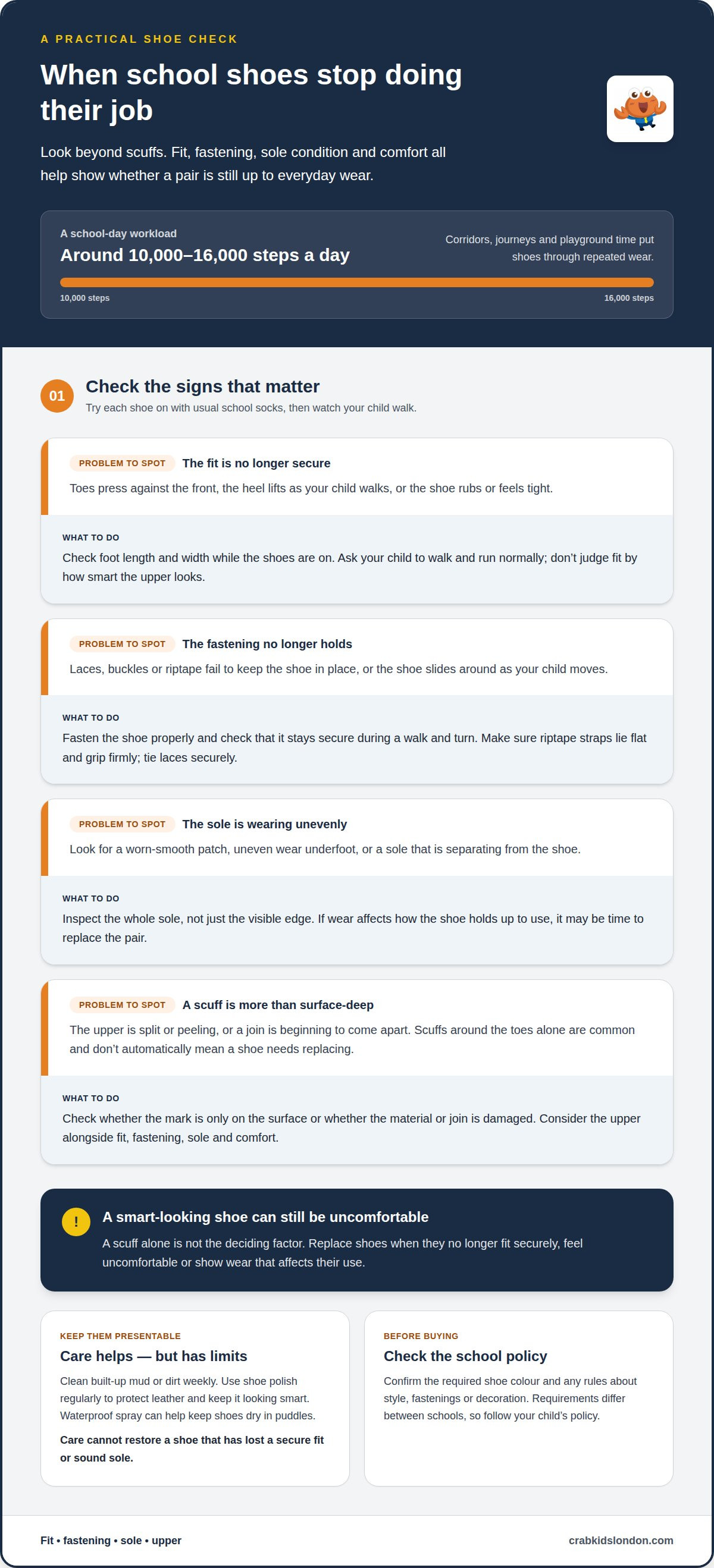
Replace school shoes when they no longer fit securely, feel uncomfortable or show wear that affects their use. Children can take around 10,000 to 16,000 steps a day, so a school shoe faces repeated pressure from corridors, journeys and the playground. A scuffed upper alone doesn’t mean the pair has reached the end of its life. Look at fit, fastenings, soles and comfort together.
Check each shoe while your child is wearing it with their usual school socks. Look for toes pressing against the front, a heel lifting as they walk, or a fastening that fails to hold the foot in place. Ask whether the shoe rubs during ordinary walking or running. If it does, or feels tight, don’t judge fit by how smart the upper looks.
Durable materials can help school shoes withstand daily wear, but material alone doesn’t determine how long a pair lasts. Leather school shoes may need regular care to stay presentable: clean away built-up mud or dirt weekly, and use shoe polish regularly to protect leather and keep it looking smart. Waterproof spray can help keep shoes dry in puddles. These steps support upkeep, but they can’t restore a shoe that has lost a secure fit or sound sole.
Scuffs are common around the toes, especially for children who run, kneel or play on the ground. Check whether a mark is only on the surface or whether the material is split, peeling or opening at a join. Inspect the sole too, looking for uneven wear, separation or a smooth patch where the tread has worn down. A Mary Jane style can look tidy, but its strap and sole still need to hold up to everyday movement.
Before buying, check the school’s uniform policy for the required shoe colour and any rules about style, fastenings or decoration. Requirements differ between schools, so follow your child’s policy rather than assuming every black shoe or Mary Jane style will meet it.
- Fit: Check for toe pressure, heel movement and rubbing during a normal walk.
- Fastening: Make sure laces, buckles or riptape still secure the shoe properly.
- Sole: Look for separation, worn tread or uneven wear under the foot.
- Upper: Distinguish surface scuffs from splits or joins that are coming apart.
For comfortable school shoes for active kids, durability means more than resisting scuffs. Choose a pair that fits securely and suits the school’s stated requirements, then keep an eye on wear as your child uses it. A school shoe size guide can help you assess fit before deciding whether the current pair still has room to serve.
Fastenings, padded ankles and leather linings
Fastenings keep shoes in place as children walk, run and move through school. Compare how each option closes, adjusts and holds during everyday use.
Fastening options
Velcro, also called riptape, opens and closes quickly, which can make it practical for younger children and busy mornings. Check that the straps lie flat and hold firmly across the foot. Premium Velcro is described as retaining its stickiness after a few hundred uses, but grit and repeated pulling can affect how well it grips. Press the fastening together fully rather than leaving its edges loose.
Lace-up shoes allow the fit to be adjusted along the front. They can suit a child who needs a closer hold across the foot, but laces must be tied securely and retied if they loosen. A buckle closes over a strap, as on a Mary Jane style; check that it fastens comfortably without pinching. Zips close quickly, but the shoe still needs to hold the foot securely. For a narrow foot, check whether the fastening can draw the shoe snug without creating pressure. Try the fastening with school socks on, then ask your child to walk and turn. A secure shoe shouldn’t slide around as they move.
Choose based on your child’s routine, not just the shoe’s appearance. Riptape can make independent dressing easier, while laces allow hands-on adjustment. Buckles keep a strap closed, and zips can make shoes quicker to put on. Consider how your child manages the fastening at the start and end of the school day. Wet hands or gloves may make a small buckle harder to operate. The right option is one your child can fasten properly and that stays in place while walking and running.
Padded ankles and leather linings
Check the collar around the ankle for soft padding and a smooth finish. Padding may help reduce rubbing where the shoe meets the ankle during repeated walking. Feel inside for raised seams, rough edges or folded lining that could press against the foot. Have your child walk in both shoes, then check for any signs of rubbing before deciding whether the fit feels comfortable.
A leather lining is a material choice, not a substitute for checking fit. See how the lining sits across the heel and sides and whether it feels even against a school sock. If the shoe feels narrow, a smooth lining won’t make a tight fit comfortable. Compare both shoes, as pressure or rubbing may be more noticeable on one foot. After a normal day, check for damp patches, scuffed lining or areas that have begun to lift. These details can help distinguish a fastening issue from discomfort caused by the shoe’s shape or interior finish.
Cushioned school shoe designs
Cushioning should feel comfortable underfoot without making a school shoe feel bulky or unstable. Check the fit and the child’s movement together: a soft footbed won’t compensate for footwear that’s too long, too short or too narrow. Infant and junior styles can differ in shape and fastening, so judge each pair on the child’s foot, not its age label.
A Mary Jane, lace-up or riptape style may suit different preferences and routines. Check the inside finish, how the shoe feels beneath the heel and forefoot, and whether it bends naturally as your child walks. Ask them to walk across the room and turn. If they alter their stride, shuffle or complain of pressure, take the shoe off and reassess the fit.
Measure both feet for length and width rather than choosing by age alone. Children’s feet can differ, and the larger foot needs to fit comfortably. The guide recommends leaving around 1.5cm between the longest toe and the end of the shoe. Check this with your child standing, since their foot spreads under weight. A shoe that feels cushioned but squeezes across the toes is not a good fit.
Age can offer context, but it cannot set the size. In the UK, many four-year-old boys wear infant school shoes around UK size 7 to 10. Many seven-year-old boys wear junior shoes around UK size 11 to 13, while many eleven-year-old boys wear around UK size 1 to 3. These examples show why a fitting decision should use current foot measurements, not an age-to-size assumption.
- Measure: Record the length and width of each foot while your child is standing.
- Allow room: Check for around 1.5cm from the longest toe to the shoe’s end.
- Test movement: Have your child walk and turn in both shoes, wearing their usual school socks.
- Review: Check the fit every few months, as children’s feet grow quickly.
A cushioned design should feel even under the foot, not lumpy or compressed. Press gently across the heel and forefoot, then ask your child where they feel pressure. Notice whether the shoe stays comfortable during several minutes of walking, rather than relying on a quick try-on. For growing feet, repeat the fit check every few months and whenever the child reports tightness.
Use a school shoe size guide alongside measurements to compare the fit. Styles and finish matter, but comfort depends on the shoe sitting securely, with enough room at the toes and no pinching at the sides.
Flexible soles and freedom of movement
A school shoe sole should bend with your child’s step without folding or twisting out of shape. Flexibility helps the shoe move naturally during walking, running and play, while grip matters on wet playground surfaces. Check how the sole responds to gentle pressure, then watch your child walk and turn in both shoes.
Start at the forefoot. Hold the heel and toe, then press gently to see whether the sole flexes where the foot bends. A completely rigid sole can restrict a step; one that folds too easily may feel unstable. During a fitting, ask your child to walk across the room, climb a step and change direction. Notice whether the shoe moves with the foot or drags at the toe.
Grip matters on wet school corridors and playgrounds. A treaded sole may help with traction, but no sole removes every risk. Check the tread pattern and make sure it isn’t worn smooth. After football or running games, inspect the soles for packed dirt that could affect contact with the floor.
Non-marking soles may be required for PE or indoor activities, but school rules vary. Check the uniform policy or PE instructions before treating school shoes as a substitute for trainers. Some schools expect separate PE footwear, while others specify which soles are suitable for indoor floors. A dark sole doesn’t automatically mark, and colour alone doesn’t prove that it is non-marking.
Injection-moulded describes a manufacturing method in which material is shaped in a mould to form the sole or part of the shoe. Rather than judging the method by its name, inspect the finished shoe. Look closely at the join around the upper, the edges near the toe and heel, and any visible gaps. A neat, secure-looking connection is one practical point to assess alongside comfort and movement.
- Flex: Press the forefoot gently and check that it bends without collapsing.
- Grip: Inspect the tread for wear or dirt, especially after wet playground use.
- PE use: Follow the school’s instructions on non-marking soles and separate trainers.
- Finish: Examine the sole-to-upper join, including on patent leather styles.
A cushioned footbed can feel soft at first, but test it alongside sole flexibility. Have your child take several steps in the morning, then repeat the walk after they’ve been wearing the shoes for a while. Check for rubbing or a changed stride. For a child who plays football at breaktime, a secure fit, flexible forefoot and suitable tread each deserve attention.
Sturdy, scuff-resistant soles and reinforced toe caps
A reinforced toe can take some of the knocks shoes get during a busy school day. Check the front of each shoe for a protective overlay or bumper, then see how it joins the upper. A neat, secure edge matters: lifting, splitting or a sharp ridge can affect comfort and lead to further wear. Ask your child to walk in the pair and notice any rubbing around the toes.
Scuff-resistant materials can help keep shoes looking presentable, but “resistant” doesn’t mean mark-proof. Kneeling on the playground or catching a toe while running can still leave scratches. Compare the material around the toe with the rest of the upper. Patent finishes show marks differently from textured leather, so consider which surface will be easiest to clean after school.
Inspect the sole as well as the toe. Press along its edges and check for gaps where it meets the upper. Look underneath for defined tread, rather than an area worn smooth. Uneven wear can show where the shoe takes the most pressure. If the sole starts separating or the tread wears down, a smart upper won’t make the shoe dependable for daily use.
OrthoLite is a name used for some footwear insoles. If a shoe describes an OrthoLite footbed or an odour-resistant feature, read the product details to understand what it means. Don’t assume every insole has the same construction or effect. Remove an insole only if it is designed to come out, then check for compression, damage or persistent dampness. A clean, intact footbed should also sit flat when replaced.
Odour can build up when shoes stay damp after a day of wear. Air them out between school days and let any removable insole dry separately, following its care instructions. Avoid putting shoes away while wet or masking odour with fragrance. If the lining is damaged or stays damp, check whether the shoe still feels comfortable and secure during a normal walk.
- Toe protection: Check that a reinforced toe or bumper has no lifting edges.
- Upper material: Consider how patent or textured surfaces show scuffs and can be cleaned.
- Sole condition: Look for separation, smooth tread and uneven wear underneath.
- Footbed: Check for compression, damage and dampness before putting shoes back on.
Choose protection to suit your child’s routine, rather than relying on a premium label or scuff-resistant claim alone. A toe bumper can help protect a high-contact area, while a sturdy sole and intact footbed support everyday wear. Recheck these details after regular playground use, especially if you notice fresh marks, rubbing or a change in how the shoe sits.
Crabkids London: Shoe Care
Crabkids London sells shoe care products to help maintain children’s school shoes through everyday use. Its CB London Leather Shoe Cleaner is a foam-based cleaner for leather, synthetic leather and patent leather. It needs no rinsing and has no harsh chemicals or strong odour. Care can help keep shoes clean, but it can’t make an ill-fitting pair comfortable or restore a damaged sole.
If worn shoes need replacing, explore Crabkids London’s boys’ and girls’ school shoe ranges, keeping fit, fastening and sole condition in mind. The shoes come in wide and narrow fit options. Backpacks are also available for carrying school essentials. Choose shoe care when your current pair remains comfortable and sound; consider new shoes when fit or wear becomes a concern.
For help choosing the right next step, contact Crabkids London.
Make the next school-shoe choice with confidence
Finding comfortable school shoes for active kids is an ongoing decision, not just a shopping-day task. Your child’s comments after wearing a pair can guide your next choice. Notice whether they mention pressure, rubbing or tired feet, and consider the activities that shape their school day. A child who spends breaks running may value different features from one who mostly walks between lessons. Use these observations to focus on what matters for their routine, rather than choosing by appearance alone.
Keep a simple note of what worked well, such as a fastening your child could manage independently or a shape that felt comfortable throughout the day. That gives you a practical starting point as their needs change. It also helps you recognise when care is enough and when it’s time to consider another pair.
For help with your next step, contact Crabkids London. A considered choice can make busy school mornings feel more straightforward, and help your child head into the day ready to move.
Frequently Asked Questions
What features make school shoes comfortable for active children?
Comfort comes from a combination of secure fit, soft contact points and freedom to move. Check that the heel stays in place, the fastening doesn’t press into the foot, and the lining feels smooth against school socks. During a fitting, ask your child to walk, turn and climb a step. Their movement and comments can reveal discomfort that isn’t obvious while they’re sitting.
Which school shoes combine comfort and durability for active kids in the UK?
Look for school shoes that feel comfortable in motion and have sound construction at the sole, toe and upper joins. A reinforced toe can help protect a high-contact area, while firmly attached soles show no obvious gaps. The right choice also depends on your child’s foot shape and the school’s uniform requirements. Use everyday activities, such as walking to school and playing at breaktime, to guide your priorities.
What should I look for in lightweight, flexible school shoes for running and playground use?
Choose a pair that bends naturally at the forefoot and feels stable when your child changes direction. Check the tread for grip and see whether it stays clear of packed dirt after playground use. A shoe’s weight alone doesn’t show whether it will suit running; let your child walk, jog gently and turn in it. For PE, follow the school’s instructions about suitable footwear and separate trainers.
How should school shoes fit, and how much growing room should parents allow?
School shoes should feel secure without pressing on the toes, sides or heel. Measure both feet while your child is standing, and use the larger foot to guide the fit. Allow around 1.5cm between the longest toe and the shoe’s end. Then check that the foot doesn’t slide forward or lift at the heel during walking. Try shoes with the socks your child wears to school.
What materials and soles suit breathable, hard-wearing school shoes?
Choose an upper and lining that feel comfortable against the foot and have a finish you can maintain for school use. Leather, synthetic leather and patent finishes each need appropriate care, so follow the product’s cleaning instructions. Assess the sole for grip, flexibility and a secure join with the upper. After a damp school day, let shoes air out fully before storing them to help manage moisture inside.
How much do comfortable school shoes for children cost in the UK?
There isn’t one fixed price for children’s school shoes. The cost depends on the individual style, materials and construction. Compare shoes by fit and the features your child needs, rather than relying on price alone. Consider care too: regular cleaning can help keep suitable leather shoes looking smart, while damaged or poorly fitting shoes need more than cleaning.
How can parents prevent blisters and check whether children’s school shoes still fit?
To reduce rubbing, check for rough seams, pressure points and heel movement before a full school day. Have your child wear the shoes briefly at home and tell you if any area feels uncomfortable. Reassess the fit if they report tightness, change how they walk or develop rubbing. Look inside for worn lining and outside for sole separation; appearance alone won’t show whether the shoe still fits.
Are leather school shoes better than synthetic shoes for comfort and durability?
Material alone doesn’t determine durability, and comfort depends on fit. Leather shoes need regular care, including weekly cleaning and regular polishing.