

5 Checks for Choosing Socks to Wear with School Shoes
Socks can affect how school shoes fit as well as complete an outfit. The best socks to wear with school shoes are a comfortable thickness, sit smoothly and suit the shoe style. These five checks cover colour, style, fabric, comfort and fit, helping you choose a pair that works for the school day, not just one that looks right at the door.
It’s easy to focus on whether socks match the uniform, but thickness and seams matter when children wear shoes for much of the day. A bulky pair can squeeze toes or rub, while socks that slip or bunch can make shoes uncomfortable. Use these practical checks to coordinate colours, choose suitable styles and fabrics, and spot when socks may be affecting shoe fit.
Key Takeaways
- Coordinate sock colour with the shoes and trousers for a tidy, uniform-friendly look.
- Choose a comfortable sock thickness that won’t make school shoes feel tight or rub against the toes.
- Match sock length and style to the shoe, from plain pairs with leather lace-ups to suitable options for Mary Janes and loafers.
- Compare fabric feel and durability, as cotton blends and bamboo offer different benefits for active school days.
- Notice slipping, bunching or pressure marks: socks that fit properly can help shoes feel more comfortable.
1. Choosing sock colours to complement an outfit
Start with the school uniform, then choose a sock colour that sits neatly with the shoes and trousers. Plain black socks create a coordinated look with black school shoes, while navy may suit navy trousers and matching footwear. The best socks to wear with school shoes must also feel comfortable through the school day, so colour shouldn’t be the only test.
UK schools set their own uniform requirements, so there’s no single sock colour or style for every pupil. Follow the school’s uniform policy for permitted colours and designs. If plain black socks are allowed, for example, avoid bright stripes or prominent logos that may not meet the dress code.
For a balanced outfit, coordinate socks with both shoes and trousers. Let the more colourful item guide your choice: with grey trousers and black shoes, grey or black socks keep the look consistent. If the uniform has a tartan skirt, plain socks in a permitted shade avoid competing patterns. Black socks are also a traditional choice for formal occasions, including weddings, funerals and major interviews.
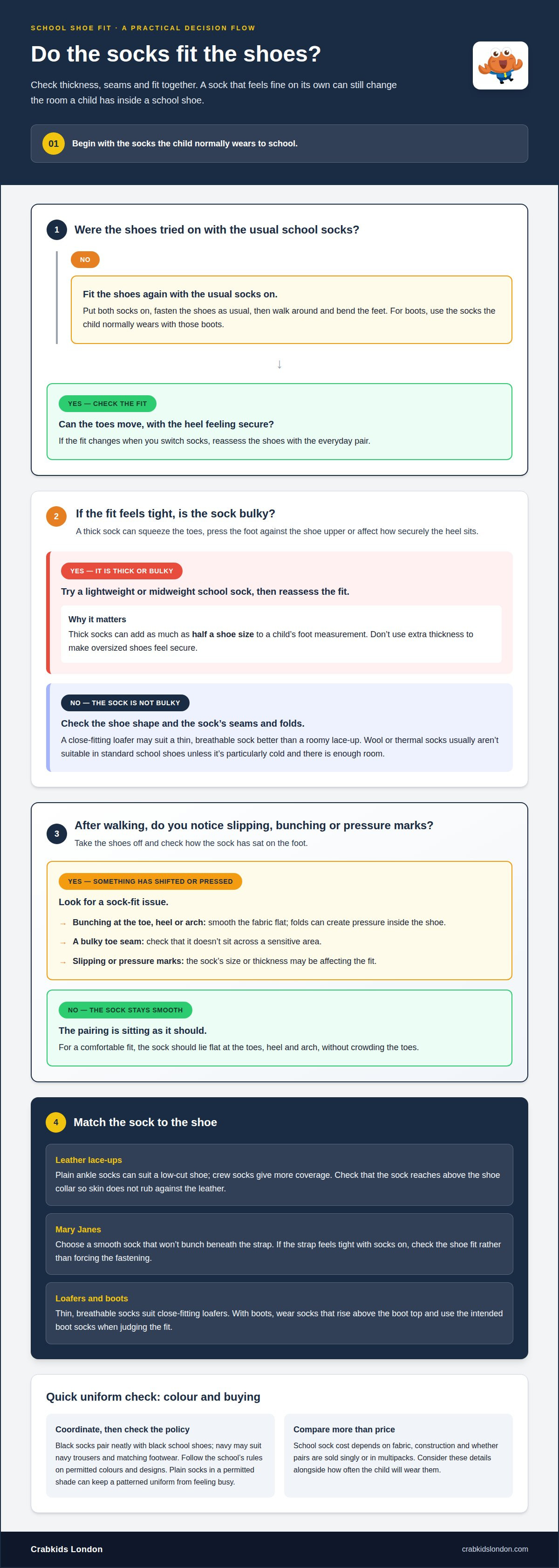
Choose lightweight or midweight socks for most school shoes. A thinner pair may suit a close-fitting shoe, while a midweight option can feel more comfortable if there’s room around the foot. Thick winter socks take up extra space and change the fit, so they’re not a good way to make oversized school shoes feel secure. Choose shoes that fit properly with the socks the child normally wears.
Match sock height to the footwear. Ankle or crew-length socks work with many traditional school shoes, while socks worn with boots should rise above the boot top. This coverage helps prevent the boot edge from rubbing directly against the skin. Trainer liners may not suit a standard school day, particularly if they slip below the heel or leave skin exposed to rubbing.
For shoe fitting, have the child wear their usual school socks rather than trying shoes on barefoot. Check that each sock lies flat, with no folds at the toe or heel. Have them walk around in the shoes, then look for slipping, bunching around the arch or pressure marks after they take them off. These signs may indicate that the sock’s size or thickness is affecting the fit.
The cost of school socks in the UK depends on fabric, construction and whether they’re sold singly or in multipacks. Compare these details with how often the child will wear them, rather than using price alone as your guide.
For a straightforward starting point, browse school socks and consider the colour, height and thickness alongside the child’s uniform and shoes.
2. Matching socks to shoe fit and materials
A sock changes how much room a child’s foot needs inside a shoe. Choose its thickness alongside the shoe’s shape, fastening and fit, rather than treating socks as an afterthought. A pair that feels comfortable in a roomy lace-up may make a snug loafer feel tight. The best socks to wear with school shoes sit smoothly inside the footwear without crowding the toes.
Start by matching thickness to the available space. Lightweight or midweight socks are generally practical for standard school shoes because they’re less likely to alter the fit. Thin, breathable socks suit close-fitting loafers better than bulky pairs. Wool or thermal socks usually aren’t suitable inside standard school shoes unless it’s particularly cold and the shoes have enough room.
Thick socks can add as much as half a shoe size to a child’s foot measurement. That extra bulk may squeeze the toes, press the foot against the upper or change how securely the heel sits. Don’t use a thicker pair to compensate for shoes that feel oversized. A well-fitting shoe worn with a standard sock is usually a kinder choice for growing feet.
Seams matter as much as thickness. A bulky toe seam can irritate a child’s toes during a school day involving walking and sitting. Before wearing a new pair to school, smooth the fabric over the toes and check that the seam doesn’t sit across a sensitive area. The sock should lie flat at the heel and around the arch, without folds that create pressure inside the shoe.
Use the socks the child normally wears to school when trying on shoes. Put both socks on, fasten the shoes as usual, then check that the toes can move and the heel feels secure. Walk around and bend the feet. If the fit changes after switching to a thicker sock, reassess the shoe with the everyday pair.
Boots need the same careful pairing. Measure children’s feet for boots while they’re wearing the socks they usually wear with them. A winter boot sock may be thicker than a standard school sock, so fitting with the thinner pair can leave less room than expected. Keep the intended sock in mind when judging toe space and heel movement.
For a practical starting point, compare everyday school sock options with the shoes the child wears most. The right thickness helps preserve a comfortable fit without relying on extra bulk.
3. Sock styles for leather shoes, Mary Janes and loafers
Match sock style to the shoe’s shape, opening and fastening. Traditional leather school shoes usually work well with plain ankle or crew socks. These lengths cover the foot without adding unnecessary fabric around the shoe opening. For a uniform-ready outfit, choose a simple finish that sits neatly with the shoe and doesn’t compete with the rest of the clothing.
With leather lace-ups, plain socks keep the look tidy and practical. An ankle sock can suit a low-cut shoe, while a crew sock gives more coverage above the shoe edge. Check where the shoe collar rests against the ankle. If the sock ends below it, skin may rub against the leather while walking.
Mary Janes have a strap across the foot, so avoid socks that bunch beneath it. A smooth ankle sock can sit inside the shoe without gathering under the strap. Crew socks offer more visible coverage, particularly with skirts or dresses. If the strap feels tight after adding socks, check the shoe fit rather than stretching or forcing the fastening.
Loafers often fit more closely than lace-up shoes, so choose a thin, breathable sock rather than a bulky style. A thick cuff or folded fabric can press against the instep and make the shoe feel snug. Try the intended pair with the loafers and walk around. If toes feel crowded or the heel slips, reassess the sock thickness and fit.
Consider the outfit as well as the shoe. Plain socks are an easy match for black leather lace-ups, while a permitted uniform colour can keep the look consistent. With a skirt and Mary Janes, choose a length that shows evenly above the shoe. With trousers and loafers, check that the sock stays covered during ordinary movement.
Sock height should also suit the child’s activity. Socks worn with boots need to extend above the boot top, reducing direct contact between the boot edge and skin. For lower school shoes, ankle or crew lengths provide coverage without excess material. Avoid trainer liners if they slip below the heel or leave skin exposed to rubbing.
Before wearing a new style for a full school day, check the heel, toe seam and cuff with the shoes on. Ask the child to walk, sit and climb stairs. Look for heel slippage, fabric gathering under a Mary Jane strap or pressure from a loafer’s upper. A smooth, secure sock helps the shoe sit comfortably through these movements.
4. Suitable fabrics, including cotton blends and bamboo
Fabric affects how school socks feel, hold their shape and cope with daily wear. Pure cotton feels familiar, but it may lose its shape or withstand wear less effectively than a blend containing synthetic fibres. A cotton-rich blend, for example, can combine a soft feel with added resilience. Check the fabric composition and how the sock feels inside the child’s usual school shoes.
Blended socks can be a practical choice for busy school days. Synthetic fibres in a cotton blend can help the sock retain its shape through repeated wear and washing. Check the toe and heel, which experience regular friction inside leather shoes. Reinforced areas can help these parts cope with active use, while a smooth toe seam can reduce irritation.
Bamboo-rich socks offer a different feel. They’re described as soft and breathable, which may suit a child who prefers a lighter, gentler fabric. However, they may wear through faster when shoes fit snugly or a child is particularly active. Check the heels and toes during laundry for thinning fabric, especially if the child walks or runs a lot at school.
No single fabric suits every child or shoe. Compare how the sock feels with the shoe’s fit: thicker fabric takes up more room, while a lighter pair leaves more space. If a child says a shoe feels tight after changing socks, try the usual pair again before deciding the shoe itself is the problem. Keep the fabric consistent during fitting.
To help prevent blisters and odour, choose socks that sit smoothly without bunching, and put on a clean, dry pair each school day. Wash worn socks and rotate pairs, giving each one time out of use. A damp or folded sock can rub inside a shoe, so smooth the heel and toe before putting shoes on.
Care also affects how long cotton blends and bamboo-rich socks remain comfortable. Follow the care label, then check each pair after washing for stretched cuffs, rough seams or worn patches. If a sock has lost its shape, it may slide down or gather inside a Mary Jane or lace-up shoe. Set damaged pairs aside rather than wearing them to school.
Keep a small rotation of suitable pairs, sorted by fabric and thickness. That makes it easier to replace a worn bamboo-rich pair with a similar option, or choose a cotton blend for more regular wear. For children with sensitive skin, pay attention to the cuff and toe seam as well as the fibre. A comfortable fabric should stay smooth during walking, sitting and play.
5. How socks affect children's shoe fit
A sock adds material around a child’s foot, changing how much space remains inside a shoe. That small difference can affect toe room, heel hold and pressure across the instep. The best socks to wear with school shoes fit smoothly and work with the shoe’s shape, rather than forcing the foot into less space.
Check the fit with the socks your child normally wears to school. Put both socks on before trying shoes, then fasten them as usual. Have your child stand and walk, checking whether the toes feel crowded or the heel lifts. A shoe that feels comfortable barefoot may pinch once a thicker sock is added.
Thickness can also affect foot measurements. Socks make feet slightly larger than bare feet, so include their thickness when measuring. A thick pair can add as much as half a shoe size to a child’s foot measurement. That’s why a winter sock shouldn’t be used to fit a shoe intended for thinner everyday socks.
Look for signs of poor sock fit after wearing shoes. A sock that slides down, bunches around the arch or leaves deep marks may be the wrong size or shape. Smooth it out and check the heel and toe before putting shoes on again. If fabric gathers inside a Mary Jane or lace-up, it can create pressure at that spot.
Unsuitable socks can make shoes feel either tight or loose. Too much fabric may squeeze toes, make seams rub and leave feet too warm indoors. Too little coverage, or a sock that moves around, can increase friction. Rubbing, pinching and blisters may follow when the shoe and sock combination doesn’t hold the foot comfortably.
Seasonal changes call for a separate fit check. Measure feet for boots while your child wears the socks normally paired with them. Before trying summer sandals, remove thick winter socks; otherwise, the sandals may seem to need more room than they do when worn as intended.
Pay attention to the sock top as well as the foot. A softer top may suit a child bothered by elastic pressure, while a firmer cuff can help keep socks up during outdoor play. Children with swelling, circulation concerns or discomfort from ordinary elastic tops may prefer gentler soft-top socks.
Use the same sock type for the final shoe-fit check that your child will wear regularly. If you’re reviewing the fit alongside a new size, the shoe size guide can help you work through the sizing process.
Crabkids London: Socks
Crabkids London offers socks alongside boys’ and girls’ school shoes, making it a natural next step when you’re choosing a school-day pair. Use the checks above to narrow down the colour, style, fabric and thickness that suit your child’s uniform and footwear. Then browse the school socks collection to explore the available options.
If you’re also choosing shoes, consider how the socks your child wears will affect the fit. Pairing the right sock with suitable school footwear helps keep the whole outfit practical for everyday wear. For help with your choices, contact Crabkids London.
Choose with the next school day in mind
A dependable school-day routine starts with choices your child can wear comfortably and manage independently. As their preferences and uniform needs change, involve them in choosing suitable options. This can make getting dressed smoother and help them feel prepared. The aim isn’t to find one perfect pair, but a practical match for their shoes and everyday routine.
Socks and shoes work as a pair. If your child mentions pressure, rubbing or slipping, treat that as useful feedback and reassess the combination. This simple habit can help you notice when a familiar choice no longer feels right. Finding the best socks to wear with school shoes is easier when comfort is part of the decision from the start.
Crabkids London offers boys’ and girls’ school shoes, as well as BackPacks. If you’d like help choosing school essentials, contact Crabkids London for help. A practical set-up can help your child feel ready for the school day.
Frequently Asked Questions
What makes the best socks for school shoes?
A good school sock combines a secure fit, suitable thickness and fabric that feels comfortable inside the shoe. Check that it stays in place during movement and doesn’t gather beneath the toes. For example, a pupil wearing leather lace-ups may prefer a plain ankle or crew sock. The right choice must also follow the school’s uniform policy, so check permitted colours and styles before buying.
What socks are best for comfort with school shoes?
Choose a pair that feels smooth against the foot and doesn’t crowd the toes inside the shoe. A flat toe seam can help prevent a raised ridge from pressing against the toes during lessons or walking between classrooms. Check the cuff too: a softer top may suit a child who dislikes tight elastic. Try a new pair at home with the usual shoes before adding it to the school rotation.
Which sock materials keep feet dry and reduce sweating?
No sock material can guarantee dry feet throughout a school day. Bamboo-rich socks are described as soft and breathable, while fabric blends vary in feel and construction. Choose a pair that doesn’t make the shoe feel hot or cramped, and change out of damp socks after school. A fresh, dry pair for the next day is a practical step, especially after active play or wet weather.
Are cotton, wool or synthetic school socks better?
Each material has different trade-offs. Pure cotton may lose its shape or withstand wear less well than a blend containing synthetic fibres. Bamboo-rich socks can feel soft and breathable, but may wear through faster in snug shoes or with particularly active children. Wool or thermal socks generally aren’t a match for standard school shoes unless it’s especially cold and the footwear has enough room.
What sock thickness works best with leather school shoes?
Lightweight or midweight socks are generally a practical match for leather school shoes. They’re less likely to change the fit than bulky socks, which can leave less room for toes and increase pressure. For a close-fitting loafer, try a thinner, breathable pair. For lace-ups with more room, a midweight sock may work well. Judge the fit with the actual pair the child will wear to school.
What are the best durable school socks for everyday wear?
Look for socks with reinforced heels and toes, as these areas experience repeated friction during walking and play. A cotton blend containing synthetic fibres may retain its shape and withstand wear better than pure cotton. Check the heels, toes and cuffs during laundry for thinning or stretching. Washing socks and rotating pairs helps reduce repeated wear on the same pair and keeps sound options ready for school.
Are ankle, crew or knee-high socks best with different school shoes?
Ankle and crew socks are usually suitable for traditional leather school shoes. Choose a height that covers the skin where the shoe edge might rub. With boots, socks should rise above the top to prevent direct contact between the boot and skin. Knee-high socks may suit some uniform outfits, but the school’s dress code and the child’s comfort should guide that choice.