

The Best School Shoes for Boys with Narrow Feet: 2026 Buying Guide
Did you know that up to 72% of school-age children are wearing shoes that don't actually fit their feet? For parents of boys with narrow profiles, this statistic isn't just a number; it's the daily reality of heel blisters and shoes that look three sizes too big. Finding school shoes for narrow feet boys often feels like a choice between a secure fit and a shoe that can actually survive a game of football.
We understand the frustration of seeing "clunky" shoes that gap at the ankles or watching your son curl his toes just to keep his footwear on. It's a common struggle to find a pair that offers adjustability without sacrificing the toughness required for the playground. This 2026 guide promises to help you discover the perfect secure fit whilst ensuring the durability needed for an active school life.
We'll provide easy-to-follow measuring advice for home use and highlight the best styles designed for narrow heels and low-volume feet. You'll learn how to prioritise security over empty space to keep him comfortable and confident from the first bell to the final whistle.
Key Takeaways
- Identify why standard fittings often gape at the ankles and how this leads to premature shoe wear and heel blisters.
- Discover why lace-up or multi-strap fastenings are essential for providing the customisable security that narrow heels require.
- Understand how high-quality leather moulds to unique foot shapes, making it the ideal material when selecting school shoes for narrow feet boys.
- Learn the "Finger Test" and other practical home measurement techniques to verify a secure, "no-gap" fit.
- Balance playground-ready durability with the streamlined aesthetics that prevent narrow-footed boys from feeling weighed down by clunky footwear.
Understanding the Narrow Foot: Why Standard School Shoes Slip and Gape
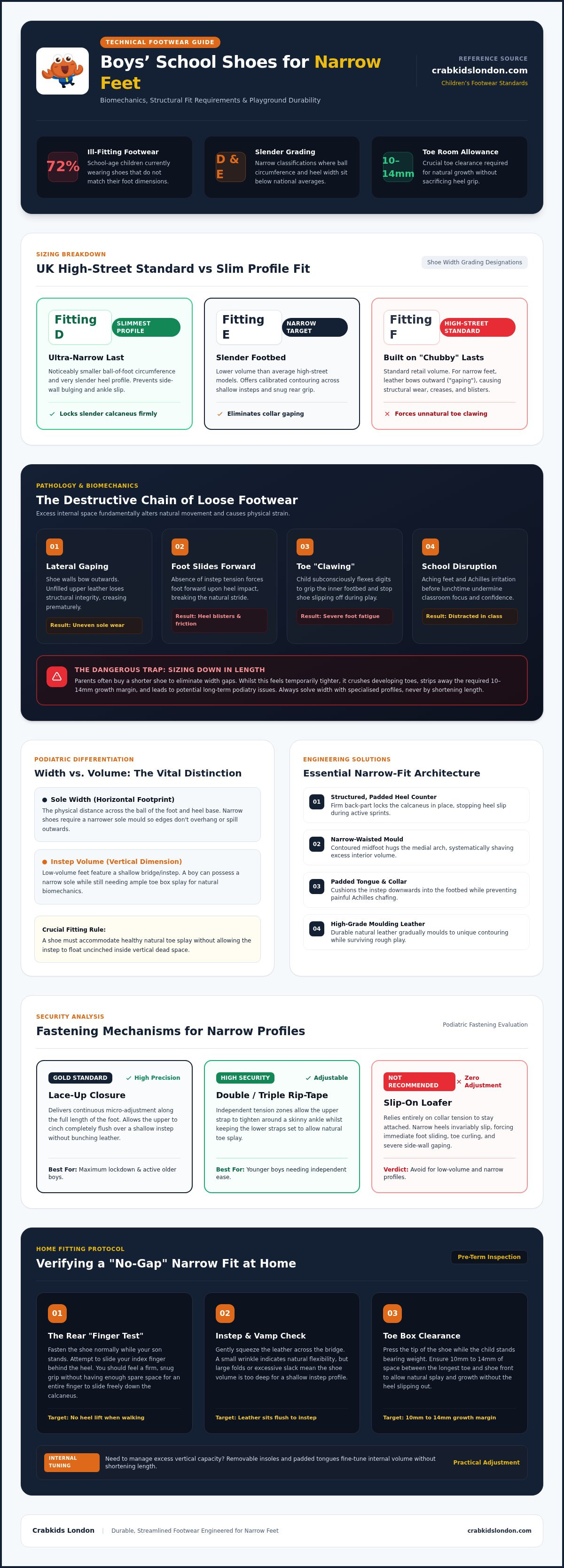
In the UK children's footwear market, most high-street retailers cater to a standard "F" width. For a boy with a slender foot, this medium fit creates significant problems. A narrow foot is typically classified as an "E" or "D" fitting, where the circumference of the ball of the foot and the width of the heel are smaller than the national average. Most standard shoe width grading systems use these letter designations to help parents find a precise match, but many standard shoes are built on "chubby" lasts that simply don't accommodate a slimmer profile.
When a child wears a shoe that is too wide, the material at the sides bows outwards. This is known as "gaping". It doesn't just look untidy; it compromises the structural integrity of the footwear. Because the foot isn't supporting the upper, the leather creases more deeply and the sole wears unevenly. Finding proper school shoes for narrow feet boys ensures the shoe stays flush against the skin. This prevents the friction that leads to painful heel blisters whilst protecting the skin from Achilles irritation during active playground games.
The Biomechanics of a Poor Fit
Excess internal space forces a child to change how they walk. Instead of a natural heel-to-toe transition, the foot often slides forward with every step. To compensate, boys often "claw" their toes, subconsciously curling them to grip the footbed and stop the shoe from flying off. This constant tension leads to severe foot fatigue. It often results in a boy becoming distracted in class because his feet ache before the lunch bell has even rung. Some parents try to fix this by "sizing down" to a shorter length, but this is a dangerous mistake. It might feel tighter, but it crushes the toes and prevents natural growth, potentially leading to long-term podiatry issues.
Width vs Volume: The Subtle Difference
It is possible to have a narrow foot but a high instep, or a wide foot that is very flat. Understanding this distinction is vital for a secure fit. Low-volume feet are defined as those with a shallow bridge or instep. A boy might need a narrow sole but still require enough room in the toe box for his toes to splay naturally. If you aren't sure of your son's requirements, using a shoe size guide can help you determine the correct length-to-width ratio before you buy.
Essential Design Features for Narrow-Footed Boys
Finding the right school shoes for narrow feet boys requires looking beyond the size label. Whilst width fittings provide a starting point, specific design elements dictate whether a shoe will actually stay secure during a busy school day. Following podiatric guidelines for children's footwear, parents should prioritise adjustable fastenings that prevent the foot from sliding forward. These features ensure the shoe acts as a stable extension of the foot rather than a loose weight that hinders movement.
Laces vs Rip-Tape: Which Offers More Security?
Lace-up designs remain the gold standard for precision. They allow you to cinch the leather flush against the instep, which is vital for boys with a shallow bridge. For younger children, double or triple rip-tape straps provide similar benefits. These independent straps allow for a tighter fit at the ankle whilst keeping the midfoot stable. Slip-on loafers are rarely recommended for very narrow profiles. Without a fastening to pull the upper tight, the foot relies entirely on the shoe's opening to stay in place, almost always resulting in the "gaping" mentioned previously.
Heel Grip and Ankle Support
A structured, padded heel counter is non-negotiable for narrow heels. This firm "back-part" provides the necessary grip to lock the calcaneus in place. When combined with a padded collar, it prevents the ankle from lifting out of the shoe during playground games. Look for "narrow-waisted" shoe moulds that hug the arch of the foot. This streamlined shape reduces the internal volume, ensuring a snugger feel without needing to sacrifice the 10mm to 14mm of toe room required for healthy growth. Exploring quality boys' school footwear helps you identify these structural advantages in practice.
Internal volume can be further managed through clever design details like tongue padding. This extra cushioning takes up excess vertical space, pushing the foot down into the footbed for a more secure fit. If a shoe still feels slightly loose despite the correct length, removable insoles offer a practical solution. They allow you to fine-tune the internal capacity, ensuring the shoe fits perfectly from day one. These small adjustments make a significant difference in how school shoes for narrow feet boys perform over a long academic year.
Durability Meets Fit: Why Tough Leather is Crucial for Active Boys
Choosing school shoes for narrow feet boys often feels like a compromise between a slim silhouette and playground durability. High-quality leather is the essential solution. Unlike synthetic materials that remain rigid or boxy, genuine leather possesses natural elasticity. This allows the upper to mould specifically to a child's foot shape over time, creating a bespoke fit that prevents the gaping issues discussed in previous sections. Government health advice emphasises the importance of measuring both length and width to ensure the leather can perform this function correctly. If the shoe is too wide at the start, the leather will simply crease and lose its structural integrity.
For parents seeking a deeper look at resilient materials, our guide on Durable Boys Leather School Shoes provides further technical insights. Beyond fit, leather provides natural breathability. This is vital for narrow-footed boys because moisture buildup inside a shoe acts as a lubricant. Even a perfectly fitted shoe can start to slip if the lining doesn't wick away sweat. Breathable linings maintain a high-friction environment that keeps the heel locked firmly against the counter during high-energy activities.
Scuff-Resistant Technology for Narrower Profiles
Many parents worry that narrow shoes are too delicate for football and playground games. Modern designs solve this by incorporating reinforced toe bumpers into streamlined profiles. These protective layers prevent the scuffing that occurs during active play without making the shoe look clunky. A secure fit actually reduces damage. When a shoe fits properly, the foot moves in unison with the sole, eliminating the "toe-drag" common in loose, oversized footwear. Regular maintenance with a leather shoe cleaning lotion keeps the material supple, ensuring it doesn't crack or stiffen.
Sole Flexibility and Grip
Sole flexibility is a critical factor that is often overlooked. A stiff, heavy sole acts as a lever. As the boy walks, a rigid sole resists the natural bend of the foot, forcing the narrow heel to pop out of the back of the shoe with every step. Before buying, perform the "bend test" by ensuring the shoe flexes easily at the ball of the foot. This flexibility allows the leather to work with the foot's movement rather than against it. Leather naturally "remembers" the foot shape over time, providing a consistent, secure fit that synthetic alternatives cannot match.
How to Measure and Verify a Narrow Fit at Home
Measuring for school shoes for narrow feet boys requires more than a simple length check. For the most accurate results, always measure your child's feet in the afternoon or evening. Feet naturally expand throughout the day. Sizing taken in the morning often leads to shoes that feel restrictive by the final bell.
Start by using the Crabkids Shoe Size Guide to establish a baseline length. Once the shoes arrive, perform the "Finger Test". With your son standing, try to slide your pinky finger into the side of the shoe near the ankle. If there is a significant gap or the leather bows outwards, the width is likely too generous for a slender profile. A secure fit should sit flush against the foot without pinching.
The "Walk Test" provides the final verification for school shoes for narrow feet boys. Watch your child walk on a carpeted surface, paying close attention to the heel counter. If the heel lifts out of the shoe or the child's gait looks "clunky", the shoe lacks the necessary security. A well-fitted shoe should move in total unison with the foot, providing quiet confidence during every step.
Measuring Width and Circumference
To identify a true narrow fit, use a soft tape measure to check the "joint girth". This is the circumference around the widest part of the foot at the ball. Compare this against standard UK width charts to see if your child falls into the D or E category. Some boys have a standard-width forefoot but a very slim heel. In these cases, the focus should be on heel-grip features and adjustable fastenings rather than just a narrower sole unit.
The Final Fit Checklist
A successful fit balances growing room with stability. Use these three checks to confirm the fit is correct before heading to the playground:
- The Thumb Check: Ensure there is roughly 10mm to 14mm of space at the end of the longest toe to allow for natural growth.
- The Eyelet Test: On lace-up styles, the eyelets should have a clear gap between them when tied. If they touch, the shoe is too wide for the foot's volume.
- The Arch Hug: The leather should sit flush against the arch without puckering or creasing.
Once you have found the right fit, using a leather shoe cleaning lotion ensures the material stays supple and maintains its shape. Explore our collection of reliable school shoes to find a pair built for active school life.
Choosing Crabkids London: Durable Solutions for Narrower Profiles
Crabkids London operates as a practical specialist for parents who value resilience and professional style. We understand that the British school day is a high-energy environment. Finding school shoes for narrow feet boys shouldn't feel like a constant battle against poor fit and premature wear. Our philosophy centres on providing quiet confidence through product longevity. We do the heavy lifting by designing footwear that balances the formal requirements of the classroom with the rugged reality of the playground.
Our specific leather selection is the foundation of this promise. We choose high-quality hides that offer the perfect ratio of strength to suppleness. This ensures the material is sturdy enough to protect the foot whilst being flexible enough to mould to a narrower profile. This custom-feel fit eliminates the "clunky" look often associated with standard junior footwear. By focusing on the lifecycle of the shoe, we ensure your investment lasts from the first autumn term to the final summer bell.
Efficiency is key for busy families. We have streamlined the process of ordering boys school shoes online, offering fast UK delivery to ensure your son is ready for the new term without delay. To further refine the fit, we recommend pairing our footwear with high-quality school socks. The right hosiery provides an extra layer of comfort and helps take up minor volume gaps, ensuring a truly snug, "no-slip" experience throughout the day.
Built for the British School Day
Our designs specifically accommodate the high-energy behaviour of active boys. We prioritise supportive footwear that aids natural foot development whilst standing up to the rigours of football and playground games. This commitment to quality means our shoes maintain their shape and support across months of daily use. You can trust our footwear to provide the stability a narrow foot requires without restricting the movement needed for growth.
The Complete School Kit
A successful term starts with an organised morning routine. Beyond footwear, we help parents prepare with durable school backpacks designed to carry heavy books and kits with ease. Maintenance is equally important for fit longevity. Regular application of shoe cleaning lotion keeps the leather soft and prevents it from stiffening, which is vital for maintaining that moulded, secure fit. Ready to upgrade his school wardrobe? Shop the New Arrivals Collection today to find the latest in durable, narrow-fit school footwear.
Securing the Term Ahead with the Right Fit
Finding the ideal school shoes for narrow feet boys doesn't have to be a source of parental stress. By prioritising adjustable fastenings like laces or multi-strap designs, you provide the customisable security needed to prevent heel slippage and toe clawing. High-quality leather construction is essential; it's the only material that naturally moulds to a slender foot whilst maintaining the resilience required for daily playground activity. Verifying the fit at home with the afternoon "Finger Test" ensures he starts the term with a pair that sits flush against the skin.
Our footwear is expertly designed for durability, helping your son navigate the school day with quiet confidence. Browse our collection of durable boys school shoes today to find his perfect match. With fast UK-wide delivery, you can easily organise his school kit from the comfort of home. Investing in a secure, well-fitted shoe gives him the freedom to move, learn, and play without the distraction of aching feet. We're here to help you find that perfect balance of comfort and longevity for the busy academic year ahead.
Frequently Asked Questions
How do I know if my son has narrow feet?
You can identify narrow feet by observing how a standard shoe sits on the foot during a fitting. If the leather at the sides bows outwards or the eyelets meet when you tie the laces, the shoe likely has too much internal volume. Professionally, a narrow foot is designated as a 'D' or 'E' width in the UK. Measuring the joint girth at the ball of the foot is the most reliable way to confirm a slender profile.
Can I use insoles to make a standard shoe fit a narrow foot?
Insoles can help reduce excess vertical volume, but they don't fix a shoe that is fundamentally too wide at the sole unit. Whilst they might stop the foot from sliding forward, they won't prevent the ankle from gapping at the sides. It's always better to purchase school shoes for narrow feet boys that are built on a slim last. Use insoles only as a final adjustment for a near-perfect fit rather than a primary solution.
Are lace-up school shoes better than Velcro for narrow feet?
Lace-up shoes provide the highest level of customisation because you can cinch the material flush against the entire instep. This precision is vital for boys with low-volume feet. However, multi-strap rip-tape designs are a robust alternative for younger children. These independent straps allow you to tighten the ankle and midfoot separately. Both options are significantly more secure than slip-on styles, which offer almost no adjustability for narrower profiles and often lead to persistent heel slipping.
Why do my son’s heels keep slipping out of his school shoes?
Heel slippage usually occurs because the heel counter is too wide or the shoe lacks a secure fastening to lock the foot back into the seat. In standard-width shoes, the back-part is often too generous for a slender calcaneus. This causes the foot to lift with every step, leading to blisters and premature wear. Choosing a shoe with a firm, padded heel counter and adjustable laces will typically resolve this issue immediately.
What is the narrowest width fitting for boys school shoes in the UK?
The UK children's footwear standard uses 'D' as the designation for extra narrow and 'E' for narrow fittings. Most high-street retailers start their standard range at 'F', which is a medium width. If your son measures as a 'D' or 'E', he will require a specialised last that accounts for a slimmer heel and lower instep. Using a dedicated size guide helps ensure you select a shoe designed specifically for these narrower dimensions and avoids a clunky look.
Will leather school shoes stretch and become too wide over time?
High-quality leather is prized because it moulds to the unique contours of the foot, but it shouldn't lose its structural integrity or sag. If a shoe is properly cared for and fits well from the start, it will maintain its secure grip. Problems usually arise when a shoe is too wide initially; the excess material creases deeply and the upper begins to stretch out of shape. Regular maintenance with a leather lotion ensures the material remains supple without becoming loose.
How often should I re-measure my child’s feet if they are narrow?
Primary school boys can experience growth spurts every 8 to 12 weeks, so we recommend checking the fit every three months. Even if the foot is narrow, the length will increase steadily and requires monitoring. It is vital to ensure there is always 10mm to 14mm of growing room at the toe. Regular checks prevent your son from clawing his toes in a shoe that has become too short, which is a common risk for slender feet.
Do narrow feet need different types of school socks?
Whilst thicker socks can help take up minor excess volume, they aren't a substitute for a well-fitted shoe. However, pairing quality school shoes for narrow feet boys with the right hosiery can improve overall comfort. Look for socks with a high cotton content for breathability and enough thickness to provide a snug feel. This combination ensures the foot stays locked in place whilst preventing the moisture buildup that often leads to internal slipping during the school day.