

School Shoes with Changeable Straps: A Practical Buying Guide
Could “changeable” mean a better fit, or simply a strap you can swap? The wording can be confusing when you’re shopping for school shoes with changeable straps. An adjustable strap tightens or loosens the fastening; a replaceable or interchangeable strap is designed to come off and be changed. They solve different problems, so check what the product description means before you buy.
It’s understandable to want easy fastening without compromising a secure fit. A strap should suit your child’s hands and school-day routine, from getting ready in the morning to changing for PE. It also needs to hold securely without becoming a daily struggle to fasten.
This guide explains the difference between adjustable and changeable straps, compares common fastening options and sets out what to consider before buying. You’ll learn how to weigh up ease of use, fit and durability while keeping your school’s footwear rules in mind. The aim is to choose a pair that works for your child, not just a feature that sounds useful on the shelf.
Key Takeaways
- Check whether “changeable” means the strap adjusts for fit or can be removed and replaced.
- Compare riptape, buckle and lace fastenings by how easily your child can open, adjust and secure them.
- When choosing school shoes with changeable straps, consider your child’s routine, preferred fastening and school footwear rules.
- Assess fit and shoe construction alongside the strap; a changeable strap alone doesn’t guarantee longer wear.
- Use a simple final check to weigh up comfort, secure fastening and everyday practicality before deciding.
What do ‘changeable straps’ mean on school shoes?
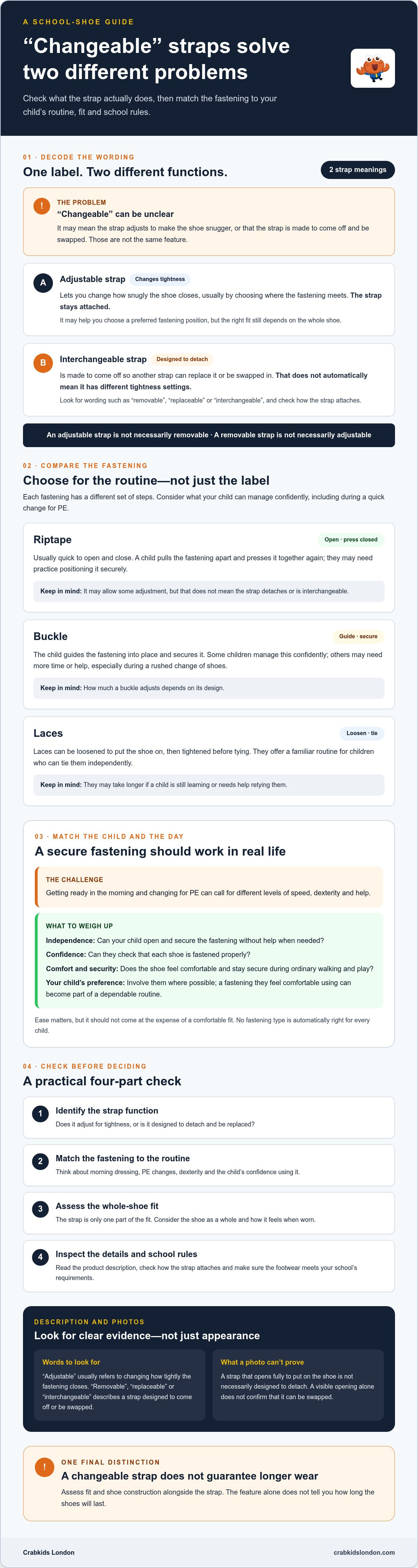
On school shoes, “changeable straps” can describe more than one function. The phrase may mean a strap that adjusts how snugly the shoe fastens, or one designed to detach so it can be replaced or swapped. These are different features, so look beyond the label to the product description and the shoe’s construction.
An adjustable strap changes how tightly a shoe fastens; an interchangeable strap is designed to detach so it can be replaced or swapped. A strap can be adjustable without being removable, and a removable strap won’t necessarily offer different tightness settings. If you’re searching for school shoes with changeable straps for a particular reason, first identify which function you need.
Adjustable straps versus interchangeable straps
An adjustable fastening lets you change how snugly the shoe closes, usually by choosing where the fastening meets. The strap remains attached to the shoe. This can help accommodate a child’s preferred fastening position, but the right fit still depends on the whole shoe.
An interchangeable strap is made to come off so another strap can take its place. Look for an explicit statement that straps are removable or replaceable, and check that the product explains how they attach. Images can help you understand the design, but a strap opening in a photo doesn’t, by itself, confirm that it can be swapped.
Common school-shoe fastening styles
Riptape, also known as hook-and-loop fastening, is familiar to many children and can make shoes easier to open and close independently. The fastening works by pressing two surfaces together; see this overview of hook-and-loop fasteners for more detail. Riptape may allow some adjustment, but that doesn’t mean the strap detaches or is interchangeable.
Buckles and laces involve different routines. A buckle needs to be fastened and released through its fitting, whilst laces need tying and loosening. Consider what your child can manage confidently on a busy morning. None of these styles is automatically right for every child, and the fastening type alone doesn’t tell you whether a strap is replaceable.
Once you’ve identified the fastening, assess the fit of the shoe as a whole. Crabkids London’s children’s shoe size guide can help you consider sizing alongside the strap. Check the product’s stated features, the visible attachment points and your school’s footwear requirements before deciding what “changeable” means for that pair.
Compare school-shoe strap styles for comfort, confidence and busy mornings
The best fastening is one your child can manage reliably and that holds the shoe securely. Think about the whole routine: getting dressed in the morning, fastening shoes after changing for PE and moving comfortably through the school day. Ease matters, but it shouldn’t come at the expense of a comfortable fit.
Riptape: Usually quick to open and close. A child can pull the fastening apart and press it together again, though they may need practice positioning it securely. The design may allow some adjustment, but that doesn’t mean the strap is removable or replaceable.
Buckle: The child needs to guide the fastening into place and secure it. Some children manage this confidently; others may need more time or help, particularly during a rushed change of shoes. How much a buckle adjusts depends on its design.
Laces: Can be loosened to put the shoe on and tightened before tying. This offers a familiar routine for children who can tie laces independently, but may take longer if they’re still learning or need help retying them.
Which fastening may suit your child’s routine?
For a child changing quickly for PE, a fastening they can open and secure without help may make transitions simpler. Another child may be happy with laces and prefer the familiar feel of tying them. Consider dexterity, confidence and whether your child can check that each shoe is fastened properly, not just how quickly they can do it.
Involve your child in the decision where possible. A fastening they’re comfortable using is more likely to become part of a dependable morning routine. Convenience is only one part of the choice, though: the shoe should feel comfortable and stay secure during ordinary walking and play.
What to check in product descriptions and photos
Read the wording closely. “Adjustable” usually describes changing how tightly the fastening closes; “removable”, “replaceable” or “interchangeable” indicates a strap designed to come off or be swapped. When looking for school shoes with changeable straps, choose a description that explains the strap’s function rather than relying on a broad label.
Photos can help you see how the fastening closes and where the strap sits across the foot. But a strap that opens fully to put on the shoe isn’t necessarily designed to detach from it. If the description doesn’t clearly explain removal or replacement, don’t infer that function from appearance alone.
Compare these details with your child’s routine and footwear requirements. For a practical next step, browse children’s school shoes and weigh up the fastening alongside comfort and fit.
How to choose school shoes with changeable straps: a practical checklist
A useful buying decision follows a simple order: identify what the strap does, match the fastening to your child’s routine, assess the fit, then inspect the shoe’s construction. This keeps a feature label in perspective. The best choice meets school requirements and feels comfortable and secure through an ordinary school day.
- Identify the strap function. Check whether it adjusts for tightness or is designed to detach and be replaced. Look for clear wording rather than assuming the terms mean the same thing.
- Consider the routine. Think about morning dressing, changes for PE and whether your child can open and fasten the shoe independently. Keep their preferred fastening in mind, too.
- Assess the fit. Check the shoe while your child is standing, with room for their toes to move comfortably. The fastening should hold the foot without pressing or gaping.
- Review the construction. Look over the fastening, its attachment to the shoe and the joins between the upper and sole. These details matter during regular school-day wear.
Match fastening choice to school-day needs
Consider how often your child will need to open and secure their shoes. If they change footwear for PE, let them practise the fastening at home. This can show whether they can manage it confidently without help. A child who handles riptape with ease may find another fastening slower; a sibling may feel differently. Choose for the child wearing the shoes, not just what worked for someone else in the family.
Check your school’s footwear requirements before settling on a style. A fastening that suits your child still needs to meet uniform rules. For school shoes with changeable straps, make sure the stated strap function is useful for your needs rather than treating “changeable” as a benefit in itself.
Check fit before deciding on strap features
Have your child stand in the shoes and check that their toes can move comfortably. Fasten each shoe as they would for school: the strap should sit securely without digging in, and the shoe shouldn’t feel loose or gape. Ask your child how the shoes feel, then watch them walk normally. They should feel comfortable and stay secure.
For at-home sizing support, use the children’s shoe size guide. A strap feature can’t make an unsuitable fit right, so assess sizing and comfort before comparing extras.
Will changeable straps make school shoes last longer?
Not by themselves. A strap designed to detach or be replaced may let you change that component, but it doesn’t guarantee the shoe will last longer. A replaceable strap is a feature of one component, whilst overall shoe durability depends on fit, construction, daily wear and care.
School shoes handle regular walking, play and repeated fastening. If a shoe is too tight, too loose or uncomfortable, it may not suit your child’s day, whatever type of strap it has. Construction matters too: inspect the fastening and where it joins the shoe, as well as the upper and sole. A changeable feature can’t compensate for wear elsewhere.
Signs a school-shoe strap needs attention
Check the fastening periodically, especially if it starts taking more effort to close. Look for loose stitching, frayed or damaged edges, and a fastening that no longer holds securely. Notice whether the strap repeatedly comes undone during ordinary movement. These signs can affect comfort and how securely the shoe stays on the foot.
If damage makes the shoe insecure or uncomfortable, stop using it until the issue is addressed. Don’t assume a strap can be replaced just because it appears to open fully; check that the shoe is specifically designed for removal or replacement.
- Stitching: Look for loose threads or separation around the strap attachment.
- Fastening: Check that it closes and stays secured as intended.
- Visible wear: Notice damaged edges or any deterioration affecting comfort or security.
Care habits that support everyday wear
After damp weather, let shoes dry naturally before wearing them again. Remove surface dirt regularly, and follow care advice suited to the shoe’s material rather than using the same product on every finish. For leather footwear, use care products intended for leather, such as leather shoe cleaning lotion.
These habits help keep shoes ready for daily use, but they can’t prevent all wear. Check the fit and fastening as your child wears the shoes, and pay attention to changes in comfort or security. If you’re choosing a new pair, browse children’s school shoes and consider the whole shoe, not just whether its strap is changeable.
Choose school shoes with changeable straps with confidence
By now, you’ve seen why the word “changeable” needs a closer look. Use this final checklist to compare features with your child’s needs, rather than letting one label make the decision. The priority is a secure, comfortable fit that works through the school day.
A quick shortlist before you buy
- Clarify the strap function. Does it adjust for tightness, or is it described as detachable, replaceable or interchangeable? Look for wording that makes the distinction clear.
- Match it to your child’s routine. Consider whether your child can fasten and release the shoe comfortably, including during a quick change for PE.
- Check fit and size. Revisit sizing guidance, then check that the shoe feels comfortable when your child is standing and walking. The fastening should hold the shoe securely without pressing or gaping.
- Inspect the construction. Look at how the fastening is attached and check for signs of weak stitching or poor alignment. A replaceable strap doesn’t guarantee that the rest of the shoe will last longer.
- Keep school rules in mind. Make sure the footwear meets your school’s requirements, as well as your child’s preferences.
Use the checklist to compare school shoes with changeable straps against other suitable options. If a product description doesn’t explain what “changeable” means, don’t assume the strap can be removed. If a feature sounds useful but the shoe doesn’t fit comfortably, the feature shouldn’t outweigh the fit.
Browse school footwear with the right criteria in mind
As you browse, weigh up each shoe’s stated details against your shortlist: fastening routine, fit, construction and school suitability. Crabkids designs and sells children’s school shoes for comfort and active school life. Explore boys’ school shoes or girls’ school shoes, then assess the details that matter for your child. Judge strap features from each shoe’s own description rather than assuming they are the same across a category.
A final check can make the choice clearer: understand the strap, match it to the routine, check the fit and inspect the construction. Choose the pair that feels secure and comfortable, not simply the one with the most appealing feature label. When you’re ready to browse, explore Crabkids London.
Make your next school-shoe choice with confidence
The term “changeable” can mean an adjustable fastening or a strap designed to detach and be replaced, so check the product details rather than relying on the label. Compare riptape, buckles and laces against your child’s routine and confidence with fastening shoes. Above all, prioritise a comfortable, secure fit and sound construction: a replaceable strap alone won’t make a shoe last longer.
Use these checks to narrow down school shoes with changeable straps and other everyday options. Crabkids London designs and sells boys’ and girls’ school shoes for comfort and active school life, with online sales across the United Kingdom.
Explore Crabkids London and browse school footwear with your child’s routine, fit and comfort in mind. A clear checklist makes the decision simpler, so you can choose a pair that feels right for the school day ahead.
Frequently Asked Questions
What does ‘changeable strap’ mean on a school shoe?
“Changeable strap” can describe a strap that adjusts for tightness or one designed to detach and be replaced. These functions aren’t the same, so read the shoe’s description rather than relying on the label. For school shoes with changeable straps, look for clear wording about whether the strap adjusts, comes off or can be swapped. Photos may show how it fastens, but appearance alone doesn’t confirm that it’s removable.
Are adjustable straps the same as interchangeable straps?
No. An adjustable strap changes how snugly the shoe fastens but usually remains attached to the shoe. An interchangeable strap is designed to detach so it can be swapped for another. A shoe may have one function without the other. Check the product description for explicit terms such as “adjustable”, “removable” or “replaceable”, and don’t assume that a strap that opens fully is interchangeable.
Can you replace the straps on children’s school shoes?
Only if the shoe is designed for the strap to be removed or replaced. Many fastenings open to let a child put the shoe on, but that doesn’t mean the strap detaches from the shoe. Look for clear product wording about replacement and check how the strap attaches. If replacement isn’t specified, don’t assume a new strap will fit or secure the shoe properly.
Are school shoes with straps easy for children to fasten themselves?
They can be, depending on the fastening and the child’s dexterity and confidence. Riptape is often straightforward to open and press closed, while buckles require accurate fastening and laces need tying. Give your child a chance to practise opening and securing the shoes, including after a change for PE. The fastening should be manageable, but it must also hold the shoe securely and feel comfortable.
How should school shoes with straps fit?
School shoes should feel comfortable and stay secure during ordinary walking. Check the fit with your child standing, and make sure their toes can move comfortably. Fasten the strap as your child would for school: it should hold the foot without pressing, and the shoe shouldn’t gape or slip around. If the shoes feel uncomfortable or insecure, the strap feature doesn’t make the fit suitable.
Do changeable straps make school shoes last longer?
No, a changeable strap alone doesn’t guarantee a longer-lasting shoe. Overall wear also depends on fit, construction, how the shoes are used and how they’re cared for. A strap designed to be replaced may let you change that component, but it can’t prevent wear to the sole, upper or other parts. Look at the condition of the whole shoe, not just the fastening.
How can I tell when a school-shoe strap needs replacing?
Look for loose stitching, frayed or damaged edges, or a fastening that no longer stays closed. If the strap repeatedly comes undone or has become difficult to secure, check whether the shoe is still holding the foot safely. Replacement is appropriate only if the shoe is designed for it. Stop using the shoes if damage makes them insecure or uncomfortable.