

School Shoes for Growing Feet: Supporting Healthy Development in 2026
Did you know that podiatrists recommend checking a child's shoe fit every 8 to 12 weeks during their primary school years? It's a relentless cycle for parents, balancing the need for quality with the reality of constant growth spurts. You want to ensure your child's long-term foot health without the frustration of buying new pairs every few months or worrying about permanent damage from a poor fit. Finding the right school shoes for growing feet shouldn't be a guessing game.
We're here to help you choose footwear that protects developing bones whilst providing the resilience needed for energetic playground behaviour. You'll learn how to identify the correct amount of growth room and when it's exactly the right time to move up a size. We will explore the benefits of high-quality leather for natural movement and provide a clear strategy for monitoring fit throughout the academic year using our professional sizing tools.
Key Takeaways
- Understand why soft cartilage in young feet requires flexible, non-restrictive footwear to avoid permanent bone misalignment.
- Apply the 1cm to 1.5cm growth room rule to ensure your child’s shoes provide lasting value without sacrificing foot health.
- Discover the benefits of high-quality leather that moulds to a child’s unique foot shape whilst maintaining structural integrity.
- Spot the subtle physical and behavioural indicators that signify it is time to upgrade your school shoes for growing feet.
- Select the most appropriate fastening systems to ensure maximum stability and support during high-energy playground behaviour.
Understanding the Impact of School Shoes on Growing Feet
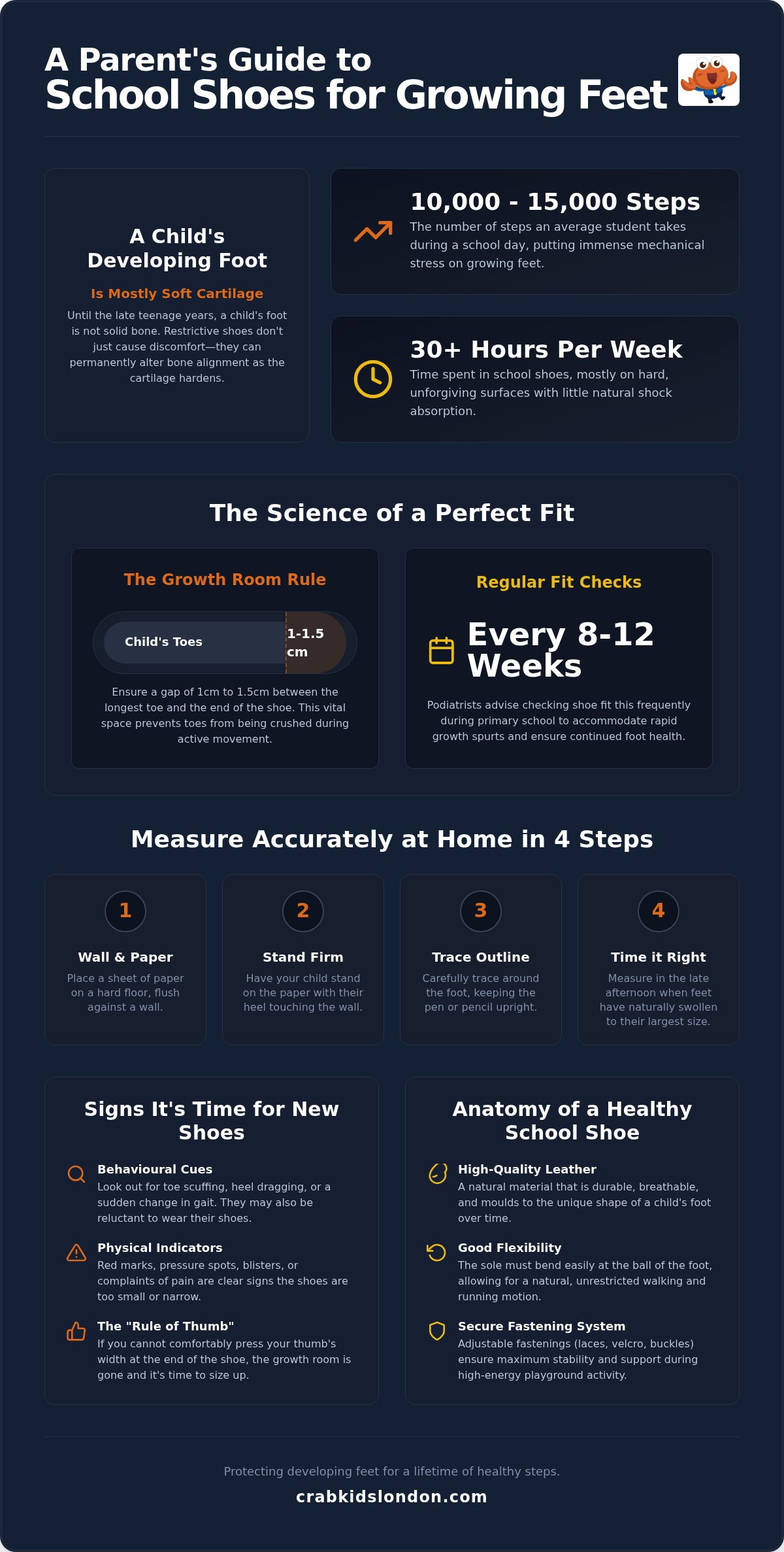
Children's feet are remarkably resilient, but they are also incredibly vulnerable. Until the late teenage years, a child's foot is not a solid structure of bone. Instead, it consists largely of soft, pliable cartilage. This means that school shoes for growing feet act as a physical mould. If a shoe is too narrow or restrictive, it doesn't just cause temporary discomfort; it can permanently alter bone alignment as that cartilage ossifies into bone. Healthy development depends entirely on the foot's ability to splay and flex naturally without external pressure.
The mechanical stress placed on these developing structures is immense. The average student takes between 10,000 and 15,000 steps during a single school day. Every one of those steps involves the foot expanding under weight and flexing at the toe joints. If the footwear is too rigid or poorly sized, it restricts this natural movement, leading to long-term issues with posture and gait.
Cartilage to Bone: The Biological Growth Timeline
The process of ossification is a gradual biological journey. At birth, many bones in the foot are simply gaps of cartilage that slowly fill with calcium and harden over nearly two decades. A crucial milestone occurs around age six or seven, which is when the foot's arch typically begins to form. Before this stage, a child's foot often appears flat because of a functional fat pad. Footwear must adapt to these changing requirements, providing enough space for the toes to spread whilst offering the structural integrity needed as the arch develops. A firm grasp of understanding shoe sizing systems is the first step in protecting this delicate timeline.
Why School Shoes Matter More Than Weekend Trainers
Parents often prioritise high-performance trainers for weekend sports, yet children spend upwards of 30 hours a week in their school shoes. Most of this time is spent on unforgiving, rigid surfaces like concrete playgrounds and hard corridor floors. Unlike softer grass or carpeted home environments, these surfaces provide zero shock absorption. The shoe must do all the heavy lifting.
If a child starts scuffing their toes or dragging their heels, it is rarely just "clumsy" behaviour. Often, it's a sign that the shoe is too heavy, too loose, or has become too small. Monitoring these physical cues is essential. You can use a dedicated shoe size guide to check for growth regularly, ensuring that the footwear continues to support natural movement rather than hindering it. When shoes fit correctly, they become an extension of the foot, allowing for active play without the risk of deformity or pain.
The Science of Sizing: Measuring for Development and Longevity
Finding the right fit for school shoes growing feet requires a methodical approach. It is not enough to simply ask a child if a shoe feels comfortable. Young children often have a high pain threshold for ill-fitting footwear because their nerves and bones are still developing. Instead, you must look for "growth room." This is the essential gap of 1cm to 1.5cm between the tip of the longest toe and the front of the shoe. This space allows the foot to slide forward as it flexes during running and jumping, preventing the toes from being crushed against the internal toe box.
Length is only half the battle. Measuring width is non-negotiable. A shoe that is too narrow restricts the natural splay of the toes, whilst a shoe that is too wide allows the foot to slide around, leading to friction blisters and instability. Use the "Rule of Thumb" as your first line of defence. When your child is standing, press your thumb firmly at the end of the shoe. If you cannot feel that thumb-width of space, the shoe is already too small. To maintain a consistent record of these changes, use a professional shoe size guide to check measurements at least every six months.
How to Measure Growing Feet at Home
You don't need specialist equipment to get an accurate measurement. Place a piece of paper against a wall and have your child stand on it with their heels touching the wall. Trace around the foot with a pencil, keeping it vertical. It's critical to do this whilst they are standing, as the foot expands significantly under body weight. Always measure in the late afternoon. Feet naturally swell throughout the day; measuring at 4 pm ensures the shoes will remain comfortable even during the final school bell. Ensuring a precise fit does more than protect health. It ensures the material doesn't wear unevenly, directly impacting the longevity of the footwear.
Junior vs Senior Sizing: Navigating the Transition
The UK sizing system can be confusing, particularly the jump between "Infant" and "Junior" sizes. Most children transition into junior sizing during their early primary years, but the timing varies for every individual. Once a child moves into adult sizing, the shoes often feature more robust internal support to handle increased body weight and higher activity levels. Don't overlook the impact of hosiery. Always pair new shoes with high-quality school socks. Socks that are too small or overly thick can cramp the toes just as much as the shoes themselves, undoing the benefits of a well-fitted shoe. For parents preparing for the next term, browsing our new arrivals is a practical way to see how modern designs incorporate this necessary growth room without compromising on style.
Material Matters: Balancing Flexibility with Playground Protection
Selecting the right material is a critical decision for school shoes growing feet. Whilst some modern synthetics offer lower price points, they often lack the structural integrity and adaptive qualities required for daily wear. High-quality leather remains the gold standard for school footwear. It offers a unique combination of durability and pliability. Unlike rigid plastics, leather possesses a natural ability to "mould" to the unique contours of a child's foot over several weeks. This bespoke fit reduces pressure points and accommodates the subtle changes in foot shape that occur during rapid growth phases.
The construction of the sole is equally vital. A common mistake is choosing a shoe that is either too stiff or too flimsy. For healthy development, a shoe must pass the "bend test." The sole should flex easily at the ball of the foot, where the toes naturally hinge, whilst remaining stable and supportive through the arch. This allows for a natural gait and prevents the muscles in the foot from overworking. For those with broader requirements, school shoes for wide feet children utilise specific upper patterns that provide this flexibility without squeezing the metatarsals.
Breathability and the Growth Environment
Children's feet have more sweat glands per square centimetre than adult feet. In a synthetic shoe, heat and moisture become trapped, creating a damp environment that leads to skin irritation and fungal infections. Leather is naturally porous, allowing air to circulate and moisture to escape. This maintains a healthy "micro-climate" inside the shoe. By keeping the foot dry, breathable materials also prevent the foot from sliding within the shoe. This stability is essential for preventing friction blisters and ensuring that school shoes growing feet stay securely in place during high-energy playground behaviour.
Outsole Technology: Grip Without Rigidity
The ideal school shoe outsole provides a middle ground between barefoot flexibility and heavy-duty protection. Lightweight rubber outsoles offer superior traction on wet tarmac and slippery hall floors without adding unnecessary weight. We recommend looking for a "zero-drop" or very low heel profile. This design ensures the heel and the ball of the foot are on the same level, promoting a natural posture and preventing the shortening of the Achilles tendon. To ensure these shoes last the full academic year, look for styles with reinforced toe bumpers. These scuff-resistant features protect the leather during crawling or football games, maintaining the shoe's appearance whilst the internal structure continues to support foot health.
Monitoring Growth: Signs Your Child Has Outgrown Their Shoes
Waiting for a child to complain about tight footwear is a common parental mistake. Because their feet are largely composed of flexible cartilage, children often don't feel the gradual compression of a shoe that has become too small. Their feet simply adapt to the restricted space. This makes it your responsibility to spot the subtle cues of school shoes growing feet before they lead to permanent damage. Beyond physical discomfort, look for behavioural changes. A child who suddenly becomes "clumsy," trips frequently, or unexpectedly refuses to join in playground games may be subconsciously protecting sore feet. These "hidden" signs are often the first indicators that the current pair has reached its limit.
The Physical Checklist: Toes, Heels, and Arches
Perform a weekly physical inspection of your child’s feet. Look for tell-tale marks of friction or pressure. Redness on the pinky toe or the top of the toe joints suggests the toe box is now too narrow or shallow. "Hammering" of the big toe, where it begins to curl downwards to find space, is a serious sign of an immediate need for a larger size. Don't just look at the length; check the sides of the shoe. If the leather is bulging over the edge of the sole, your child likely needs a wider fit to accommodate their developing foot splay. Finally, inspect the heel. Excessive wear on the inner lining or a heel that slips out during walking indicates the shoe's structure is no longer aligned with the foot's proportions.
The 'Wear Pattern' Test
The soles of the shoes tell a story of growth and gait. Flip the shoes over and examine the tread. Uneven wear, such as heavy erosion on the inner or outer edges, can signal a recent growth spurt that has shifted your child's centre of gravity. It's also vital to remember that a shoe that is too large can be just as damaging as one that is too small. Excess room causes the foot to slide, leading to instability and clawing of the toes to maintain grip. If the shoe has a removable insole, take it out and look for the "footprint" left behind. If the toe marks are touching the very edge, the growth room is gone. For a comprehensive review of these indicators, consult our 5 signs kids need new school shoes checklist. If you identify any of these issues, it's time to browse our latest boys' and girls' school shoes to ensure continued healthy development.
Selecting the Ideal Pair for Healthy Foot Development
At Crabkids London, we understand that school shoes growing feet require more than just a smart appearance. Our design philosophy combines expert fit with the structural integrity of high-grade leather. Stability is a non-negotiable requirement for active children. We prioritise secure, adjustable fastenings to ensure the foot remains correctly positioned over the sole. For junior pupils, velcro straps provide a reliable, customisable fit that encourages independence. For senior students, laces offer the precise tension needed for more strenuous activity, ensuring the shoe supports the foot without restricting circulation.
Maintaining the material's integrity is just as important as the initial fit. Over time, leather can become stiff if neglected. Applying a leather cleaning lotion helps to preserve the natural oils within the hide. This keeps the upper supple, allowing it to continue moulding to the foot's shape as it grows. Regular care ensures the footwear remains a comfortable, protective environment rather than a restrictive one.
Why Quality Leather is a Sustainable Choice
Investing in durable leather is a strategic decision for both foot health and your budget. Whilst "fast fashion" alternatives might seem cost-effective, they often lack the resilience to withstand the 15,000 steps a child takes daily. One pair of well-constructed school shoes growing feet can provide better support and longevity than two pairs of cheap, synthetic shoes. This craftsmanship also ensures the shoes maintain their shape, providing consistent support until the next growth spurt. Whilst our shoes are built to last, remember that sharing used footwear is not recommended. Every child's unique walking pattern shapes the insole; wearing "pre-moulded" shoes can interfere with natural development.
Preparing for the Next Term with Confidence
Getting the timing right is essential for a stress-free start to the academic year. We recommend measuring and purchasing in late August. This ensures you account for summer growth spurts whilst avoiding the last-minute rush. If you find your child has outgrown their current pair unexpectedly, our fast delivery service ensures they won't be without support for long. Explore our latest range of boys' school shoes and girls' school shoes to find the perfect balance of resilience and style. Ensure your child starts the term on the right foot with Crabkids London.
Equipping Your Child for a Healthy Academic Year
Choosing the right school shoes growing feet require is a long-term investment in your child's physical health and comfort. By prioritising high-quality leather and maintaining that essential 1cm of growth room, you ensure their feet develop naturally without restriction or pain. It's vital to perform regular fit checks every term. Children's feet change rapidly, and their bones need the space to splay and flex during those 15,000 daily steps on hard school floors.
Our collection is designed to handle the high-energy reality of the playground whilst meeting formal uniform requirements. We provide durable leather built for playground behaviour, supported by a free UK shoe size guide for parents to use at home. With fast national delivery across the UK, we ensure your child is always wearing the correct size, no matter how quickly they grow. Start the new term with the confidence that their development is protected.
Shop the 2026 School Shoe Collection at Crabkids London
Frequently Asked Questions
How often should I check my child's school shoe size?
You should check your child's shoe fit every 8 to 12 weeks during the primary school years. This frequency accounts for the rapid growth spurts common in younger children. For secondary school students, a check every six months is usually sufficient. Regular monitoring ensures you catch the moment growth room disappears before it causes discomfort or restricts natural development.
Is it okay to buy school shoes a size bigger to make them last longer?
Buying shoes that are a full size too large is not recommended as it compromises foot stability. Excess room causes the foot to slide forward, which can lead to friction blisters and "clawing" of the toes as the child tries to grip the shoe. It also increases the risk of tripping during playground activity. Stick to the recommended 1cm of growth room for the best balance of longevity and safety.
Why does my child keep scuffing the toes of their shoes?
Persistent scuffing often indicates that the shoes have become too small or are too heavy for the child's gait. When a shoe lacks sufficient growth room, the child cannot flex their foot properly, causing them to drag their toes. It can also happen if the sole is too rigid. If scuffing starts suddenly, it's a clear signal to re-measure their feet immediately using a professional guide.
Can poor school shoes cause permanent foot problems?
Yes, ill-fitting footwear can lead to permanent bone misalignment because a child's foot is mostly soft cartilage until their late teens. Restrictive school shoes growing feet are forced into can cause issues like bunions, ingrown toenails, and hammer toes. Since children often don't feel the pain of a tight fit, these structural changes can happen gradually without the parent or child noticing until the damage is done.
Should I choose leather or synthetic materials for growing feet?
High-quality leather is the superior choice for developing feet. Unlike synthetic materials, leather is breathable and naturally pliable, allowing it to mould to the unique shape of your child's foot. This flexibility is essential for accommodating growth whilst maintaining a healthy internal environment. Synthetics often trap heat and moisture, which can lead to skin irritation and a less comfortable fit over a long school day.
How much room should there be at the end of a school shoe?
There should ideally be between 1cm and 1.5cm of space between the longest toe and the end of the shoe. This "growth room" allows the foot to expand and slide forward naturally during movement. It ensures that school shoes growing feet occupy don't become restrictive within just a few weeks of purchase. Anything less than 1cm indicates that it is time to shop for the next size up.
What are the best school shoes for children with very wide feet?
The best options for wide feet are leather styles specifically designed with a broader toe box and adjustable fastenings. Look for shoes that offer different width fittings rather than just larger sizes. Velcro straps or laces are essential as they allow you to customise the tension across the instep. This prevents the metatarsals from being squeezed whilst ensuring the heel remains secure and supported during active play.
Can I use hand-me-down school shoes for my younger child?
We generally advise against using second-hand school shoes. Even if the soles look unworn, the internal footbed will have already moulded to the shape and walking pattern of the previous owner. Forcing a different foot into this pre-set shape can interfere with natural development and lead to poor posture. It's always safer to provide each child with a new pair that can adapt to their specific foot contours.