

School Shoe Rules for September 2026: A Parent’s Checklist
You’ve found a smart-looking pair of black shoes, only to discover they may count as trainers under your school’s policy. Checking the school shoe rules for September before you buy can help you avoid that last-minute surprise. Each school sets its own footwear requirements, so a pair that looks suitably smart may not meet the written rules.
It’s understandable to focus on colour, comfort and durability when shopping. But checking the policy first can save you from buying shoes your child can’t wear at school. Once you know what’s allowed, you can compare suitable pairs for fit and everyday use.
This checklist shows you where to find the footwear policy, which details to check and what to do if the wording is unclear. It also offers practical ways to balance school requirements with fit and daily wear, so you can shop with fewer surprises and more confidence.
Key Takeaways
- Use the school’s current written policy to guide your search. Common expectations may not match your child’s requirements.
- Check what terms such as “smart” or “plain” mean in practice, and ask the school if the wording leaves room for doubt.
- Compare each option with the policy first, then consider comfort, fit and suitability for an active school day.
- Follow a pre-term checklist to choose, check the fit and inspect the shoes while there’s time to resolve questions.
- Explore Crabkids London’s children’s school shoes as one option, then confirm that your preferred pair meets the school’s rules.
School shoe rules for September: what should parents check first?
Start with your child’s school, not the shoe shop. The current written uniform policy is the clearest guide to which footwear will be accepted. General advice often recommends plain, dark shoes, but that doesn’t tell you whether a particular style meets your school’s requirements. Uniforms have a wider history and purpose, as outlined in this overview of the history of school uniforms, but the school’s own wording is what matters when you buy.
The school’s rules tell you what your child may wear; general shopping advice can only help you compare suitable options. Keeping that distinction in mind can prevent you from choosing a pair based on assumptions and later finding it doesn’t meet the policy.
Where to find the school’s footwear requirements
Check the current uniform policy, then compare it with the parent handbook and school website. Look for messages or updates sent ahead of the September term, as requirements may have changed since your last shoe purchase. If documents conflict, or a phrase such as “appropriate footwear” is unclear, contact the school office before shopping. You can ask which document is current and how the rule applies to the style you’re considering.
Which details should the September checklist include?
Write down the exact requirements rather than relying on memory. Check the policy for details such as:
- Colour: Is a specific colour required, or are alternatives allowed?
- Style: Does the school describe the footwear as a shoe, or rule out particular styles?
- Fastenings: Are laces, straps or other fastenings mentioned?
- Restrictions: Does the policy refer to logos, heels, open toes or trainers?
These are prompts to check against your school’s wording, not rules that apply across the UK. If a restriction isn’t explained clearly, ask what it means before deciding that a shoe is allowed or unsuitable. Once you’ve confirmed the permitted style, you can consider comfort and fit. Crabkids London’s children’s shoe size guide can help with that next step, but it doesn’t replace the school’s policy.
Keep your notes handy while comparing shoes. A short list of permitted colours, styles, fastenings and restrictions gives you a practical way to assess each pair before spending time or money on a choice the school may not accept.
How school shoe rules differ between schools and what wording means
A school shoe rule is a footwear requirement set by your child’s own school. It might specify a colour or fastening, or rule out certain styles. Policies vary, so don’t assume that a shoe accepted at another school will be allowed at yours. Check the wording in your child’s current policy.
Read each instruction closely. Words such as “must” or “must not” usually signal a requirement or restriction. An example photograph can help show the intended look, but may not cover every acceptable option. General advice in a handbook may also differ from a specific footwear rule. If it isn’t clear which instruction applies, ask the school rather than relying on a guess.
How to interpret colour, style and fastening instructions
Compare the exact wording with the shoe you’re considering. If the policy names a colour, check the shoe’s stated colour. If it specifies a fastening, look for that detail in the product description or photographs. Terms such as “smart”, “suitable” or “traditional” can be open to interpretation, so don’t treat your own understanding of them as approval. Send the school a product description or image and ask whether that specific option meets its requirements.
Are trainers, logos or decorative details allowed?
That depends on the individual school’s written policy. Check whether it mentions trainers, sports-style designs, visible branding, decorative details or particular sole designs. A shoe that looks plain to you may still be considered unsuitable under your school’s interpretation. If the distinction isn’t clear, confirm before buying.
If a footwear rule is unclear, ask the school how it applies to the exact shoe you’re considering before you buy. A specific question is easier to answer than a general one. For example, ask, “Does this style meet the policy?” and include a link or image. Keep the reply with your notes so you can refer to it later.
Once the policy is clear, assess comfort separately. The Royal College of Podiatry’s podiatrists’ school shoe advice offers a useful reference when considering children’s footwear. Policy approval and a comfortable fit are separate checks, and both matter for a full day of school activities.
With the requirements confirmed, you can compare suitable options without relying on guesswork. If you’re ready to browse, explore children’s school shoes from Crabkids London, then check each pair against your school’s policy.
Compare school shoe options against the policy, comfort and everyday use
Once you’ve confirmed the school’s requirements, use them as your first filter. Compare options that appear to meet the stated rules, then consider fit, fastening and the activities your child does on a typical school day. This order makes the school shoe rules for September easier to apply without losing sight of practical wear.
Does the shoe meet the school’s stated requirements?
Check each visible detail against the policy, including colour, shape, sole, fastening and decorative features. Product photographs can help you assess appearance, whilst descriptions may clarify details that aren’t obvious in an image. If a feature seems borderline, ask the school before ordering instead of assuming it will be accepted.
This comparison table turns the written policy into a practical shopping check:
| Policy requirement | Shoe detail to check | Question to ask |
|---|---|---|
| Specified colour | Colour shown in the product description and photographs | Does this exact colour meet the policy? |
| Permitted style | Overall shape and whether the design looks like the style described | Is this style allowed for everyday school wear? |
| Fastening requirement | Laces, straps or another fastening shown or listed | Does the school require or exclude a particular fastening? |
| Restrictions on details | Sole, logo, trim or other decorative features | Could any of these details conflict with the policy? |
Will the shoes work for a full school day?
After checking the policy, consider how the shoes feel and function during lessons, break times and the journey to and from school. The fastening should feel secure and be manageable for your child. Check the shoes on your child’s feet rather than choosing by appearance alone. A suitable fit matters for everyday movement, but no material or style can guarantee comfort or long wear for every child.
For a practical fit check, use the children’s shoe size guide and follow its guidance. Also consider your child’s typical activities. A day involving plenty of walking and active play may put different demands on shoes than a mostly classroom-based day. Check the fit again as your child grows, and look for signs that the fit or condition has changed.
Crabkids London’s children’s school shoes are positioned for comfort, durability and active school life. These are useful qualities to consider after confirming that a particular option meets your school’s written requirements.
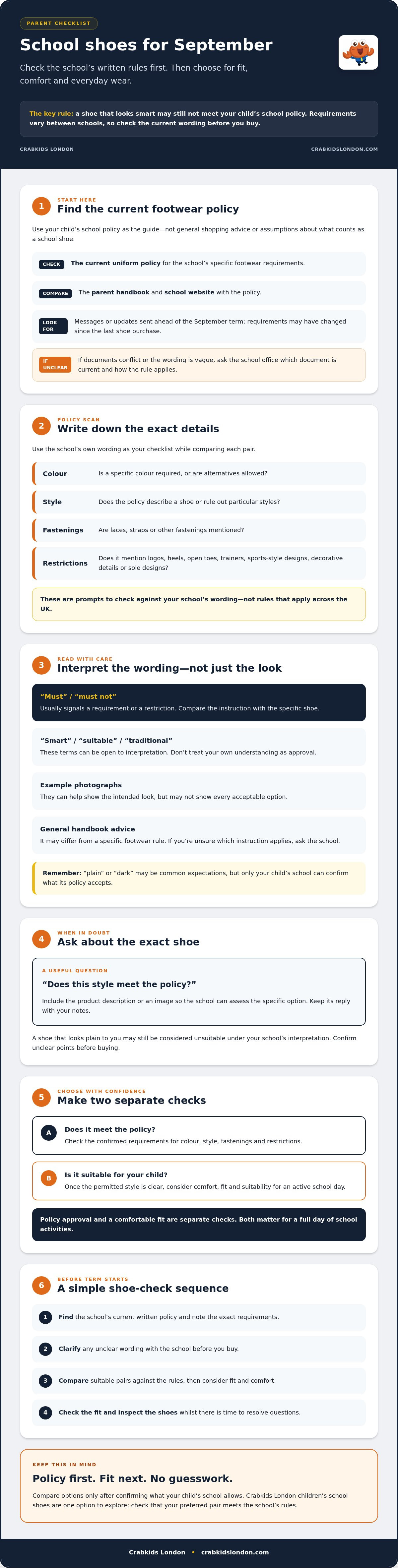
September school shoe checklist: before the first day
Preparing early gives you time to resolve a policy question or consider another pair before term starts. Work through these steps in order, keeping the school’s instructions nearby as you check your options.
- Find the current policy. Use the school’s latest uniform information, not just last year’s notes.
- Confirm the details. Check colour, style, fastenings and any restrictions. Ask the school about wording that could be interpreted in more than one way.
- Choose a compliant option. Compare shoes with the confirmed requirements before weighing up comfort and everyday use.
- Check the fit. Have your child try the shoes on with their usual school socks and fasten them as they would for school.
- Inspect the pair. Check both shoes for damage and make sure they’re ready for regular wear.
Allow time for the school to answer questions and, if needed, for you to consider another option. September can feel close once the holidays are under way, so try not to leave the policy check until the final days.
What to check when the shoes arrive
Compare the delivered pair with the order details and the school policy. Check both shoes for the required colour, shape, sole and fastening. With your child wearing their usual school socks, make sure the shoes feel comfortable and stay secure as they walk. Look for visible damage or anything that could affect everyday wear. If something seems wrong, pause before the first day and check your options with the retailer.
What if the school says the shoes do not comply?
Ask which specific policy requirement the pair doesn’t meet. Then check whether another style would be suitable, or whether the school can agree to a temporary arrangement while you find an alternative. Keep the school’s reply with the relevant policy wording. That gives you a clear reference when comparing another pair with the school shoe rules for September.
Once the shoes are approved and fit well, a simple care routine can help keep them presentable through regular wear. See Crabkids London’s leather shoe-cleaning lotion as one shoe-care option, and follow the product instructions. For September footwear, explore children’s school shoes from Crabkids London after checking your school’s requirements.
Choose school shoes for September with confidence
A confident choice follows a clear order: confirm the current policy, compare shoe details, check the fit and prepare early. This helps you avoid relying on last year’s assumptions or choosing a pair before you know what the school will accept.
A final policy-first check before buying
Revisit the latest uniform information before placing an order. Check each requirement against the specific pair you’re considering, including colour, style and fastening. If the wording is uncertain, ask the school to confirm rather than guessing. Make your choice once the policy is clear and you’ve considered your child’s needs. School shoe rules for September are school-specific, so a pair that looks suitable isn’t automatically compliant.
Once you’ve confirmed what’s permitted, weigh up fit and practical wear. A child may walk, run and play in their shoes throughout the day, so comfort and durability are useful considerations alongside appearance. Neither replaces the policy check, and neither can guarantee that a particular pair will suit every child.
Prepare footwear for the first week
Before the first school day, have your child try the shoes on with their usual school socks. Check that the fit feels comfortable and the fastening stays secure when they walk. Inspect both shoes for damage or visible faults, and make time for basic cleaning or care suited to the footwear. Keep the order information and the school’s policy details together in case you need to check a feature or ask a question.
Preparing ahead also leaves room to act if the fit isn’t right or the school raises a concern. Contact the school to clarify any policy point, then use its answer to guide your next step. This gives you time to address a problem before it becomes a first-day scramble.
Crabkids London offers children’s school shoes positioned around comfort, durability and active school life. They’re an option to explore, not a guarantee that any particular pair meets your school’s rules. Check the product details against the policy, then consider how the shoes will feel through a full day.
With the requirements confirmed and the fit checked, you’re ready to make a considered choice. Browse the children’s school shoe range as one place to explore options for September.
Get ready for a smoother September start
The safest school-shoe choice starts with the school’s current written policy, not assumptions about what other schools accept. Check the wording, confirm anything unclear, then compare suitable shoes for fit, fastening and the demands of an active school day. A final check at home gives you time to address a sizing or condition issue before term begins.
Keep the school shoe rules for September close while you shop. Crabkids London offers children’s school shoes described as durable and comfortable, designed with active school life in mind. Those qualities are worth considering alongside the policy, but no product can guarantee that a particular pair meets your school’s requirements. Check the details before choosing.
Explore children’s school shoes for September and compare the options with your school’s stated rules. With a clear policy, a careful fit check and some preparation, you can approach the first day with greater confidence.
Frequently Asked Questions
Do all UK schools have the same school shoe rules?
No. Schools set their own footwear requirements, so there isn’t one style that’s guaranteed to be accepted everywhere. One school may specify colour or fastening, whilst another may describe permitted footwear differently. Check your child’s current uniform policy rather than relying on advice from another parent or a different school. If you’re unsure how a requirement applies to a particular pair, ask the school before buying.
Can children wear trainers to school in September?
That depends on the school’s written policy. Some policies may allow certain trainer styles, whilst others may rule them out, including styles that look like smart shoes. Check for references to trainers, sports-style designs or permitted footwear. Don’t assume that a plain or dark colour makes a trainer acceptable. If the policy doesn’t give a clear answer, ask the school about the specific pair you’re considering.
What colour should school shoes be?
Choose a colour that matches your child’s school policy. Some schools specify a colour, whilst others may use broader wording or provide examples. Don’t assume that black is required simply because it’s a common choice, or that another colour will be accepted without checking. Read the written rule and any current guidance from the school. If the wording is unclear, confirm which colours are permitted before shopping.
Are black trainers allowed as school shoes?
Not necessarily. A black colour doesn’t automatically make a trainer compliant, as the school may have separate rules about style, soles, branding or sportswear. Check whether its policy permits trainers or describes a particular type of shoe. Product photographs can help you assess a pair, but they can’t confirm how the school interprets its rules. If in doubt, send the school the product details and ask before ordering.
How can I find my child’s school shoe policy?
Start with the school’s current uniform policy on its website, then check the parent handbook and any updates sent before the September term. Read the footwear section carefully and note any requirements about colour, style, fastenings or decorative details. If information differs between documents, contact the school office to check which guidance is current. Keep the policy handy while comparing shoes so you can refer to the exact wording.
What should I do if the school shoe rules are unclear?
Ask the school to explain the specific phrase or requirement you’re unsure about. Include a product description or image of the shoes you’re considering, and ask whether that particular pair meets the policy. This is more useful than relying on a general guess about terms such as “smart” or “suitable”. Keep the response with the policy wording, especially if you need to compare another style or follow up later.
When should I buy school shoes for September?
Buying in July or August gives you time to check the policy, try the shoes and ask questions before term begins. Buying too early may mean your child’s feet grow before September, whilst leaving it until the final weeks of the holidays can mean longer queues or fewer options. Once you’ve confirmed the rules, allow time to check fit and condition at home, and consider another option if needed.