

Is It Worth Investing in Expensive School Shoes? A UK Parent's Guide
The cheapest pair of school shoes often turns out to be the most expensive mistake in your family budget. When your child spends upwards of thirty hours each week running across rough tarmac, asking is it worth investing in expensive school shoes is a sensible, practical dilemma. Are you paying for genuine engineering and resilience, or simply funding a high-street brand label?
You likely know the familiar irritation of watching budget soles detach and toes scuff through before the October half-term, prompting chaotic replacement shopping trips while your child battles damp socks and blisters. Quality footwear should act as durable developmental equipment, not disposable uniform compliance. In this guide, you will discover whether well-crafted footwear genuinely shields growing feet, endures playground punishment, and reduces long-term spending. We break down the real cost-per-wear differences over the mandatory 190-day school year, examine how structural support protects developing arches, and provide a clear checklist to identify robust construction before you buy.
Key Takeaways
- Measure true footwear value through cost-per-wear across the entire school year rather than focusing solely on upfront register costs.
- Protect developing feet by choosing structured heel counters that stabilise malleable cartilage and promote healthy alignment during active play.
- Understand why asking is it worth investing in expensive school shoes comes down to comparing breathable full-grain leather against fragile synthetic options.
- Use a four-step physical inspection test to verify sole flexibility, torsional rigidity, and stitch quality before making a purchase.
- Maximise product lifespan and maintain water resistance through a simple five-minute weekly routine using dedicated shoe care.
The Economics of School Shoes: Calculating Real Cost-Per-Wear
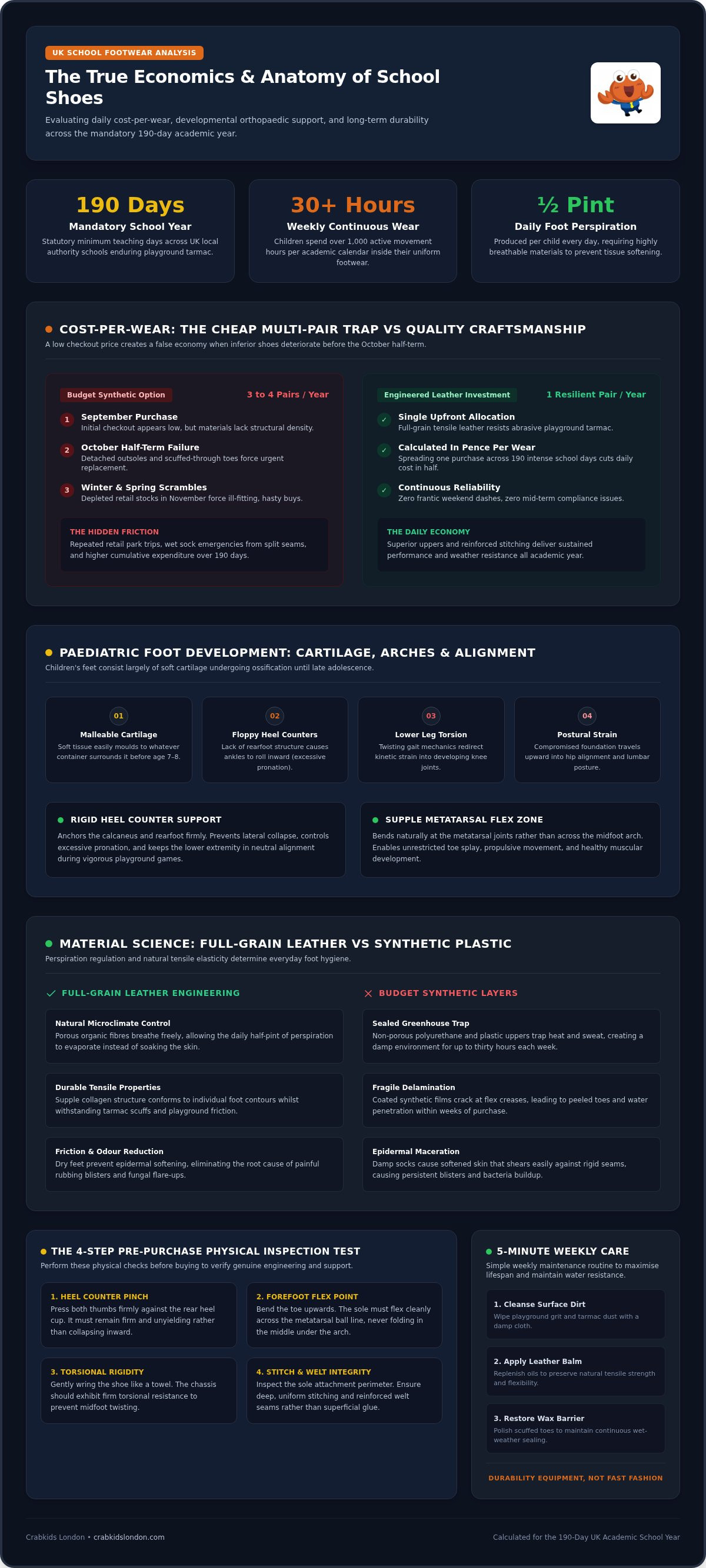
Price tags at the checkout counter tell only half the story. When assessing school footwear, the true measure of financial value rests on cost-per-wear. A child spends upwards of thirty hours each week inside their school shoes, racking up over a thousand hours of active movement across an academic calendar. Looking strictly at the initial register receipt obscures the daily economy of footwear engineered to endure.
A persistent cycle of buying cheap pairs creates a false economy. Supermarket footwear often suffers from detached outsoles and worn-through toes before the autumn half-term arrives, necessitating three or four replacement pairs before the summer break. Evaluating durable uppers and the natural tensile properties of genuine leather reveals far greater longevity than disposable synthetic layers, effectively cutting the daily expense of school footwear in half over the course of the year.
Calculating the Real Cost-Per-Wear Across the Academic Year
Local authority schools across the UK operate for a statutory minimum of 190 mandatory teaching days each year. Calculating your actual footwear spend requires dividing the purchase price by those 190 intense days of tarmac football, playground tag, and wet walking commutes. When you spread the cost of a single, well-crafted pair across an entire school calendar, the actual daily cost amounts to mere pence per active wear. A higher upfront spend yields consistent daily performance, whereas bargain options demand repeated investments that quietly drain your family budget.
The Hidden Pitfalls of the Multi-Pair Replacement Cycle
The true cost of low-grade footwear extends far beyond the till. Rushing through the multi-pair replacement cycle introduces persistent friction to family life:
- Wasted time and stress: Frantic weekend dashes to crowded retail parks disrupt family routines just to replace split shoes mid-term.
- Sizing scrambles: High-street stock runs low by November, leaving parents struggling to locate compliant styles in the correct fitting.
- Weather exposure: Split welt seams and punctured toes allow autumn rain to soak through, leaving children sitting in damp socks during class.
When asking is it worth investing in expensive school shoes, consider the frustration of watching inferior soles peel apart during a rainy November morning. Investing in dependable boys' school shoes or durable girls' styles breaks the cycle of constant emergency shopping trips, delivering uninterrupted daily reliability.
How Premium Footwear Protects Developing Bones and Posture
Children's feet are not simply miniature adult feet. Until late adolescence, a child's foot consists largely of pliable cartilage that has not yet completed ossification. These soft tissues easily mould to whatever container surrounds them. When weighing whether is it worth investing in expensive school shoes, the physical development of your child's musculoskeletal system provides a definitive answer. Flimsy shoes compromise structural growth long before foot arches stabilise around age seven or eight.
Musculoskeletal Alignment and Natural Arch Development
Unsupportive soles and floppy uppers force children into awkward gait compensations. Without a reinforced heel counter to anchor the rearfoot, ankles frequently roll inward. This excessive pronation twists the lower leg, sending undue mechanical strain directly into growing knees, hips, and lumbar posture.
Properly engineered shoes balance a rigid, supportive heel cup with a supple forefoot that bends naturally at the metatarsal joints. This design permits healthy toe splay during playground games while keeping gait mechanics strictly neutral. While government officials emphasise durability and value within their statutory guidance on the cost of school uniforms, physical health remains the paramount return on investment. Verifying measurements with an accurate online shoe size guide ensures internal arch contours sit precisely where growing feet require cushioning.
Breathability, Lining Materials, and Foot Hygiene
An active child's feet produce roughly half a pint of perspiration every single day. Synthetic plastic footwear acts like a sealed greenhouse, trapping heat and moisture against the skin. This damp microclimate softens epidermal tissue, leading to persistent friction blisters, fungal flare-ups, and unpleasant odours.
- Natural climate control: Genuine leather breathes freely, allowing perspiration to evaporate rather than pooling inside the footbed.
- Custom moulding: Leather gently stretches to match unique forefoot shapes without losing structural tension.
- Blister prevention: Padded collars and soft leather linings stop abrasive heel rubbing during energetic lunchtime football matches.
Pairing breathable leather shoes with moisture-wicking school socks keeps feet dry and comfortable through long classroom days. If you are questioning whether is it worth investing in expensive school shoes, remember that daily biomechanical protection safeguards your child well into adulthood. Discover resilient footwear tailored for British classrooms at Crabkids London to give your child sturdy support from their first bell to the final bell.
Material Showdown: Genuine Leather vs Cheap Synthetic Shoes
Look past the surface finish. At first glance on a shop shelf, a shiny polyurethane (PU) synthetic shoe looks nearly identical to genuine leather. Beneath that uniform topcoat lies a completely different material architecture. Understanding the mechanical differences between natural hide and artificial plastic quickly clarifies whether is it worth investing in expensive school shoes for the demanding term ahead.
Upper Resilience: Why Natural Leather Outlasts Coated Plastics
Polyurethane footwear consists of a thin woven backing covered with a synthetic plastic skin. Every step forces the shoe to crease across the forefoot. Within weeks of playground games, this repetitive bending causes artificial coatings to crack, peel, and flake away. Once plastic splits, you cannot repair it. Rain seeps straight through the fissures, exposing the fabric backing beneath.
Full-grain leather behaves differently. Natural collagen fibres form an interlocking structural weave that yields under tension without tearing. It softens and adapts. When playground scrapes inevitably occur, quality leather does not peel. Applying a nourishing leather shoe cleaning lotion conditions the grain, blends scuffs away, and renews essential water repellence. Premium leather restores easily; synthetic plastic simply degrades.
Outsole Engineering: Grip, Shock Absorption, and Flexibility
Outsole compounds dictate how well footwear absorbs relentless tarmac shocks. Budget options often rely on hollow injection-moulded plastic or lightweight foam. These soles compress flat under repetitive load, losing structural support and wearing completely smooth within two months. A bald sole turns rain-slicked school playgrounds into slipping hazards.
- Shock dissipation: High-density vulcanised rubber outsoles cushion heel strikes, protecting developing joints from hard playground surfaces.
- Wet-weather traction: Moulded tread channels evacuate surface water, ensuring firm footing during wet autumn break times.
- Toe reinforcement: Built-up rubber bumpers wrap around the front edge, halting toe-scuff wear before it damages the main upper.
Evaluating sole density and upper fibres proves why is it worth investing in expensive school shoes engineered with genuine leather and resilient rubber outsoles. Superior components survive active playground play, eliminating the headache of mid-term breakdowns.
How to Tell If a Price Tag Reflects Genuine Craftsmanship
A higher price tag does not automatically guarantee premium quality. Sometimes you are paying purely for designer labels rather than superior materials. Knowing how to assess physical build quality helps determine whether is it worth investing in expensive school shoes or walking away from an overpriced brand.
The Physical Inspection: Torsion, Flexibility, and Stitching Tests
Put marketing claims aside and run this four-step physical test before buying any school shoe:
- Flex the forefoot: Push the toe upward toward the collar. The sole should bend cleanly at the ball of the foot, mirroring natural toe joints. If it folds across the middle arch, put it back.
- Test torsional rigidity: Hold the heel firmly in one hand and the toe in the other, twisting in opposite directions. A well-built shoe resists moderate twisting, providing stable arch support under active playground loads. If a shoe wrings out like a wet towel, it will fail to support your child's feet on the playground.
- Examine critical seams: Check the fastening straps, eyelets, and perimeter of the toe box. Look for tight, reinforced double-stitching rather than single threads or messy glue lines.
- Feel collar padding: Pinch the heel collar and tongue. Thick internal cushioning prevents friction against the Achilles tendon, preventing painful blisters during the first weeks of term.
Accurate Home Sizing to Protect Your Footwear Investment
Even the finest craftsmanship fails if the fit is incorrect. Parents frequently buy shoes two sizes too large to make them last, but this proves counterproductive. Excess space causes the foot to slide forward, creating severe toe scuffing, tripping hazards, and awkward leather creasing that degrades the upper prematurely.
Aim for approximately 10 to 12 millimetres of clearance between the longest toe and the front edge of the shoe. This allowance accommodates natural foot expansion and steady growth without destabilising walking gait. Use our comprehensive shoe size guide to take exact foot measurements at home before ordering. Once you confirm the correct measurements, explore Crabkids London school shoes to secure laboratory-tested construction built specifically for active UK school life.
Making the Investment Last: Durability, Care, and Smart Choices
Buying well-constructed footwear represents only the first step in beating the school uniform budget trap. Unlocking the true lifespan of premium footwear depends on disciplined, simple maintenance. When you protect the material integrity of your purchase, the question of whether is it worth investing in expensive school shoes resolves itself through multiple terms of reliable wear and the potential to pass them down to younger siblings.
Essential Shoe Care Routines for Active School Days
Wet playground mud and winter grit act like sandpaper on footwear if left unattended. Establishing a swift, five-minute weekend habit preserves both appearance and weather resistance:
- Clear playground grime: Wipe dried dirt and mud away with a damp cloth before particles settle into leather pores.
- Condition the hide: Hydrate stiffening leather using dedicated leather shoe cleaning lotion to replenish lost oils, soften creases, and restore an active water-repellent barrier.
- Dry naturally: Never dry soaked shoes against direct radiators or fan heaters. Intense artificial heat turns supple leather brittle, causing irreparable cracking and shrinking internal footbeds. Stuff wet shoes with newspaper and let them air dry overnight at room temperature.
The Verdict: When Expensive School Shoes Are Worth Every Penny
For active children navigating wet British playgrounds and long school hours, premium craftsmanship proves its worth every single day. Children cannot focus in class when pinched by stiff synthetic uppers, nor should they endure damp socks and painful heel friction. Resilient footwear absorbs punishment without falling apart, keeping children grounded, comfortable, and ready to learn.
Durable selections across our collections of boys' school shoes and girls' school shoes demonstrate that lasting comfort and structural resilience go hand in hand. When shoes survive a full academic year without splitting seams or worn-out toes, the initial investment repays itself many times over. Check out the latest designs in our new arrivals collection to secure footwear engineered to handle the toughest school terms ahead.
Equip Growing Feet for Long-Term Playground Resilience
Selecting school footwear represents an investment in daily comfort, healthy musculoskeletal development, and parental peace of mind. When weighing whether is it worth investing in expensive school shoes, remember that engineering and material resilience always defeat the false economy of flimsy alternatives. High-grade construction cushions delicate cartilage, prevents painful mid-term shopping emergencies, and delivers remarkable cost-per-wear value across the entire 190-day academic calendar.
Your child deserves footwear that handles the physical reality of British playgrounds without splitting or rubbing. Our collections feature durable full-grain leather uppers built to withstand rigorous activity, paired with ergonomic shock-absorbing outsoles designed to protect growing feet throughout long school days. Explore durable, playground-ready footwear at Crabkids London today, backed by fast, reliable UK nationwide delivery and dedicated size-matching support to ensure an effortless, blister-free fit.
Frequently Asked Questions
Is it worth buying expensive school shoes if my child grows quickly?
When deciding whether is it worth investing in expensive school shoes during rapid growth phases, age makes a big difference. For toddlers whose feet grow every few months, top-tier footwear may be outgrown quickly. From age seven onwards, foot growth stabilises to roughly one size per year. Investing in structured, durable leather shoes protects developing cartilage from unnatural strain, making quality footwear genuinely economical.
How many pairs of school shoes should a child need each year?
A child should only require one durable pair for the entire 190-day academic year. High-grade leather shoes engineered with shock-absorbing rubber outsoles withstand playground football and wet commutes without failing. In contrast, fragile synthetic alternatives often split or peel by the end of each term, forcing parents into a frustrating cycle of purchasing three or four replacement pairs before the summer holidays.
Can poor quality school shoes cause long-term foot problems?
Yes, substandard footwear can permanently impact physical posture. Children's foot bones remain soft cartilage until late adolescence, moulding easily to restrictive or unsupportive shapes. Shoes lacking rigid heel counters permit excessive inward rolling, known as overpronation. This instability twists the lower leg, placing premature stress on knees, hips, and spinal alignment that can persist into adulthood as chronic joint pain.
What is the difference between genuine leather and synthetic school shoes?
The difference lies in cellular structure, breathability, and repairability. Genuine leather features natural collagen fibres that breathe, mould to unique foot contours, and release perspiration throughout the day. Synthetic polyurethane forms a non-porous plastic seal that traps sweat, encouraging blisters and odour. When leather uppers scuff, conditioning restores the grain; cracked synthetic coatings cannot be repaired and must be thrown away.
How much growing room should I leave when buying school shoes?
Leave approximately 10 to 12 millimetres of clearance, roughly equivalent to the width of an adult thumb, ahead of the longest toe. This allowance provides enough room for natural toe splay and term-time growth without destabilising walking gait. Buying shoes overly large to prolong wear causes heel slippage, awkward tripping, and unnatural creasing that breaks down upper materials prematurely.
What should I do if my child scuffs their school shoes within days?
Surface scuffs are inevitable on active UK playgrounds, but quality leather can be easily restored. Wipe away dried mud with a damp cloth, then apply a nourishing leather lotion or pigmented polish to rehydrate the fibres. Buffing gently with a soft brush blends away scrapes and restores water resistance. Unlike cheap artificial plastics that peel permanently, genuine leather responds beautifully to regular care.
Can expensive school shoes be handed down to younger siblings?
When evaluating whether is it worth investing in expensive school shoes for multiple children, premium pairs often survive well enough to hand down. High-density rubber outsoles and resilient leather uppers frequently outlast a single child's school year. Inspect the heel counter to ensure it remains upright and firm, then replace the inner footbed to give the younger sibling fresh, personalised arch support.