

How to stop Velcro on school shoes wearing out
A strap that stops sticking may need cleaning before it needs replacing. To stop Velcro on school shoes wearing out, brush debris from the hook side with a toothbrush, then carefully pick out trapped fibres. If the loop side has loose fibres, trim them lightly and evenly without cutting into the fastener.
It’s frustrating when a child’s shoes won’t stay fastened during the school day, but dirt and fluff can reduce the grip. A gentle clean is a practical first step: avoid pulling at the fastener or cutting away too much material. Clear debris from both sides, trim loose fibres carefully and look after straps and laces. If cleaning no longer restores the fastening, check whether the strap or fastener is damaged before deciding what to do next.
Key Takeaways
- Start with a gentle clean of the hook side to help clear the debris that can stop the fastener gripping.
- Trim only loose, fuzzy fibres, using a careful, light touch to avoid damaging the strap.
- Use a suitable tool to lift trapped fluff from the fuzzy side, and deal with mud without pulling at the fastening.
- Line straps up neatly when fastening, and replace worn laces when they become damaged.
- If cleaning no longer helps, explore the next steps for worn fasteners and consider school shoes suited to everyday use.
Brushing debris from the hook side of hook-and-loop fasteners
Repair costs in the UK depend on the damage and work required, so there is no single price for every shoe. Cleaning may restore grip, while replacing a worn strap or fastener involves different materials and labour.
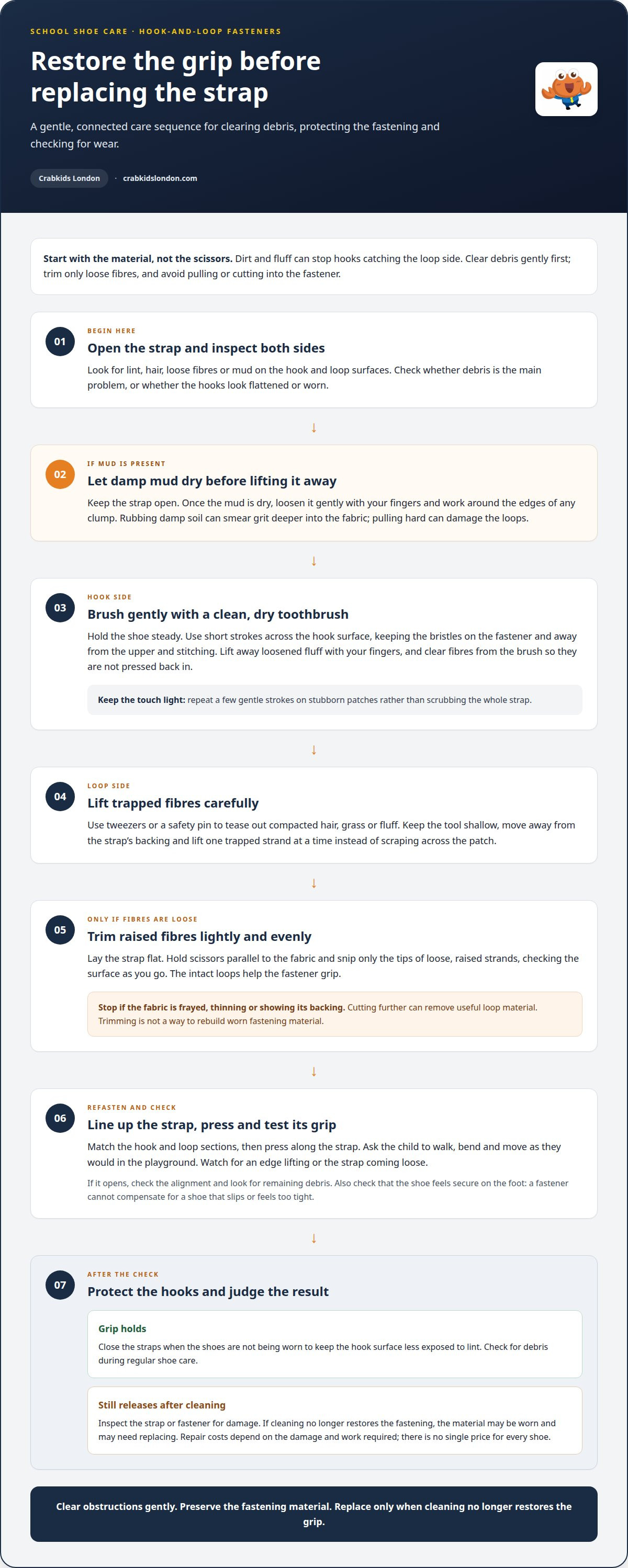
- Inspect the rough side with the strap open. Look closely at the small hooks before brushing. Lint, hair and loose fibres can lodge between them, stopping the hooks from catching the fuzzy loop side. Check whether debris is the main issue or whether the hooks look flattened or worn. Learning how to stop Velcro on school shoes wearing out starts with spotting the difference between dirt and damaged material.
- Brush with a clean, dry toothbrush. Hold the shoe steady and use short strokes across the hook surface. Work gently from one edge to the other, then brush back over clogged areas. A toothbrush can loosen trapped debris without the force of scraping with a hard object. Keep the bristles on the fastener, away from the shoe’s upper and stitching.
- Lift away debris as it comes loose. Use your fingers to remove loose fluff from the fastener. Check the toothbrush bristles too, so you don’t press collected fibres back into the hooks. Repeat a few light strokes on stubborn patches instead of scrubbing the whole strap aggressively. The aim is to clear obstructions while leaving the hook material intact.
- Line up the strap before testing its grip. Match the hook side with the fuzzy section on the shoe, then press along the strap. A crooked or partly attached strap has less contact with its matching surface. Check that the shoe also feels secure on the foot. A fastener cannot compensate for a shoe that slips or feels too tight.
- Check the fastening during ordinary movement. Ask the child to walk, bend and move as they would in the playground. Watch for a strap lifting at the edge or coming loose. If it opens, inspect the alignment and remove any remaining debris. This cleaning step is a practical part of how to stop Velcro on school shoes wearing out, because dirt can obstruct the fastening.
- Protect the hooks between wears. Close the straps when the shoes aren’t being worn, rather than leaving the hook surface exposed to lint. Velcro is often quicker to fasten than laces, which can help children manage shoes independently. Check for debris during regular shoe care. If the strap still releases after cleaning, the fastening material may be worn rather than dirty.
Carefully trimming fibres
- Inspect the fuzzy loop section before cutting. Open the shoe strap and look for loose, raised fibres standing above the fabric. A few stray strands differ from a loop surface that has become broadly fluffy. Check whether the fuzz is concentrated along one edge or spread across the strap. Trim only obvious excess; the intact loops help the fastener grip.
- Position the strap flat and steady. Lay it on a firm surface with the fuzzy section facing upwards. Keep the shoe still so the scissors cannot slip towards the upper or lining. Good light helps you distinguish loose fluff from the woven material beneath it. Keep the strap away from a child while trimming, and set the scissors aside afterwards.
- Use scissors to remove only the raised fibres. Hold the blades parallel to the strap and snip the tips of loose strands. Take off a little at a time rather than cutting close to the fabric. For example, if one tuft rises above the rest, shorten that tuft first, then inspect the surface before making another cut.
- Work lightly across uneven patches. If excess fluff covers a wider area, make small, even trims over the fuzzy section. Pause between snips and compare the trimmed patch with the surrounding fabric. Avoid digging the scissor points into the loops or cutting a smooth channel through them. The aim is to reduce surface fuzz, not remove the fastening layer.
- Stop if the loop material itself looks damaged. A frayed edge, thinning patch or exposed backing is different from a few loose fibres. Cutting further can remove useful loop material and leave less surface for the hooks to catch. If the strap’s fuzzy section is very fluffy, trimming excess may help; extensive wear can mean the loop section needs replacing.
- Test the strap after trimming. Line the fuzzy section up with the hook area and press the strap down along its length. Open it again and look for fibres caught on the hooks. If the surface still looks fuzzy, don’t keep cutting without checking the remaining fabric. A clean, even surface matters more than making the strap look perfectly smooth.
Careful trimming is a small maintenance step, not a way to rebuild worn fastening material. To preserve the strap, remove only loose fluff and stop before cutting into the woven loop surface.
Cleaning fluff and mud from Velcro
- Open the straps and check both fastening surfaces. Separate the hook and loop sides before cleaning. Look for hair, grass, playground fluff and mud lodged between the fibres. Check whether the debris is loose or pressed into the surface. A strap covered with dry fluff needs a different touch from one carrying damp mud. Keep the shoes on a stable surface while you inspect them.
- Let wet mud dry before lifting it away. Damp soil can smear across the loop fabric when rubbed, pushing grit deeper into the fastening. Leave the strap open until the mud has dried, then gently loosen the crust with your fingers. Don’t pull hard at the loops. If a clump remains attached, work around its edges rather than tearing at the fabric.
- Lift compacted debris with tweezers or a safety pin. Use the point carefully to tease out a strand of grass, hair or fluff caught in the fuzzy side. Keep the tool shallow and move away from the strap’s backing. For example, lift one trapped fibre at a time instead of scraping across the whole patch. A light touch reduces the chance of cutting or snagging useful loops.
- Clear loose dirt from the hook side separately. Once the mud is dry, use a toothbrush to brush away surface grit and loosen fibres. Make short, controlled strokes over the rough section. Check the bristles as you go, and remove collected dirt before continuing. Avoid forcing grit deeper by pressing hard. The hook and fuzzy sides work together, so cleaning only one may leave the strap struggling to grip.
- Check the fastener for remaining residue. Hold the strap open and inspect its full length, including the edges where mud can collect. Pick out visible strands with tweezers, then bring the two sides together. If the surfaces meet unevenly because debris remains, open them again and clean that spot. Don’t use scissors to remove mud or scrape the fabric with a blade.
- Let the shoe dry fully before fastening it. Keep the strap open after cleaning so moisture can escape from the fabric and surrounding shoe. Then press the fastener together and check that it holds across the contact area. If the strap still lifts after visible fluff and mud are cleared, the fibres may be worn rather than dirty. Repeated rough scraping won’t restore worn material.
Once the straps are clean and dry, a child can practise opening, positioning and pressing them together, while an adult checks that the fastening holds. The Velcro shoe videos show fastening movements performed by a typically developing child from a first-person viewpoint. They give a clear view of the actions involved, and the cleaned shoes let the child practise those movements on their own straps.
The page recommends Velcro as an ideal fastening from around the first-walker stage through age 5-6. The page says laces are usually introduced from around age 6-7, depending on a child's coordination and patience. Keeping the hook and loop surfaces clear can help the straps close as intended, and regular checks can show when debris needs removing or fibres appear worn.
Durability and maintenance of laces and Velcro
Check the strap attachment as well as the fastening surface. This helps you tell whether the strap can be repaired or the shoes no longer fasten securely.
-
Check straps for peeling
Open each strap and inspect where it joins the shoe. Look for loose stitching, lifting adhesive or a gap that widens when you gently move the strap. Don’t pull hard, as force can worsen a small separation. If the strap remains attached but the fastener won’t grip, worn hook or loop material may be the cause.
-
Assess worn straps for repair or replacement
Check whether the strap itself is worn or just its loop section. On many Velcro-fastened shoes, the loop section is on the strap and can be replaced separately from the hook section. A sturdy strap may also be resewn if its attachment has come loose. With thick material, sewing carefully through existing stitch holes can help avoid unnecessary damage.
-
Prevent a peeling strap from worsening. Close the shoe gently, aligning the strap with its matching fastening patch instead of pulling it sideways. If the attachment is lifting, don’t keep tugging to test its strength. A loose strap can catch during normal movement, so don’t rely on a fastening that separates as your child walks or plays. Any repair or replacement needs to address the attachment, not just the fuzzy surface.
Handle washing carefully. Washing school shoes does not automatically damage the Velcro, but rough rubbing can disturb its fibres. Remove loose dirt first and avoid scrubbing the fastening surface. Let the shoe dry fully with the strap open before closing it again. If mud remains trapped, clear it gently rather than pressing the strap together over grit.
-
Decide whether the shoes still work securely. Replace shoes if damage prevents a secure fastening or the shoes no longer fit comfortably. Replacing a loop section or resewing a strap may fix local fastener damage, but won’t solve poor fit or wider wear. After a repair, check that the fastener holds and stays closed during normal walking and play.
Keep laces in usable condition. Replace school shoe laces when they’re damaged or worn, and tie them securely before activity. Laces and Velcro need different checks: laces can be changed separately, while Velcro is harder to clean or replace. Regularly inspect both shoes, including strap joins, lace holes and fastening surfaces.
Removing debris from the fuzzy side
- Open the strap and inspect the loop surface. The fuzzy side is made of small loops that catch the hooks when pressed together. Check for hair, thread, grass or lint caught across the strap. Notice whether debris sits on top or has wound around the loops. This helps you choose a tool and avoid pulling useful fibres from the fastener.
- Choose tweezers or a safety pin for trapped strands. Hold the strap flat and lift visible debris gently from the loop surface. Tweezers give a firm grip on hair or thread, while a safety pin can tease out a strand caught between loops. Keep the point shallow and work beneath the debris, not through the fabric. Don’t drag a sharp tool across the strap.
- Work from the edge of each piece of debris. If a long hair crosses several loops, loosen one end first, then lift it away gradually. Pulling sharply can stretch or snag the surrounding loops. For a short thread caught near the strap edge, use the tweezers to grip the end and ease it out. Stop if the material begins to lift with the debris.
- Check the strap edges and corners separately. Fluff often collects where the fuzzy patch meets the strap stitching. Turn the shoe so you can see each edge, then use the tool tip to free visible fibres. Avoid picking at stitches or pushing debris further into the fabric. A loose seam needs attention as well as a clean fastening surface.
- Compare the cleared area with the untouched surface. Look for loops that remain intact and free from strands. If debris is still visible, lift it with tweezers rather than repeatedly scraping the same patch. Removing only what is caught helps preserve the loop surface. A thinning or torn patch is wear, not loose debris, and picking cannot restore missing material.
- Test the fastening after clearing the loops. Line the strap up with the hook section and press the surfaces together across their contact area. Open the strap carefully and check whether it catches evenly. If one corner lifts, inspect that spot for a remaining strand or damage. Keep the straps open when the shoes are stored, so the loop material is less exposed to lint.
Before putting the shoes away, inspect the fuzzy surface in good light. Gently move the strap so the loops change angle, making strands that blend into the fabric easier to spot. Use a safety pin or tweezers to remove debris caught in the fuzzy side of the hook-and-loop fastener. Focus on the trapped material, not the surrounding loops, and stop if you can’t tell whether a fibre is loose or part of the strap.
After cleaning, leave the strap open while you check the fastening again. Press it together without forcing it, then release it slowly and see whether it grips evenly from edge to edge. If a small area still doesn’t catch, examine it closely before removing anything else: a visible snag may be part of the fabric, not debris. Don’t keep picking at a worn spot, as further handling won’t replace missing loops. A careful final inspection helps distinguish loose material from damage and keeps cleaning focused.
Crabkids London: Boys' School Shoes
Crabkids London offers boys’ and girls’ school shoes for families choosing a replacement pair when cleaning or repair no longer restores a secure fastening. The shoes are designed for comfort and active school life, making them a practical option when worn fasteners or general wear make the current pair unsuitable.
Before choosing a replacement, consider whether the shoes still fit comfortably and stay secure during normal movement. If a new pair is the sensible next step, explore Crabkids London’s school shoes and use the maintenance advice in this guide to care for them.
Contact Crabkids London to discuss your school shoe needs.
Keep the next school day running smoothly
Make fastener care part of your pre-school shoe check: spot wear early and decide whether the current pair still feels secure and comfortable. A little attention can help you act before a loose strap becomes a morning distraction. The aim when learning how to stop Velcro on school shoes wearing out is to keep each pair practical for everyday use, not to keep a worn-out shoe at all costs.
If replacement is the sensible next step, Crabkids London offers boys’ and girls’ school shoes, along with backpacks for school-day essentials. Choose an option that suits your child’s needs, then keep checking that their shoes remain comfortable and fasten securely as they wear them.
Contact Crabkids London for shoe advice and take the next step with confidence.
Frequently Asked Questions
Still not sticking?
First, check whether the strap meets its matching patch across the full width. If it catches only at one edge, it may come loose as your child moves. Have your child sit with their back against a firm support while fastening, then practise pressing the strap down evenly. If it still releases despite full contact and clean surfaces, inspect for flattened hooks or worn loops.
Best replacement Velcro strips for children's school shoes UK
Use replacement loop tape cut to fit the worn section of the strap; it can be bought at a craft store and sewn or stuck on.