

How to Break in Kids' School Shoes Fast: The 2026 Parent’s Guide
Imagine the scene: it's the first morning of the new term, but instead of a proud photo at the front door, you're dealing with a child in tears because their new footwear feels like stiff blocks of wood. Most parents have faced this exact stress during the back-to-school rush, worrying about painful blisters before the first bell even rings. If you need to know how to break in kids' school shoes fast, you aren't alone. It's a common challenge for families who value durable leather but want to avoid the pinchy discomfort of the first few wears.
You'll be relieved to learn that stiff leather doesn't have to mean a week of complaints. This guide shares the safest methods to soften new school shoes, ensuring they match your child's unique gait from day one. We'll walk you through practical techniques to make high-quality leather shoes supple and playground-ready, as premium materials respond far better to softening than cheap synthetics. By the end, you'll have the confidence to prepare any pair for a full day of activity, keeping your child comfortable and their shoes in top condition for the year.
Key Takeaways
- Understand why initial stiffness indicates quality leather and how targeted softening prevents blisters while supporting healthy walking behaviour.
- Learn how to break in kids' school shoes fast using the thick sock method and controlled heat to create immediate comfort.
- Follow a practical 48-hour plan involving short indoor walks to ensure new shoes are playground-ready before the first day.
- Discover why premium leather is more adaptable than synthetic materials, allowing for a more personalised fit that lasts all year.
- Save time by choosing designs with padded collars and cushioned insoles that naturally require less break-in effort.
Why Breaking in School Shoes is Essential for Foot Health
High-quality leather is naturally resilient. This stiffness isn't a design flaw; it's a sign of a sturdy, durable product built to withstand a full school year. Understanding the properties of leather and how it softens is the first step for any proactive parent. Unlike thin synthetics that offer little support, premium leather fibres are densely packed. They require a short period of movement and warmth to mould to the foot's unique shape. Skipping this preparation often results in unnecessary discomfort during the first week of term.
If you ignore this process, the results are often painful. Un-broken shoes create friction, leading to deep-tissue blisters or skin abrasions. For children, whose feet are still developing and largely made of flexible cartilage, this pressure is more than just an annoyance. Constant pinching can force them into poor walking behaviour, such as toe-scrunching or limping, to avoid the pain. Learning how to break in kids' school shoes fast ensures they start the term with confidence, focusing on their new classmates rather than a stinging heel. Pain distracts; comfort empowers.
Identifying the 'Hot Spots' in New Footwear
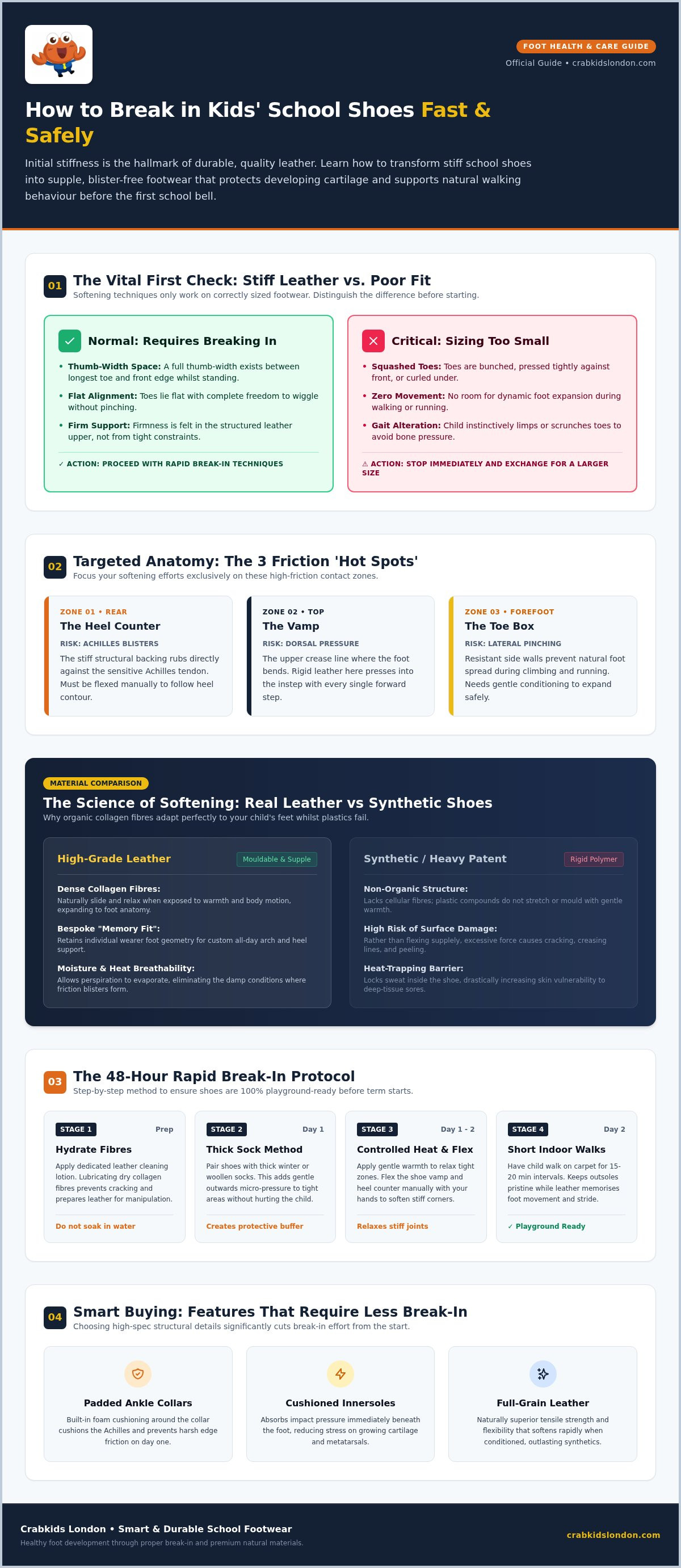
New footwear rarely pinches everywhere. Friction usually concentrates in three specific zones that require your attention. The heel counter is the most frequent culprit, where the stiff backing rubs against the Achilles. Next is the toe box; if the leather is too rigid, it won't flex as the child climbs or runs. Finally, pay attention to the vamp, which is the top area where the shoe creases. If this section is too hard, it can press down on the top of the foot during every step. Identifying these spots early allows for targeted softening.
The Difference Between 'Breaking In' and 'Poor Fit'
Distinguishing between a stiff shoe and a small shoe is vital for foot health. A shoe that needs breaking in will feel tight but shouldn't squash the toes. You should always be able to feel a thumb-width of space at the end of the toe box whilst the child is standing. If your child's toes are curled or there is no room to wiggle, no amount of softening will fix the issue. Before you begin any softening techniques, consult our shoe size guide to confirm the measurements are accurate. Recognising the difference early prevents you from wasting time trying to learn how to break in kids' school shoes fast when the pair simply needs to be exchanged for a larger size.
The Science of Softening: Leather vs Synthetic Materials
Leather is an organic material composed of complex collagen fibres. These fibres are naturally flexible but can become rigid during the manufacturing and storage process. When you apply gentle warmth or movement, these fibres relax and slide over one another. This allows the material to expand and mould to a specific shape. Understanding this physical reaction is key to learning how to break in kids' school shoes fast. Synthetic materials lack this cellular structure. Plastic-based shoes or those with heavy "patent" coatings don't stretch; they simply bend or, in worse cases, crack under pressure.
Natural oils play a vital role in this process. When leather is well-conditioned, the fibres remain lubricated and supple. If the material becomes too dry, the fibres can snap, leading to permanent damage and surface peeling. This is why better-quality leather responds so much more effectively to break-in techniques than cheaper, man-made alternatives. It's about working with the material's natural properties rather than fighting against them. Using the right approach ensures the shoe remains sturdy enough for the playground whilst becoming soft enough for the classroom.
Why Real Leather is Worth the Effort
Breathability is a primary benefit of choosing leather. It allows air to circulate and moisture to evaporate, which is essential for preventing the damp environment where blisters thrive. Unlike synthetics that trap heat, leather adapts to the temperature of the foot. High-quality boys' leather school shoes eventually "remember" the wearer's foot shape. This creates a bespoke fit that provides support exactly where it's needed, ensuring the shoes remain comfortable even during high-energy activity. It's a level of personalised comfort that synthetic shoes can't replicate.
Caring for the Material During Break-In
Hydration is the secret to a successful break-in. Applying a leather cleaning lotion before you begin softening helps the fibres stay resilient. It prevents the surface from discolouring or cracking whilst you manipulate the tight spots. A common mistake is soaking shoes in water to soften them quickly. Avoid this at all costs. Water strips away essential oils and can leave the leather stiff and brittle once it dries. Instead, focus on targeted heat and movement to maintain the integrity of scuff-resistant finishes. For parents who value longevity, starting with durable school footwear makes the entire maintenance process much simpler.
Fast-Track Methods: Targeted Softening Techniques
Speed is essential when the first day of term is looming. If you've left it late, knowing how to break in kids' school shoes fast can save your entire morning routine. The most effective approach combines mechanical stretching with thermal relaxation. Start by manually flexing the shoes. Hold the heel and the toe, then gently bend the sole back and forth for several minutes. This mimics the natural movement of walking and begins to loosen the stiffest parts of the leather without causing any stress to your child's feet.
Interval training isn't just for the gym. Apply a 'wear and rest' cycle to new footwear. Instead of forcing a full day of wear, have your child wear the shoes for just 20 minutes at a time around the house. This short duration allows the leather to warm up and adapt without the friction reaching a point that causes blisters. Repeat this three or four times over a weekend for the best results. Heat relaxes; movement moulds. This cycle is far more effective than a single, painful hour of continuous wear.
The Hairdryer and Thick Sock Combo
This is the gold standard for rapid softening. Have your child put on their thickest pair of winter socks before sliding into the new shoes. Identify the tight spots you found earlier, then use a hairdryer on a low heat setting to warm those areas for 30 seconds. Keep the nozzle at least 15cm away to prevent scorching the leather or damaging the finish. Whilst the material is warm, encourage your child to wiggle their toes and walk around the room. As the leather cools, it sets in this slightly expanded shape, providing immediate relief in the toe box and bridge.
Conditioning for Comfort
Squeaky shoes are a common complaint with high-quality leather. This usually happens when the tongue rubs against the eyelets or the interior lining is too dry. Applying a small amount of conditioner to these contact points silences the noise and softens the edges. Focus on the inside of the heel counter too; a hydrated interior is much smoother against the skin. Investing in quality shoe care products ensures the leather stays supple throughout the year. Proper maintenance prevents the material from drying out, which is often the root cause of 'pinchy' footwear during the winter months.
The 48-Hour Rapid Break-In Plan for Parents
When the first day of term is 48 hours away, a structured timeline is your best tool for success. You don't need a full week to prepare footwear if you follow a methodical schedule. Start your plan on a Saturday morning with an initial 15-minute indoor walk. This first session isn't about stretching the leather yet; it is purely for assessment. It allows you to see how the shoe moves with your child's foot before any modifications begin. Breaking in is the process of making leather pliable to ensure it mirrors the natural flexion of the foot.
By Saturday afternoon, focus on the 'hot spots' identified during the morning walk. This is the ideal time for targeted heat application. Use the hairdryer method on the heel and bridge for 30 seconds per area to relax the fibres. This proactive approach is how to break in kids' school shoes fast without causing the child any distress. Moving the material whilst it is warm and supple accelerates the softening process significantly, allowing the shoe to set in a more comfortable shape overnight.
Day 1: Testing the Waters
Distraction is a useful tactic during the early stages of this plan. Encourage your child to wear their new shoes whilst they are watching a favourite show or playing with toys. This allows them to move their feet naturally and flex the leather without focusing on the 'new' feeling of the footwear. Immediately after they take the shoes off, check their feet for any redness, particularly on the heels or the little toes. These marks are the primary indicators of where the material needs more attention before the final day of preparation.
Sunday morning requires the one-hour 'thick-sock challenge'. Have your child wear their thickest socks with the shoes for a full sixty minutes around the house. This session stretches the leather slightly beyond its normal capacity, creating a comfortable buffer for the first day. By Sunday evening, apply a final layer of conditioning lotion to the exterior. This keeps the material supple and adds a protective barrier against the elements before they head into the playground.
Day 2: Final Preparations
Preparation extends beyond the shoe itself. Ensure your child's school socks are the correct thickness; socks that are too thin increase friction, whilst those that are too thick can make a correctly fitted shoe feel cramped. It's also the final moment to consult our shoe size guide to confirm the fit is still optimal. For extra peace of mind, apply surgical tape or blister plasters to the heels as a preventative measure for the first full day. If you are still looking for the perfect pair to start this process, browse our collection of durable school footwear to ensure a smooth start to the term.
Choosing School Shoes That Require Less Break-In
Selecting the right pair from the outset is the most effective way to reduce parental stress. While learning how to break in kids' school shoes fast is a necessary skill, starting with superior materials makes the process significantly smoother. High-quality leather is naturally more flexible than synthetic alternatives. Cheap plastic-based shoes often remain rigid throughout their lifespan, whereas premium leather adapts to movement. At Crabkids London, we prioritise this immediate flexibility by using supple materials that require minimal intervention to become playground-ready.
The sole unit is another critical factor in early comfort. Many budget shoes use stiff, injected plastic soles that resist the natural rolling motion of a child's foot. Look for flexible rubber soles that bend easily at the ball of the foot. This flexibility reduces the strain on the upper leather, preventing the material from digging into the top of the foot. When the shoe moves with the child, the need for intensive softening techniques is greatly reduced. Check our new arrivals for designs that balance this sturdy protection with instant mobility.
A common oversight in the break-in process is ignoring the impact of correct sizing. No amount of manual flexing or heat application can fix a shoe that is fundamentally the wrong shape for a child's foot. Ensuring there is adequate width and depth from day one is the best way to avoid 'pinchy' spots. When a shoe fits correctly, the leather only needs to soften slightly to match the child's gait, rather than being forced to stretch to accommodate the foot's volume. Correct sizing is the foundation of long-term comfort.
Features of a Comfortable School Shoe
Specific design features can eliminate the most common friction points. Padded collars and heels provide a soft buffer against the Achilles, preventing the 'digging in' sensation often found in formal footwear. Anatomical footbeds are equally important, offering arch support that keeps the foot in a neutral position from the first wear. For younger children, girls' leather school shoes with adjustable straps allow for a more customised fit, ensuring the foot is secure without being constricted.
Investing in Longevity and Comfort
Choosing quality school shoes is a strategic investment in your child's daily wellbeing. Comfortable feet lead to better concentration in the classroom; the child isn't distracted by stinging heels or pinched toes. While premium options may require a higher initial outlay, their durability and ease of maintenance save money in the long term by lasting the full academic year. For more detailed advice on selecting the right pair for active children, consult our boys' leather school shoes guide to find a style that matches their energy levels.
Ready for a Confident First Day
Preparing your child for a successful school year starts with comfortable feet. By using targeted heat and the thick-sock method, you've learned how to break in kids' school shoes fast whilst protecting the material's integrity. These practical steps ensure that even the sturdiest leather becomes a supportive, flexible partner for the playground. Remember that quality construction is your best ally; shoes built with padded collars and flexible soles naturally require less effort to soften and adapt to a child's unique gait.
If you're still searching for the perfect pair, shop our latest collection of comfortable, durable school shoes. We offer expert-approved leather construction and Red Dot standard durability to handle the rigours of active childhood. With fast UK delivery available for the back-to-school rush, you can secure reliable footwear that lasts the whole year. Empower your child to focus on learning and play rather than painful blisters. With the right preparation and high-quality footwear, they'll be ready to step into the new term with total confidence.
Frequently Asked Questions
How long does it typically take to break in new school shoes?
Breaking in a new pair usually takes between two and three days of consistent, short-duration wear around the house. High-quality leather fibres need time to react to the natural warmth and movement of your child's feet. While you might want to know how to break in kids' school shoes fast, rushing the process with excessive force can damage the grain. Aim for several twenty-minute sessions over a weekend to achieve a supple, customised fit.
Can I use water to stretch my child's leather school shoes faster?
No, you should never soak leather school shoes in water to stretch them. Water strips away the essential natural oils that keep the material flexible; this often leaves the shoes brittle and prone to cracking once they dry. Instead, use a dedicated leather conditioner to hydrate the fibres. This professional approach keeps the construction sturdy whilst allowing the material to expand safely without compromising the scuff-resistant finish or overall durability.
What should I do if my child already has a blister from new shoes?
If a blister appears, stop your child from wearing the shoes immediately to prevent further friction. Clean the area and apply a cushioned blister plaster to promote healing. Before they wear the shoes again, identify the specific 'hot spot' that caused the injury. You can then use targeted softening techniques, such as manual flexing or low-heat application, to ensure that particular area of the leather becomes more pliable and less abrasive.
Is it better to buy school shoes a size larger to avoid breaking them in?
It is never advisable to buy a larger size just to avoid the break-in period. Oversized shoes allow the foot to slide, which actually increases friction and causes more severe blisters. A correct fit should have roughly a thumb-width of space at the toe whilst providing a secure grip around the heel. Properly fitted shoes only require minor softening of the leather to become comfortable, whereas poorly fitted shoes will never provide the necessary support.
Does the hairdryer method damage leather school shoes?
The hairdryer method is safe if you use low heat and maintain a distance of at least 15cm from the leather. Excessive heat or holding the nozzle too close can scorch the surface or cause the material to dry out and peel. When done correctly, the gentle warmth relaxes the collagen fibres, making them easier to manipulate. Always follow up with a quality leather lotion to restore any moisture lost during the heating process.
How can I tell if a shoe is too small or just needs breaking in?
A shoe that needs breaking in will feel firm but shouldn't squash the toes. If your child's toes are curled or there is no visible space at the end of the toe box whilst they are standing, the shoe is too small. Stiff leather will soften with movement, but a shoe that lacks sufficient volume will always cause pain. Use a reliable sizing guide to confirm the measurements before attempting any stretching or softening methods.
Are there specific socks that help with the break-in process?
Thick, padded socks are excellent for the initial stretching phase because they apply gentle, even pressure to the interior. Wearing a chunky pair during your 48-hour break-in plan helps create a comfortable buffer within the shoe. Once the leather has softened, transition to standard cotton-rich school socks. These provide the necessary breathability and moisture-wicking properties to keep feet dry and comfortable throughout a high-energy day in the classroom or playground.
Can I return school shoes once I have started the break-in process?
Most retailers, including Crabkids London, require returns to be in their original, unworn condition. If you have worn the shoes outside or applied heat and conditioners, they are generally no longer eligible for a refund or exchange. This is why it's vital to confirm the fit indoors on a carpeted surface before starting any intensive softening techniques. Always check the specific return policy of your provider to ensure you don't void your consumer rights.