

How to avoid school shoe fitting mistakes and choose shoes that fit
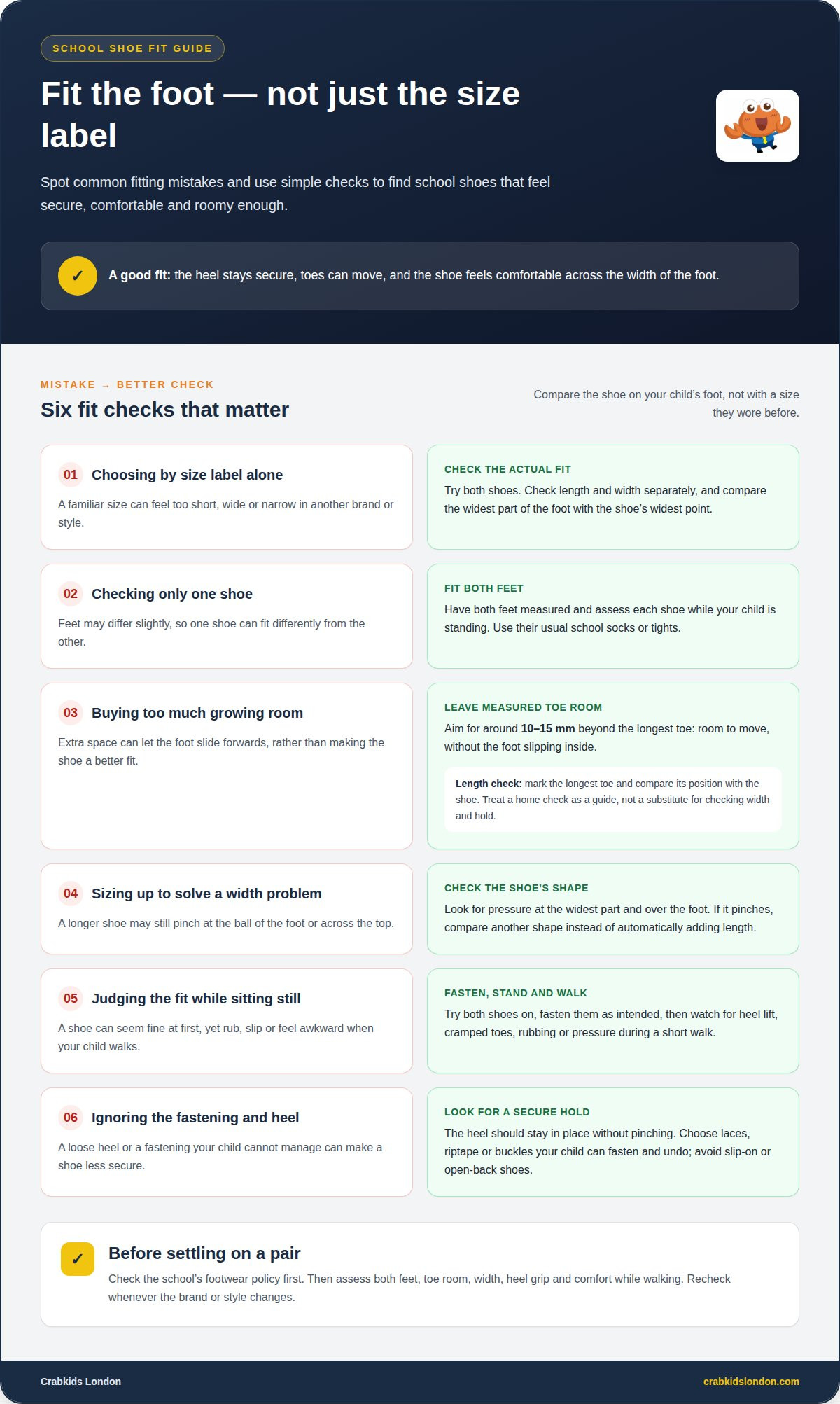
A well-fitting school shoe holds the heel securely, gives the toes room to move and feels comfortable across the width of the foot. The school shoe fitting mistakes to avoid include choosing by size alone or buying shoes with too much growing room: aim for around 10 to 15 mm beyond the longest toe. Having both feet professionally measured can help you check the fit in length and width.
It’s natural to wonder whether your child needs a professional fitting, especially when their feet are growing and different styles can fit differently. A careful fitting gives you more than a number on a shoe box. Your child should try on both shoes, walk around in them and tell you if anything pinches, rubs or slips.
This guide explains how to choose school-appropriate shoes, assess fit across styles and allow toe room without buying shoes that are too big. You’ll also find practical ways to make shopping calmer, from bringing the socks your child wears to school to giving them time to walk in their new shoes before the school day begins.
Key Takeaways
- Check your school’s footwear policy before choosing a style, fastening or colour.
- Try on both shoes and assess heel grip, width and comfort while your child walks.
- Compare fit by style, not just by the size printed on the shoe.
- Allow room for toe movement without choosing shoes so large that your child’s feet slip inside.
- Make shopping easier by bringing your child and their usual school socks or tights.
1. Choosing school-appropriate footwear
Start with your child’s school footwear policy. It may specify shoe colour, detailing or permitted styles, so check it before shopping. A polished shoe can still be unsuitable if it doesn’t meet the school’s requirements. Use the policy as the first item on your checklist, then compare shoes that meet it.
There’s no single perfect style for every child. Choose school shoes designed for everyday school wear, rather than relying on a fashion shoe or a pair intended for another activity. Check that the shoe isn’t so heavy or rigid that it feels awkward on a small foot. A wide-base heel made from shock-absorbing material can provide a steadier base for walking around school.
Fastenings should hold the shoe in place without making mornings difficult. Laces can be adjusted securely, but they may be tricky for a child who hasn’t learnt to tie them. Riptape straps or buckles can be easier to manage, provided your child can fasten and undo them properly. Practise at home before the first school day. Avoid slip-on or open-back shoes, which don’t secure the foot as firmly.
For a low-cut style such as a Mary Jane, check that the upper has enough depth and sits snugly without pressing on the foot. As your child walks, look for excessive gaps at the sides, ankles or heel. A secure fit should hold the heel without pinching. These checks make a fitting appointment more useful than choosing by appearance alone.
For a home length check, mark the position of your child’s longest toe and compare it with the shoe. The NHS advises leaving 1 cm between the longest-toe marker and the heel of the shoe. Treat this as a home check, not a substitute for assessing width and how the shoe holds the foot. Try both shoes, fasten them, then have your child walk around.
Have both feet measured and check the fit while your child is standing. Their feet may differ slightly, so assess each shoe rather than assuming one measurement suits both. Try the shoes with the socks or tights they usually wear to school. If you use removable insoles to see where the feet sit, return them to the shoes before trying them on.
Replace children’s school shoes when they’re worn out. The cost depends on the pair you choose, while a fitting appointment may have a separate charge, so account for both when planning your purchase. Your final checklist should cover school rules, fastening, heel grip, toe space and comfort during a short walk.
2. Differences in fit between brands and styles
A size label is a starting point, not a guarantee of fit. A size 6 that feels comfortable in one brand may be too short, wide or narrow in another. Children’s feet meet different shoe shapes, so parents should judge each pair on how it fits, not on a number worn previously.
Brands use different shoe shapes and proportions. One design may have a broader toe area, while another narrows towards the front. The overall length may seem right, yet the sides can press against the foot. Compare the widest part of your child’s foot with the shoe’s widest point, then check for pressure across the top.
Style affects the feel, too. A lace-up shoe can be adjusted across the instep, while a Mary Jane uses a strap to hold the foot down. A deeper upper may suit one child, while another may find it loose or restrictive. Test the specific style your child will wear rather than assuming another shape from the same range will fit identically.
Use the same checks each time you compare shoes. Have your child try both shoes with their usual school socks or tights, then fasten them as intended. Ask them to stand and walk. Notice whether the heel lifts, the toes feel cramped or the fastening needs excessive tightening. If a shoe feels uncomfortable during a short walk, its size label alone won’t make it a better fit.
Check length and width separately. Find the longest toe, then make sure there’s space in front without the foot sliding forward. Next, check the ball of the foot, where it’s widest. If the shoe pinches there, choosing a longer size may not solve the width problem. Compare another shape instead of automatically adding length.
Keep notes after trying each pair. Record the brand, style, labelled size and what your child noticed, such as pressure near the little toe or heel movement. This helps explain why a size that fitted before may feel different in another design. It also gives you a useful comparison when shopping again.
One of the school shoe fitting mistakes to avoid is treating a familiar size as a fixed answer. Recheck the fit whenever the brand or style changes. A well-fitting pair should feel secure without squeezing, and your child should walk naturally rather than compensating for a tight or loose shoe.
Try on both shoes when buying new ones: the NHS notes that most people's feet are slightly different sizes, so checking only one shoe may miss a fit problem.
School shoes should have roughly 12 mm of clearance between the longest toe and the end of the shoe. Check that space while your child is standing, rather than relying on the labelled size alone.
3. Why proper fit matters for comfort and foot health
Children can wear school shoes for up to 30 hours a week, so small fit problems can become daily discomfort. A shoe that rubs during the morning walk may keep rubbing through lessons and playtime. Proper fit means more than a comfortable first step: it should hold the foot securely whilst allowing natural movement.
Check the toe area, width and heel together. Your child’s toes should have room to move, the shoe should fit across the widest part of the foot and over its top, and the heel should stay secure without pressure. If one area feels tight, don’t assume extra length will solve it. The shoe may be the wrong shape for your child’s foot.
A toe box that squeezes can press against the toes. At the other extreme, too much space can let the foot slide forward and affect how the shoe feels during the school day. Growth matters, but growing room shouldn’t make the fit loose. Ask your child to walk and turn in both shoes, then look for rubbing, slipping or a change in their stride.
Support also depends on the shoe’s intended use. Plimsolls can suit short-term gym wear, but some supermarket styles may lack the structure, arch support and shock absorption needed for long days. Buckles and other fastenings secure a shoe only when adjusted correctly. If your child keeps gripping with their toes to hold a loose shoe in place, reassess the fit.
Signs that shoes are too small include toes pressing against the front, pinching across the sides, rubbing or discomfort during ordinary walking. Shoes that are too big may slip at the heel or let the foot move inside. Check the shoe’s interior for seams or stitching that could irritate the skin, even if the outer fit seems comfortable.
Don’t dismiss recurring foot or leg pain, frequent trips or falls, or uneven wear on the soles. These signs warrant professional help. Children with foot or leg pain or frequent falls should be assessed by a podiatrist before buying shoes. Uneven wear can also indicate that a shoe isn’t wearing evenly across the foot.
Treating discomfort as something a child simply needs to get used to is one of the school shoe fitting mistakes to avoid. Recheck the fit every two to three months, or sooner if discomfort or a noticeable change appears. This routine helps you catch a tight toe area, loose heel or worn sole before it affects walking and play.
4. Allowing room for toe movement and growth
Children’s feet can grow through up to 17 shoe sizes in their first 11 years. That makes growth room important when buying school shoes, but extra space shouldn’t mean choosing a pair that’s loose today. A well-fitted shoe leaves room beyond the longest toe whilst holding the foot securely. Check both needs together, rather than buying a larger size simply to last through the school year.
A useful fit guide is approximately 10 to 15 mm of extra length beyond the longest toe. This gives toes space to move without leaving so much room that the foot slides forward. Too much movement can make walking uncomfortable and increase rubbing. If your child’s heel lifts or their foot shifts inside the shoe, the extra length may be excessive.
For a home length check, mark where your child’s longest toe reaches inside the shoe. According to the NHS, leave 1 cm between the longest-toe marker and the heel of the shoe. Use this as one part of finding a suitable length, not the only test. The shoe also needs to fit across the foot and hold the heel securely.
Check toe movement with the shoes fastened and your child standing. Ask them to wiggle their toes, then walk and turn. Their toes should move naturally, without pressing against the front or bunching together. Watch for the foot sliding forward, especially when your child stops. Repeat the check on both feet, since each shoe needs to feel comfortable.
Growing room shouldn’t disguise a poor fit elsewhere. For example, a shoe may have space at the toe but press across the widest part of the foot. Check that it bends where the toes bend, rather than folding through the middle. If it rubs, inspect the inside for seams or stitching that could irritate the skin or contribute to blisters.
Check children’s feet and shoe fit every two to three months, or sooner if discomfort or a noticeable change appears. A sudden change in fit can matter more than the calendar. Check again if your child reports pressure, develops blisters or starts walking differently. Replace worn-out shoes rather than relying on leftover toe room to make them suitable.
Make the check practical during the school year: use the socks or tights your child normally wears, fasten the shoes and let them walk around. If the shoes have removable insoles, check where each foot sits on them, then put them back before the final try-on. This last step helps you assess the complete shoe, not just its length.
5. Making school shoe shopping calm and positive
A calmer fitting starts before you reach the shop. High street shoe shops can be especially chaotic during the final seven days before school returns, so avoid leaving the purchase until then. Choose an afternoon if possible, when feet may have swollen during the day. Bring your child, the school’s footwear rules and the socks or tights they usually wear.
A short checklist helps keep the visit focused: confirm the required style, bring your child’s usual socks and allow time to try both shoes. Explain that they’ll need to stand, walk and describe what they feel. A specific prompt, such as “Does your heel lift when you walk?”, is more useful than asking whether the shoes feel perfect.
Let your child take part, but don’t let appearance decide the fit. Fasten both shoes as intended, then ask them to walk, turn and stop. Watch for heel slippage, toes pressing together or rubbing near a seam. If discomfort appears, pause and try another size or shape rather than asking them to tolerate it.
Socks affect the space inside a shoe, so try the pair your child will wear to school. A thicker sock can make a close fit feel tight; a thinner one can make the shoe feel less secure. If the shoes have removable insoles, take them out briefly to see where each foot sits, then put them back before the final try-on.
Keep the appointment manageable by taking breaks between styles. Children can compare how a lace-up feels with a riptape fastening, for example, without trying every option at once. Ask about one sensation at a time: pressure across the toes, heel movement or rubbing at the back. This gives you clearer feedback and helps your child stay involved.
After buying, let your child wear the shoes around the house before the first school day. Check for rubbing, slipping and discomfort during ordinary walking, then adjust the fastening. If the shoes feel secure indoors, repeat a quick check after your child has worn them to school. Browse the school shoe range as you compare suitable styles for your child.
Because high street shoe shops can be particularly chaotic during the final 7 days before school returns, agree on a simple plan before setting out. Parents should bring their child when buying school shoes rather than leave the child at home. Explain that the aim is to find a comfortable, secure pair, not to make a quick choice or settle on a particular look. Keeping expectations modest can make the visit feel like a shared task: your child can say what they notice, while you make sure each option is checked carefully.
Use a calm, neutral tone if the first pair isn’t right. Reassure your child that trying another style or size is a normal part of choosing, and thank them for giving clear feedback. If they become tired or frustrated, pause rather than rushing a decision. Before paying, agree on what felt comfortable and review any remaining concerns. This gives your child a meaningful role without asking them to judge fit alone, while keeping the focus on comfort and suitability.
Crabkids London: Boys' School Shoes
Crabkids London offers Boys' School Shoes and Girls' School Shoes for families choosing footwear for school. Once you’ve checked your school’s requirements and know what fit to look for, browse the range and compare styles with your child’s needs in mind.
Use the checks in this guide with any pair you consider: assess toe space, width and heel grip, then watch your child walk. Crabkids London also offers Socks, so include the socks your child wears to school in your fitting checklist.
For school shoes suited to your child’s everyday routine, visit crabkidslondon.com.
Make the next school-shoe choice with confidence
Make fitting a useful routine, not a once-a-year guess. Note what your child says about pressure, rubbing or heel movement, then use those observations the next time you compare shoes. The school shoe fitting mistakes to avoid are easier to spot when you focus on how a pair feels during movement, rather than relying on a familiar size or appearance.
When it’s time to choose school footwear, Crabkids London offers Boys' School Shoes and Girls' School Shoes, alongside BackPacks for school. Use the fit checks from this guide to inform your next shopping decision and choose a pair that suits your child’s needs and school requirements.
Explore Crabkids London’s school range and take the next step towards a more confident choice.
Frequently Asked Questions
Should I get my child’s feet professionally fitted?
Yes, a professional fitting can help assess both foot length and width, including whether a particular shoe shape suits your child. It’s especially useful if home checks leave you unsure, or if one foot differs noticeably from the other. Take the socks your child wears to school, and ask the fitter to assess both feet in the shoes being considered, not just record a size.
What are the most common mistakes when fitting children’s school shoes?
Common mistakes include relying on a familiar size label, choosing shoes with too much growing room and overlooking whether a fastening keeps the shoe secure. Another is forcing shoes on without undoing the straps or laces. This can crush the heel and bend the shoe, making it looser or more likely to rub. Teach children to open fastenings fully, then secure them properly after putting their shoes on.
How much growing room should school shoes have in the UK?
A practical guide is approximately 10 to 15 mm beyond the longest toe. That leaves space for toe movement without making the shoe so large that the foot slides inside. Check the measurement with your child standing and wearing their usual school socks. Then ask them to walk: if the heel lifts or the foot shifts forwards, reassess the fit rather than relying on the length measurement alone.