

How Often to Measure Children's Feet: A Parent's Guide
Did you know that a child's foot can grow up to two sizes in just six months? This rapid development often happens in silence, as many children don't complain when their toes begin to feel cramped. If you're wondering how often to measure children's feet to avoid permanent damage, you aren't alone. It's a common concern for parents who want to balance the household budget with their child's physical health and comfort.
This guide provides the clarity you need by providing a clear schedule for every developmental stage. You'll learn how to use the Crabkids Shoe Size Guide to achieve a precise fit at home, ensuring your child's leather shoes provide the support they need for a busy school day. We'll also reveal the subtle behavioural signs of a growth spurt, helping you spot the need for a new pair before discomfort sets in. From toddler milestones to the primary school years, here is your practical plan for healthy foot development.
Key Takeaways
- Learn exactly how often to measure children's feet to prevent the physical discomfort caused by outgrown school shoes.
- Identify the physical and behavioural cues that signal it's time for a larger size, even if your child hasn't complained.
- Master the three-dimensional aspect of shoe sizing by looking beyond length to include width and foot volume.
- Follow a simple step-by-step process to organise accurate at-home measurements using the Crabkids Shoe Size Guide.
- Protect your investment in quality leather school shoes by ensuring the fit remains perfect throughout the school year.
The Golden Rule: How Often to Measure Children’s Feet
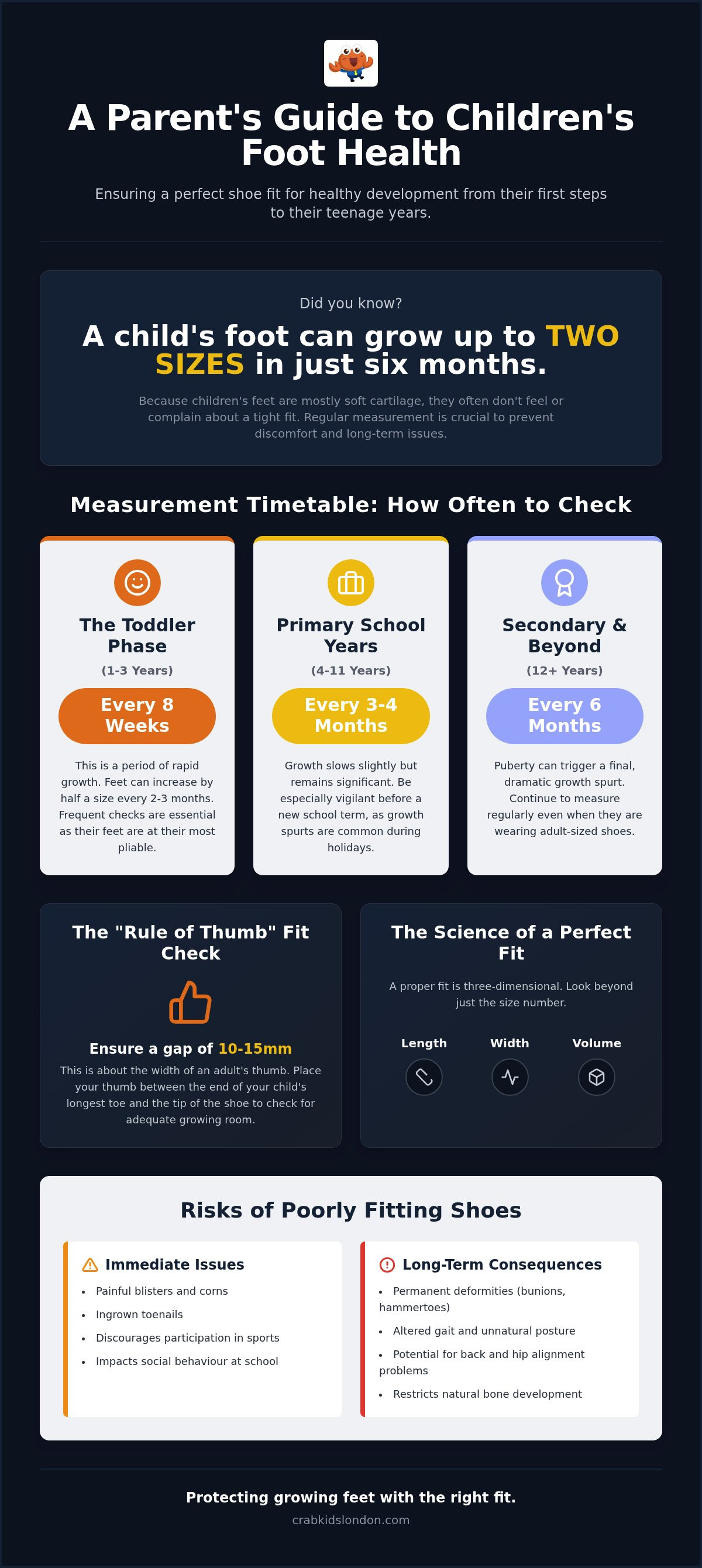
Determining how often to measure children's feet is the first step in protecting their long-term podiatric health. Many parents assume growth is a steady, predictable climb. In reality, it happens in erratic bursts. For toddlers, you should check for a new size every 8 weeks. Once they reach primary school age, this interval typically extends to every 3 to 4 months. Because children's feet are composed largely of soft cartilage, they don't always feel the sharp pain of a tight shoe. Instead, the foot simply moulds to the shape of the footwear, which can lead to permanent structural changes before they even reach secondary school.
Use the rule of thumb during every check. There should be a gap of approximately 10 to 15 millimetres between the longest toe and the end of the shoe. If you cannot fit the width of your thumb comfortably in that space, it is time to consult the Crabkids Shoe Size Guide to find their new measurement. Regular checks ensure that durable leather shoes provide the comfort and support they were designed for.
Why 8-12 Weeks is the Critical Window
Growth isn't a straight line. Whilst a child might go months with no change, a sudden spurt can see them jump two whole sizes in a single school term. This rapid change is linked to the process of ossification, where soft cartilage gradually hardens into bone. This process isn't complete until the late teens. During the school years, the feet remain highly pliable. Frequent measurements every 8 to 12 weeks catch these spurts before the shoes begin to restrict natural bone development.
Seasonal transitions often mask these changes. During the summer holidays, children often spend more time in open sandals or even barefoot, which allows the foot to spread and grow without restriction. When they return to structured leather school shoes in September, the fit that worked in July may suddenly be too restrictive. Checking their size at the start of every term is a non-negotiable habit for active families.
The Risk of Delayed Measurement
Ignoring the measurement schedule carries more than just the cost of a new pair of shoes. Persistent pressure on the toes leads to immediate issues like painful blisters, corns, and ingrown toenails. These minor ailments can quickly discourage a child from participating in playground games or sports, impacting their physical activity levels and social behaviour at school.
Long-term risks are even more significant. Consistently wearing shoes that are too small can lead to permanent deformities such as bunions or hammertoes. Furthermore, tight footwear alters a child's gait. They may begin to shuffle or walk with an unnatural posture to compensate for the discomfort, which can lead to back and hip alignment issues later in life. Keeping a strict measurement routine prevents these developmental setbacks from taking root.
Growth Spurts by Age: A Parent’s Measurement Timetable
Understanding how often to measure children's feet requires looking at their specific developmental stage. A child's age is the most reliable indicator of how quickly they will outgrow their current pair. Growth isn't linear; it's a series of jumps that demand a structured approach to fitting. By following a standardised timetable, you can ensure their footwear supports natural movement rather than restricting it.
The Toddler Phase (1-3 Years)
Rapid growth defines the first three years of life. Toddlers often use a grasping motion with their toes to maintain balance, making barefoot time essential for building muscle strength. However, when shoes are necessary for outdoor activity, you must check the fit about once a month. Between ages one and three, feet can grow by half a shoe size every two to three months, making bi-monthly measurements a necessity. Chubby toddler feet also require extra attention to width and volume. Monitoring this phase closely prevents early structural issues while the feet are at their most pliable.
The Primary School Years (4-11 Years)
Once children reach primary school, the pace of growth slows slightly but remains significant. Between ages four and ten, measuring every three to four months is the standard for how often to measure children's feet. High-energy playground behaviour puts immense pressure on footwear, meaning a precise fit is vital for both comfort and safety. Many parents experience the "August Peak," the frantic period before the new term when a sudden growth spurt is most likely. Using the Crabkids Shoe Size Guide at home allows you to skip the queues and verify sizes accurately before ordering quality school footwear.
Secondary School and Beyond
Teenagers might be wearing "adult" styles, but their physical development is far from over. Puberty often triggers a final, dramatic increase in foot size that can catch parents off guard. Extracurricular sports and increased daily walking can also cause foot volume to fluctuate as the arch matures and the foot broadens. Even at age 11 and beyond, biannual checks are necessary to ensure their shoes aren't causing long-term damage. For those moving into larger sizes, choosing Durable Boys’ Leather School Shoes ensures the footwear can handle the increased weight and activity levels of a growing teen.
Beyond the Ruler: Physical Signs Shoes are Too Small
Knowing how often to measure children's feet gives you a baseline, but physical markers are the ultimate confirmation. Every time you remove their school socks, perform a quick visual check. Look for redness across the bridge of the foot or indentations around the heel and ankle. If their toes appear slightly "curled" or don't straighten immediately after the shoes are off, the toe box has become too restrictive. These marks are immediate evidence that the leather is pressing against the foot's delicate structure, potentially causing long-term damage.
Never assume a child will tell you when their shoes are too tight. Because their feet are composed of pliable cartilage rather than hard bone, they can squeeze into cramped footwear without feeling acute pain. If you ask how they feel, the answer "they feel fine" is the least reliable indicator you have. By the time they actually complain of pain, the shoes are likely two sizes too small and may have already begun to mould the foot into an unnatural shape. Regular observation is your best tool for maintaining their comfort.
The Behavioural Checklist for Parents
Sudden changes in how a child moves are often the first red flag. If they start tripping more frequently or dragging their toes during a walk, it's likely they're struggling with a lack of space. Watch for a reluctance to join in playground games or a new habit of taking their shoes off the second they get home. They might not say their feet hurt, but they'll often complain of "tired legs." This fatigue happens because the muscles and tendons are overworking to compensate for a shoe that no longer supports a natural, healthy gait. Walking on tiptoes or a slight limp are also signs that the current size is hindering their movement.
Analysing Shoe Wear and Tear
High-quality leather is designed for durability, yet it will show specific stress points when outgrown. Perform a "Scuff Pattern" audit by examining the soles and the upper material. Bulging at the sides of the leather indicates the foot is too wide for the current style. You might also see a visible bump or "poking" in the upper where the big toe is pressing against the front. These distortions mean the leather is being stretched beyond its intended shape, which compromises both comfort and the longevity of the shoe.
Check the soles for uneven wear. If the heel is worn down significantly on one side, or if there is a distinct scuffing pattern at the very tip of the toe, the foot isn't sitting centrally in the shoe. This misalignment prevents the arch support from functioning correctly. When you spot these physical distortions, use the Crabkids Shoe Size Guide to find their new measurement and restore their playground confidence.
The Science of Fit: Length, Width, and Volume
Achieving the perfect fit requires looking beyond the tip of the toe. Whilst length is the most common metric, size is actually three-dimensional. When considering how often to measure children's feet, you must also evaluate width and total volume. A foot that is technically the correct length but lacks the necessary depth or width will still cause discomfort and restrict natural development. This is why a shoe that "fits" on paper might still feel tight in practice.
The internal structure of the foot changes significantly in early childhood. Most children are born with a fat pad that makes the foot look flat; the actual arch doesn't fully develop until around age six. During this period, the foot needs space to expand and contract. Because different brands use different moulds to make shoes, a size 2 in one brand might feel completely different in another. Leather types also play a role. A stiff patent leather will have less "give" than a soft grain leather, affecting the overall feel of the volume. Adjustable fastenings are your best tool for managing these variations. Whether it's high-tension laces or sturdy straps, these features allow you to customise the fit as the foot grows or swells throughout the day.
Why Width Matters as Much as Length
In the UK, width is categorised using a letter system, typically ranging from E (narrow) to H (extra wide). Finding the right fitting is essential for stability. A shoe that is too wide is just as problematic as one that is too narrow. If the foot slides around inside the shoe, it causes friction blisters and increases the risk of tripping on the playground. When selecting Girls’ Leather School Shoes, ensure the style matches their specific width profile to provide consistent support and prevent the foot from "clawing" to stay in place.
The Anatomy of a High-Quality School Shoe
A sturdy school shoe must balance protection with flexibility. Breathable leather is the gold standard because it allows moisture to escape, keeping feet healthy and preventing fungal issues. The construction should include a firm heel counter to hold the foot in place, paired with a flexible forefoot that allows the toes to bend naturally during a stride. Maintaining this flexibility is easier when the material is cared for properly. Using a Leather Shoe Cleaning Lotion keeps the leather supple, ensuring it continues to move with your child's foot rather than becoming brittle and restrictive.
Understanding these scientific principles helps you make better choices between your scheduled measurements. If you're ready to upgrade your child's footwear to a pair that respects their natural development, explore our range of durable school shoes designed for the rigours of the UK school day.
How to Organise Your Home Measurement Routine
Establishing a consistent routine removes the guesswork from your child's physical development. Knowing how often to measure children's feet is only half the battle; you also need a reliable system to track it. Set a recurring "Foot Check" reminder on your phone every 12 weeks. This simple habit ensures you catch growth spurts before they cause discomfort or damage. Timing is equally important. Always measure in the late afternoon or evening. Feet naturally swell during daily activity, reaching their maximum volume by the end of the day. Measuring in the morning often results in shoes that feel restrictive by lunchtime.
Preparation ensures your data is accurate. Make sure your child wears the specific School Socks they intend to wear with their new leather shoes. Padded or thick cotton socks can alter the required size by half a grade. Always measure both feet. It's perfectly normal for one foot to be slightly larger or wider than the other. You must always buy footwear to accommodate the larger foot to prevent cramping and blisters. Using the Crabkids Size Guide provides a professional baseline from the comfort of your own home.
Step-by-Step Home Measurement
You don't need complex equipment to achieve a precise result. Place a sheet of paper on a flat, hard surface with the edge touching a wall. Ask your child to stand with their heel firmly against the wall and their weight evenly distributed. Mark the paper at the tip of the longest toe, ensuring the pen is held vertically. Measure the distance from the edge of the paper to the mark in millimetres. Repeat this process for the second foot. Once you have the millimetre measurement for the larger foot, consult a trusted conversion chart to find the corresponding UK shoe size.
Ensuring the Perfect Fit Online
When your new pair arrives, verify the fit before removing any tags. Follow the "1cm of growing room" rule. There should be a thumb's width of space between the end of the longest toe and the front of the shoe. Perform a "pinch" test to feel the toe position through the leather; if the toes are touching the end, the size is too small. Check the heel for "slip" by ensuring the shoe grips the back of the foot without digging into the Achilles. If a sudden growth spurt has left your child in cramped footwear, choosing School Shoes with Fast Delivery ensures they return to a comfortable fit without delay.
Secure Your Child’s Comfort for the Term Ahead
Maintaining a proactive measurement routine is the simplest way to protect your child's developing feet. By sticking to the 8 to 12 week check-up window and watching for subtle behavioural cues, you can spot a growth spurt before it causes pain. Remember that size is three-dimensional; length, width, and volume must all work together to provide the necessary support for active playground life. Understanding how often to measure children's feet ensures their school shoes remain a reliable partner throughout the academic year.
When it's time to size up, choose footwear built for the high-energy reality of childhood. Our range features high-quality leather that supports growing feet whilst withstanding heavy daily use. With fast UK-wide delivery for busy parents, you won't have to wait to restore their comfort. Browse the latest durable school shoe arrivals at Crabkids London today to find a pair expertly designed for playground durability. Your child's next step starts with a precise fit and a sturdy foundation.
Frequently Asked Questions
How much growing room should be left in new school shoes?
Leave approximately 10 to 15 millimetres of space between the longest toe and the end of the shoe. This allowance provides enough room for the foot to expand during the natural walking motion and accommodates immediate growth. If the gap is less than the width of your thumb, the shoes are likely too small. Avoid leaving more than 1.5cm, as excessive space causes the foot to slide, leading to blisters and instability.
Can I just buy one size larger to make school shoes last longer?
Buying shoes that are too large is not recommended because it compromises your child's safety and foot development. Oversized footwear lacks the necessary support at the arch and heel, forcing the toes to "claw" to keep the shoe in place. This habit leads to tripping on the playground and can cause long-term gait issues. It is better to buy the correct size and follow a schedule for how often to measure children's feet.
What should I do if my child has two different sized feet?
Always purchase shoes based on the measurement of the larger foot to ensure comfort and prevent restriction. It is very common for children to have a size difference of half a size or more between their left and right feet. If you buy for the smaller foot, the larger one will suffer from pressure and potential deformity. You can use insoles or adjustable fastenings to secure the fit on the smaller foot.
Are home shoe measuring gauges as accurate as in-store fittings?
Home measurements are highly accurate when you use a professional resource like the Crabkids Shoe Size Guide. By following a structured process, such as placing the heel against a wall and measuring in millimetres, you can achieve a precise result. Many parents find home checks more reliable because they can be performed in the afternoon when feet are at their largest, rather than during a morning trip to a busy shop.
How do I know if my child needs a wide-fit school shoe?
Look for physical signs like bulging at the sides of the leather upper or red marks across the widest part of the foot. If the "Rule of Thumb" for length is met but the shoe still feels tight across the bridge, a wider fitting is necessary. In the UK, width is typically graded from E to H. A wide-fit shoe provides the necessary volume without requiring you to buy a size that is too long.
Do children’s feet grow faster in the summer?
Research suggests that children's feet often grow more rapidly during the summer months. Increased physical activity and warmer weather stimulate blood flow, which can accelerate growth spurts. Additionally, children often spend more time barefoot or in flexible sandals during the holidays, allowing the foot to spread naturally. This makes the late August check the most critical part of your routine for how often to measure children's feet.
Why does my child keep scuffing the toes of their shoes?
Persistent scuffing at the toes often indicates that the shoes are either too large or too small. If the shoe is too long, the child may trip over the excess material; if it is too tight, they may drag their feet to compensate for discomfort. However, scuffing is also a natural part of playground activity. Choosing durable leather shoes with reinforced toe areas helps maintain the shoe's appearance despite the rigours of the school day.
Is it okay for my child to wear hand-me-down school shoes?
It is generally best to avoid hand-me-down footwear for school-aged children. Every child has a unique walking pattern, and leather shoes quickly mould to the shape of the original wearer's foot. Wearing pre-owned shoes can force your child's foot into an unnatural position, leading to discomfort and potential structural issues. To ensure healthy development, provide each child with a new pair that supports their own specific gait and foot shape.