

How Much Growing Room in School Shoes? The Expert Parent’s Guide
Is the "extra bit of space" in your child’s new shoes a smart investment or a hidden trip hazard? Every parent knows the frustration of watching a sturdy pair of leather shoes become too tight before the first term ends. You want maximum value, yet you worry that too much room might cause long-term foot damage or blisters. Finding the "Goldilocks" zone for how much growing room in school shoes is essential for both your wallet and your child's comfort.
We understand that navigating different brand size guides is confusing and expensive. This guide provides the exact measurements and professional checks used by experts to guarantee a reliable fit. You will discover why 10 to 15 millimetres is the industry standard for healthy growth, how to perform a foolproof fitting check at home, and the best way to ensure those new shoes remain resilient for at least two terms of active playground life. We have gathered the facts so you can shop with quiet confidence and protect your child's feet without wasting money on frequent replacements.
Key Takeaways
- Master the 10-15mm rule to provide the ideal margin for both immediate foot expansion and natural growth throughout the school year.
- Use the "Standing Press" and "Thumb Test" methods to accurately verify fit at home whilst your child is weight-bearing.
- Avoid the risks of oversized footwear, such as altered walking patterns and premature leather cracking, by prioritising a secure, functional fit.
- Discover why adjustable fastenings and high-quality leather are essential for accommodating how much growing room in school shoes is needed without sacrificing support.
- Ensure your child's shoes last at least two terms by balancing professional measurements with the resilience of playground-ready materials.
Understanding Why Growing Room is Essential for Healthy Development
A child's foot is a dynamic structure, not a static object. During a typical school day, feet undergo constant changes in shape and size. When walking or running, the foot naturally elongates and widens as it absorbs impact and prepares for push-off. This movement, known as the gait cycle, requires a specific amount of space within the footwear. If you are wondering exactly how much growing room in school shoes is necessary, you must first account for this immediate functional expansion.
Adequate "wiggle room" serves two purposes. It provides the necessary volume for the foot to expand whilst active and ensures healthy air circulation. Cramped environments lead to excessive moisture and heat, which are the primary causes of friction and painful blisters amongst active children. Without this buffer, the foot is forced against the rigid boundaries of the shoe, leading to long-term risks like ingrown toenails or permanent bone misalignment. Providing a margin for growth is a financial benefit as well, as it allows for a comfortable fit that lasts through the next six months of development.
The Anatomy of a Growing Foot
Children’s feet are remarkably pliable because they consist largely of cartilage rather than solid bone. This flexibility makes them highly susceptible to being moulded by poorly fitted shoes. During the "push-off" phase of a step, the metatarsals need sufficient space to splay. A generous toe box prevents the toes from being crushed together, which is vital for maintaining natural foot posture. Understanding different shoe-size systems helps parents realise that a single number doesn't always account for these anatomical needs.
Balancing Longevity and Podiatry Standards
Many parents attempt to save money by buying shoes two sizes too big, but this is a false economy. Oversized shoes cause the foot to slide forward, leading to toe-scrunching and a disrupted gait. This instability often results in trips on the playground and premature wear of the shoe's internal lining. High-quality leather options, such as those found at Crabkids London, offer a superior solution. Leather provides a natural flex and breathability that synthetic materials lack, adapting to the foot's shape as it grows. To find the right balance between health and value, refer to a professional shoe size guide to ensure the footwear lasts at least two terms without compromising development.
The Standard: How Much Space Do Children Really Need?
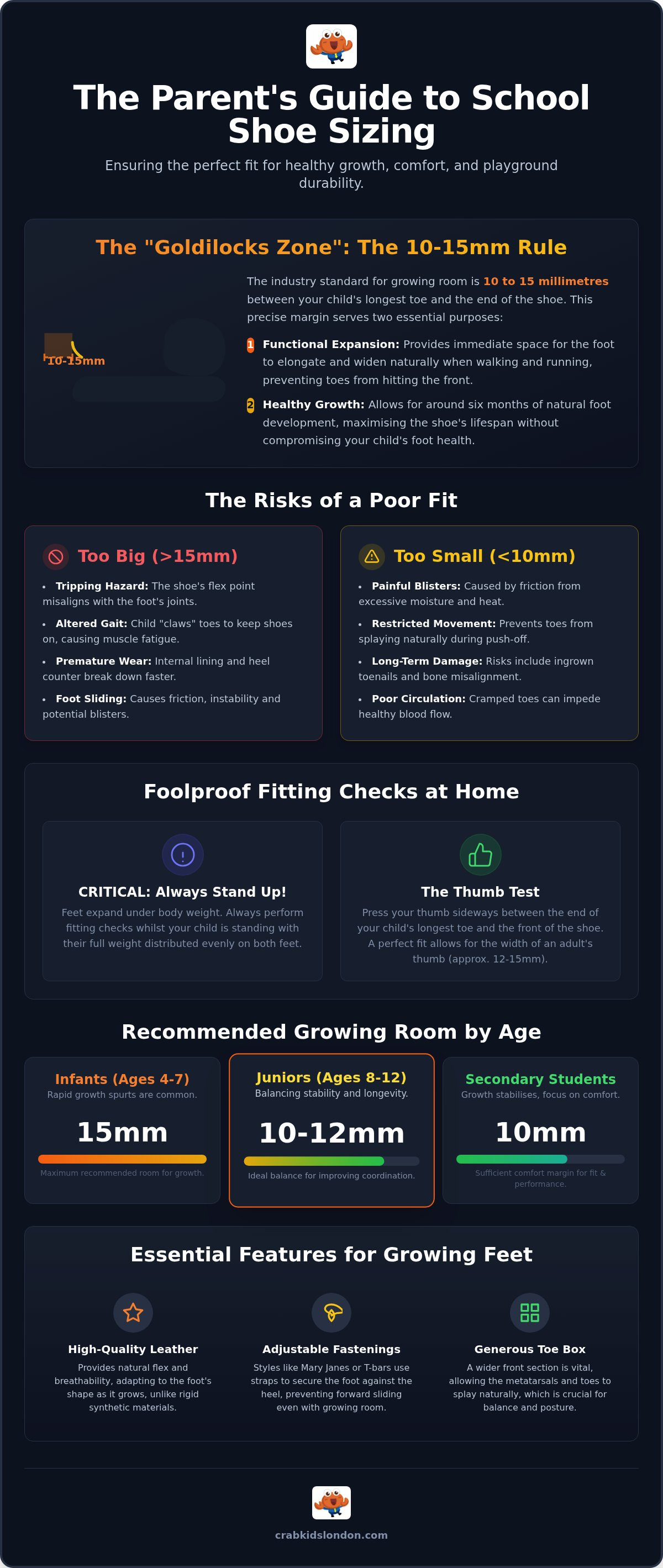
Precision is vital when determining how much growing room in school shoes is appropriate. The industry standard is a margin of 10 to 15 millimetres between the longest toe and the front of the shoe. This range isn't arbitrary. A minimum of 10mm provides the immediate functional space required for the foot to elongate during movement. Without this, the toes hit the front of the shoe with every step. Conversely, exceeding 15mm, which is roughly 1.5 shoe sizes, creates a significant tripping hazard because the shoe's flex point no longer aligns with the foot's natural joints.
Adhering to the APMA children's shoe guide ensures that you are following podiatric best practices for long-term health. Whilst it is tempting to buy large to save on future costs, an ill-fitting shoe forces the child to "claw" their toes to keep the footwear on. This leads to muscle fatigue and poor posture. Understanding how much growing room in school shoes is needed for different age groups helps prevent these common fitting errors.
Growing Room by Age Group
Growth rates change as children mature, meaning the ideal margin shifts over time. A standard approach doesn't account for the rapid development seen in early years:
- Infants (Ages 4-7): Aim for the full 15mm. Rapid growth spurts are common, and this larger buffer accommodates sudden changes whilst remaining safe for daily activity.
- Juniors (Ages 8-12): A 10-12mm margin offers the best balance of stability and longevity. At this stage, coordination is improving, but feet still require room to expand.
- Secondary Students: As growth begins to stabilise, a 10mm "comfort margin" is sufficient for both fit and performance.
Space Requirements for Different Shoe Styles
The design of the shoe influences how well it handles a growth margin. Mary Janes and T-bars feature secure straps that hold the foot back into the heel counter. This allows for slightly more growing room without the foot sliding forward. If you are looking for these specific styles, you can explore our Girls School Shoes collection for designs that offer a secure, adjustable fit.
Lace-up leather shoes provide the most customisable hold. By tightening the laces, you create a firm mid-foot grip that keeps the heel in place even when there is extra room at the toes. This structural support is why quality materials matter. Choosing a reliable partner like Crabkids London ensures that your child’s shoes provide both the necessary space and the durability to survive the school year.
Finding the Balance: Growing Room vs. Poorly Fitted Oversized Shoes
Providing too much space in an attempt to make shoes last longer often backfires. When parents exceed the recommended 15mm limit, children suffer from the "Clown Shoe" effect. This isn't merely an aesthetic issue; it fundamentally alters their natural gait. Determining how much growing room in school shoes is appropriate requires a balance between future-proofing and immediate safety. Because the shoe's flex point is designed to bend at the ball of the foot, an oversized shoe forces the leather to fold too far forward. This misalignment makes walking awkward and increases the likelihood of stumbles during high-energy play.
Durability is directly linked to fit. Many parents don't realise that oversized shoes suffer from premature wear and tear. When there is too much empty space in the toe box, the leather creases heavily with every step. Over time, these deep folds lead to the leather cracking, even in high-quality materials. By understanding how much growing room in school shoes is truly necessary, you protect the structural integrity of the footwear. A precise fit ensures the shoe bends where it’s supposed to, maintaining its shape for multiple terms.
Safety in the playground is another critical factor. Active boys, in particular, are prone to trips and falls when their shoes are too long. The excess length catches on steps or uneven surfaces, which can lead to avoidable injuries. It's also important to remember that length isn't the only factor. If a shoe is too wide, the foot will slide forward into the "growing room," leaving the heel unsupported and the toes cramped at the front despite the extra length.
Signs a Shoe is Too Big (Even with Growing Room)
Even if you’ve followed the 10-15mm rule, certain signs indicate the shoe is poorly fitted for your child's specific foot shape. Look out for these indicators:
- Heel slipping: The back of the shoe lifts away from the heel whilst walking, which causes friction and blisters.
- Side gaping: The quarters of the shoe bulge outwards when the child stands still, suggesting the width is too great.
- Toe clawing: You can see the child's toes tensing or "clawing" as they instinctively try to grip the shoe to keep it on.
Protecting Your Investment
A correct fit does more than just support the foot; it prevents the internal heel lining from wearing away prematurely. When a foot slides around inside a shoe, the constant friction destroys the fabric or leather lining, making the shoes uncomfortable long before the soles wear out. High-quality leather maintains its resilience even with a 12mm growth margin, provided the mid-foot is held securely. To keep your purchase in top condition, refer to our Expert Guide to Kids Shoe Care Products for maintenance tips that extend the life of your leather school shoes.
How to Check for Growing Room at Home
Verifying the fit of new footwear doesn't require complex machinery. You can achieve professional results at home by following a methodical four-step sequence. First, perform the "Standing Press". Always ensure your child is standing upright and bearing weight equally on both feet. Sitting down causes the foot to retract, leading to an inaccurate measurement. When standing, the foot elongates to its maximum active length, which is critical for determining how much growing room in school shoes is actually present.
Next, move to the "Thumb Test". Feel for the end of the longest toe. Remember that for many children, the second toe is longer than the big toe. There should be a clear gap between this point and the internal front of the shoe. Follow this with the "Heel Gap Check". Insert your pinky finger behind the heel whilst the child is standing. It should fit snugly without forcing the foot forward or causing the toes to scrunch. Finally, conduct the "Width Pinch". Gently pinch the leather across the ball of the foot. You should be able to feel a small ripple of movement. If the leather is taut and the foot feels squeezed, the shoe is too narrow; if you can grab a large fold of material, the width is excessive and lacks support.
The "Finger" Method for Accuracy
Using your fingers as a measuring tool is a reliable shortcut. A standard adult thumb width at the toe equates to approximately 12 to 15mm of space. This is the ideal amount for how much growing room in school shoes should be provided for a healthy gait. Conversely, if you can fit an entire index finger down the back of the heel, the shoe is likely too large and will cause slipping. Always check both feet. It's common for one foot to be slightly larger, so you must always fit the shoes to the larger of the two to ensure total comfort and avoid restricted movement.
Using a Professional Size Guide
For the highest level of precision, a printable guide is an excellent resource. When using a Crabkids London Shoe Size Guide, ensure your printer settings are at 100% scale to avoid distortion. Measure the foot in centimetres and convert this to the corresponding UK size, adding the recommended 10 to 15mm buffer. This data-driven approach removes the guesswork from online shopping and ensures the shoes provide the support your child needs for the term ahead.
Ready to upgrade your child's footwear? Shop our collection of durable leather school shoes and enjoy national UK delivery on every order.
Selecting Durable School Shoes Designed for Growing Feet
Selecting the right footwear involves more than just identifying a size on a box. To truly master how much growing room in school shoes is needed, you must select materials that accommodate that space without sacrificing support. Leather stands as the superior choice for active students. Unlike synthetic alternatives, high-quality leather offers natural flex and breathability. This allows the shoe to adapt to the foot's movement during the gait cycle whilst providing the structural integrity required for playground resilience.
Adjustable fastenings are equally important for long-term comfort. Whether you choose Velcro, buckles, or laces, these systems allow you to "fine-tune" the fit as the foot grows. A secure fastening ensures the heel stays locked in place, preventing the foot from sliding forward into the 10 to 15mm growth margin. This stability is essential for preventing the toe-clawing and blisters caused by loose footwear. By choosing adjustable options, you ensure the shoe remains a reliable partner from the first day of term to the last.
Materials That Move With the Child
Soft leather uppers are designed to "break in" over time, gradually moulding to the unique contours of your child’s foot. This bespoke fit is particularly helpful during growth spurts, as the material stretches slightly to accommodate changes in width and volume. Padded collars provide a cushioned barrier that prevents rubbing against the ankle, maintaining comfort even as the foot’s position within the shoe shifts over the months. For robust, growth-friendly designs that withstand daily wear, explore our Boys School Shoes collection.
Ready for the New Term?
As a Practical Specialist, Crabkids London understands that children rarely grow on a convenient schedule. You might find that a pair fitted in September becomes too snug by the Christmas break. We prioritise resilience and ease, offering national UK delivery to ensure you have access to reliable footwear exactly when you need it. Ordering from a dedicated provider ensures you receive shoes engineered for the rigours of the school day rather than fleeting fashion trends.
If you find yourself needing a replacement size urgently, our School Shoes Fast Delivery UK Guide explains how to secure high-quality pairs without the wait. To maintain optimal foot health, we recommend re-measuring primary-aged children every 3 to 4 months. Regular checks ensure you always know exactly how much growing room in school shoes remains, allowing you to replace them before they cause discomfort or restrict natural development.
Equipping Your Child for Every Playground Milestone
Mastering the balance between comfort and longevity doesn't have to be a guessing game. By sticking to the 10-15mm rule, you ensure your child has the functional space needed for a healthy gait whilst allowing for natural growth spurts. It's essential to remember that checking how much growing room in school shoes remains is a task for every three to four months to protect developing feet from restriction.
Choosing durable leather construction provides the resilience needed for the active UK school day. We offer expert sizing support to help you navigate the fitting process with absolute confidence. Once you've identified the correct size, our fast UK delivery ensures your child is ready for the classroom without delay. We take the stress out of the school run so you can focus on their progress.
Find the Perfect Fit: Shop Durable School Shoes at Crabkids London
Confidence starts with a sturdy foundation. Give your child the comfort they deserve and the longevity you expect for a successful school year ahead.
Frequently Asked Questions
Is 1cm of growing room too much in school shoes?
No, 1cm is actually the recommended minimum for healthy foot development. This 10mm gap provides the necessary space for the foot to expand naturally during the gait cycle. Anything less than this restricts movement and can lead to immediate discomfort. For younger children, you might even aim for 15mm to account for sudden growth spurts. It is the ideal balance for maintaining stability whilst ensuring the shoes last longer.
How often should I check my child’s school shoe fit?
You should check the fit every 3 to 4 months for primary-aged children. Younger feet can grow up to half a size in just a few weeks. Regular checks ensure you catch tightness before it causes permanent bone misalignment or painful ingrown nails. For secondary students, checking every 6 months is usually sufficient. Their growth rates begin to stabilise at this age, making their sizing needs more predictable and easier to manage.
Can I put an insole in school shoes that are a bit too big?
Adding a quality insole can help secure a shoe that is slightly too large, but it shouldn't be used to bridge a gap larger than 15mm. An insole reduces the internal volume, which prevents the foot from sliding forward and causing blisters. However, it doesn't change the shoe's flex point. If the shoe is significantly oversized, the leather will still crease prematurely and the child's natural walking pattern will remain affected.
What happens if my child wears school shoes with no growing room?
Shoes with no growing room cause immediate physical distress and long-term developmental issues. The toes become cramped and are forced to "claw" within the toe box, leading to blisters and friction burns. Over time, this lack of space can cause permanent bone deformities or ingrown toenails. Restricting how much growing room in school shoes is available also prevents the natural expansion required for running and playing on the playground.
Does growing room differ between boys and girls school shoes?
The recommended 10 to 15mm margin remains consistent regardless of gender. However, the style of the shoe often dictates how well that room is managed. Girls' school shoes like Mary Janes often have straps that keep the heel secure, whilst boys' sturdy lace-ups allow for precise tensioning across the bridge. Both styles benefit from the same growth buffer to ensure healthy development and the resilience needed for a busy school day.
Should I measure my child’s feet in the morning or afternoon?
Always measure your child's feet in the afternoon or evening. Feet naturally swell throughout the day due to activity and heat. If you measure first thing in the morning, you risk buying a size that feels uncomfortably tight by lunchtime. Fitting shoes when the feet are at their largest ensures total comfort during the most active parts of the school day, including break times, sports, and high-energy playground games.
Can I use a "thumb width" as a reliable measurement for all brands?
A thumb width is a helpful general guide, but it isn't a substitute for millimetre precision across different brands. Because an adult's thumb is roughly 12 to 15mm wide, it aligns well with the industry standard. However, different shoe-size systems can vary in their internal dimensions. You should always use the brand's specific size guide alongside the thumb test to ensure the fit is truly accurate for your child's unique foot shape.
How much growing room do teenagers need in their school shoes?
Teenagers generally need a 10mm comfort margin rather than the larger 15mm buffer required by younger children. As growth slows down, the priority shifts from future-proofing to immediate stability and performance. A 10mm gap provides enough space for the foot to expand during the gait cycle without making the shoe feel loose. This ensures the leather maintains its shape whilst providing the professional look expected in secondary school environments. Determining how much growing room in school shoes is right for teens requires balancing fit with adult-like support.