

Durable School Shoes for Children: The 2026 Guide to Playground-Proof Footwear
It's only the second Tuesday of the new term, yet you're already staring at a pair of scuffed toes and a peeling sole. It feels like throwing money away when standard pairs fail to survive the first playground football match or a rainy walk to the school gates. We know the frustration of seeing "sturdy" footwear fall apart before the first half-term break. You need durable school shoes for children that act like armour on the playground whilst remaining smart enough for the classroom.
This 2026 guide reveals the essential features that help footwear survive a full academic year. We'll explain the difference between scuff-proof and scuff-resistant materials, and why reinforced construction is the secret to preventing soles from snapping or peeling. You'll also learn practical maintenance tips to keep leather supple and water-resistant. By the end of this article, you'll have the expert knowledge required to choose a pair that lasts, saving you both time and the stress of mid-term shopping trips.
Key Takeaways
- Learn why full-grain leather is the essential choice for breathability and long-term resilience.
- Identify the specific construction methods that prevent soles from peeling and stitching from failing.
- Discover why an accurate fit ensures durable school shoes children wear don't fail before the first half-term.
- Master the 'Toe Gap' rule to provide growth room whilst maintaining the stability required for active play.
- Understand the 'Playground Factor' and how it influences the structural integrity of high-quality footwear.
What Defines Durable School Shoes for Children in 2026?
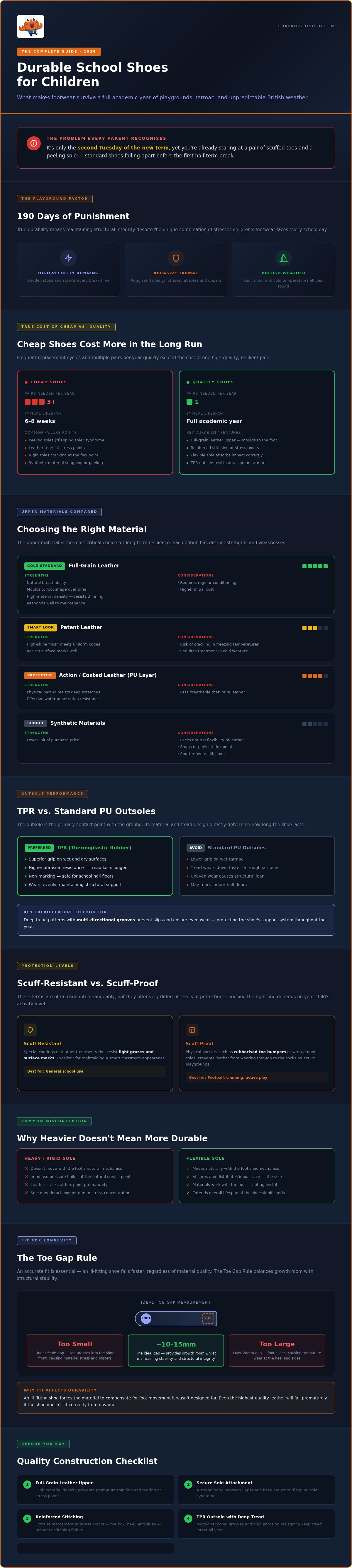
True durability isn't just about a shoe staying in one piece. It's the ability of the footwear to maintain its structural integrity despite 190 days of friction, impact, and unpredictable British weather. When we talk about durable school shoes children need, we're looking at a product that can withstand the "Playground Factor". This is the unique combination of high-velocity running, sudden stops, and the abrasive nature of tarmac that school shoes face every single day. Most children's shoes fail because they aren't designed for this level of stress, leading to soles that peel away or leather that tears at the stress points.
Identifying a long-lasting shoe requires looking beyond the surface. You should check for specific indicators of quality construction before you buy. High material density in the leather prevents premature thinning. The way the sole is attached matters just as much as the material itself. A secure bond between the upper and the base is vital for preventing the dreaded "flapping sole" syndrome. Whilst "cheap" shoes might seem like a bargain at the start of September, they often cost parents more in the long run. Frequent replacement cycles and the need for multiple pairs per year quickly exceed the cost of one high-quality, resilient pair.
The Difference Between Scuff-Resistant and Scuff-Proof
Many parents use these terms interchangeably, but they offer different levels of protection. Scuff-resistant shoes usually feature special coatings or leather treatments that help the material resist light grazes and surface marks. These are excellent for maintaining a smart appearance during classroom time. Scuff-proof shoes go a step further. They often include physical barriers, such as rubberised toe bumpers or wrap-around soles. If your child spends every break time playing football or climbing, scuff-proof features provide the physical shield necessary to prevent the leather from wearing through to the socks.
Why Weight and Flexibility Matter for Longevity
There's a common misconception that a heavy, chunky shoe is naturally more durable. In reality, excessive weight can lead to premature failure. Heavy shoes often have rigid soles that don't move with the foot. This lack of "give" puts immense pressure on the point where the shoe naturally creases, often causing the leather to crack or the sole to detach. A flexible sole actually extends the life of the shoe by absorbing impact and moving naturally. For a deeper look at how movement affects wear, see our guide on flexible school shoes for kids. Choosing durable school shoes children can actually move in ensures the materials aren't fighting against the foot's natural mechanics.
Materials that Withstand the Rigours of the School Day
The foundation of any resilient shoe lies in the quality of its raw materials. For parents seeking durable school shoes children can rely on, full-grain leather remains the gold standard. This material isn't just about looks; its natural fibres provide a unique combination of breathability and resilience. Unlike cheaper alternatives, high-quality leather moulds to the shape of the foot over time, preventing the stiff friction that causes both blisters and material fatigue. It's a living material that, when properly maintained, survives the daily grind of the classroom and the playground.
Other finishes offer different functional benefits. Patent leather provides a high-shine aesthetic that meets strict school uniform codes, though it faces a higher risk of cracking in freezing temperatures if not treated. Action leather and coated finishes use a polyurethane (PU) layer to create a physical shield over the hide. This "barrier" is particularly effective at resisting deep scratches and water penetration. Whilst synthetic alternatives are often more affordable, they frequently lack the natural flexibility of leather. This rigidity causes the material to "snap" or peel at the flex points, shortening the overall lifespan of the footwear.
The Role of High-Performance Outsoles
The outsole is the primary point of contact with the ground, making it a critical component for longevity. Thermoplastic Rubber (TPR) outsoles are generally superior to standard Polyurethane (PU) alternatives because they offer better grip and higher abrasion resistance. This means the tread stays intact for longer, even on rough tarmac. Most schools now require "non-marking" soles to protect indoor hall floors, so look for high-density rubber that provides traction without leaving streaks. Deep tread patterns with multi-directional grooves are essential. They don't just prevent slips; they ensure the shoe wears down evenly, preventing the structural lean that can ruin a shoe's support system. You can explore our robust collection of boys' school shoes to see these high-performance soles in detail.
Internal Linings and Odour Control
Durability isn't just about the exterior. Internal moisture is a silent killer of footwear, as sweat can rot stitching and weaken glue bonds from the inside out. Breathable mesh or leather linings are vital for moisture management, allowing heat to escape during high-energy activity. Keeping the interior dry preserves the structural integrity of the upper and prevents the shoe from losing its shape. Anti-microbial treatments prevent the growth of bacteria that would otherwise break down the internal foams and structural padding of the shoe. By protecting the internal components, you ensure the shoe remains comfortable and supportive until your child eventually outgrows them.
Construction Techniques: How a Shoe is Built to Last
A shoe's lifespan is determined by the invisible engineering beneath the surface. Whilst materials provide the raw resilience, construction techniques dictate how well those materials hold together under pressure. Most standard footwear uses a "cemented" construction, where the sole is simply glued to the upper. Under the intense heat and friction of playground activity, this glue can soften, leading to the dreaded flapping sole. For durable school shoes children can wear day after day, a stitched construction or a combination of stitching and high-strength bonding is far superior. This creates a mechanical connection that resists the shearing forces of running and jumping.
Reinforcement at high-tension areas is another hallmark of a playground-proof shoe. Look for double or triple stitching around the heel and the eyelets. These points experience the most stress during the "on-off" cycle and whilst the child is in motion. Another critical feature is the "Toe Bumper". These are vulcanised rubber wraps that extend from the sole over the front of the leather. By creating a physical shield, they prevent the leather from peeling away at the point where children often drag their feet or kick balls. This simple addition can double the life of a shoe's appearance.
Internal structure is just as vital as the exterior. Heel counters are stiffened inserts placed between the lining and the outer leather at the back of the shoe. They act as a chassis, providing the support needed to keep the foot aligned. Without a robust heel counter, the back of the shoe quickly collapses, ruining the fit and the support. You can see these structural features in our latest range of girls' school shoes, which are designed to maintain their shape through months of heavy use.
Padded Collars and Heel Support
Padded collars serve two purposes. They provide immediate comfort, but they also reduce the internal friction that eventually wears through the lining. When a collar is well-padded, it grips the ankle securely, preventing the foot from sliding. This stability protects the internal "back-stiffener" from being crushed. We know children often use their opposite foot to kick their shoes off at the end of the day. A reinforced heel counter ensures this habit doesn't cause the back of the shoe to collapse or lose its structural integrity over time.
Fastenings: Rip-Tape vs. Laces
The choice of fastening impacts both convenience and longevity. For younger children, high-grade hook-and-loop (rip-tape) fasteners are essential. Quality matters here; low-grade rip-tape loses its "stick" as it picks up playground grit and fluff. Professional-grade fasteners are designed for thousands of cycles without losing grip. As children grow, transitioning to laces allows for a more customised and secure fit. To ensure durable school shoes children won't break, check that the lace eyelets are reinforced with metal grommets or extra layers of leather. This prevents the laces from tearing through the upper when they are pulled tight every morning.
A Practical Guide to Choosing the Right Fit for Longevity
Finding the right fit is about more than just comfort. It's a critical factor in how long the footwear will last. An incorrect fit is actually the primary cause of premature shoe failure. When a shoe is too small, the foot puts constant pressure on the internal seams, eventually leading to bursts at the flex points. Conversely, a shoe that is too large causes the child to drag their feet, leading to excessive wear on the soles and accelerated scuffing on the toes. To get it right, follow the 'Toe Gap' rule. Aim for approximately 10mm to 15mm of space between the longest toe and the end of the shoe. This provides enough room for natural growth whilst ensuring the foot remains secure during active play.
Width is equally important for maintaining structural integrity. If your child has a wide foot but wears a standard fitting, the leather will bulge over the side of the sole. This puts immense strain on the side-seams, often causing them to fail within weeks. We offer narrow, standard, and wide options to prevent this structural stress. To ensure you're choosing the correct size from home, use our Crabkids shoe size guide for an accurate measurement before you place your order. Getting the dimensions right from the start protects the shoe's shape and extends its wearable life.
Identifying Your Child’s Wear Pattern
Every child moves differently, and their 'wear profile' should dictate the features you prioritise. If you notice the toes of their old shoes are shredded, you have a 'Toe-Dragger'. These children need the durable school shoes children's collections provide with wrap-around rubber bumpers. For the 'Heel-Striker', who wears down the back of the sole first, look for outsoles with high-density shock absorption to protect the heel counter. The 'Active Athlete' who spends every lunch break on the football pitch requires a sports-hybrid style. These designs combine the smart look of a school shoe with the reinforced stitching and flexible outsoles found in high-performance trainers.
Seasonal Considerations for UK Schools
The British weather is a major factor in shoe longevity. Wet conditions can cause untreated leather to swell and then stiffen as it dries, which leads to cracking. Choosing water-resistant leather and shoes with sealed seams prevents moisture from reaching the internal glue bonds. During winter, road salt and mud are particularly aggressive. If left on the shoe, salt can permanently dehydrate the leather, making it brittle and prone to tearing. Regular cleaning is essential to maintain the playground-proof nature of the footwear. For more specific advice on choosing styles for active boys, read our Durable Boys’ Leather School Shoes Buying Guide.
Ready to find a pair that survives the term? Explore our durable school shoe collection to find the perfect fit for your child's activity level.
The Crabkids London Approach: Designing for the Active Child
At Crabkids London, we understand that a school shoe is the most hard-working item in a child's wardrobe. Our design philosophy centres on the reality of the British school day, where a single pair of shoes must transition from a formal assembly to a high-energy game of tag. Finding durable school shoes children actually want to wear shouldn't mean compromising on style or comfort. We prioritise playground-tested designs that use premium leather, a material chosen specifically because it moulds to the unique shape of a child's foot whilst providing a natural barrier against the elements. This focus on resilience ensures our footwear maintains its "first day" look long after the September start.
This emphasis on physical resilience and active movement is a value shared by fitness experts such as Sin City Krav Maga & Fitness, who provide self-defence training where children can develop the confidence and agility that complements their playground activities.
Just as we focus on the craftsmanship of our footwear, we value the importance of a well-constructed digital presence; to see an example of expert web design, you can visit UK Web Works.
We also believe in the value of quality in every aspect of a child's surroundings; for families looking to cultivate a hardy and beautiful outdoor space, Buds Nursery Cavan offers a vast range of resilient shrubs and trees that stand up to the elements just as well as our shoes.
We act as a reliable partner for busy parents by offering a complete support system for the academic year. Beyond our robust footwear, we provide the essentials required for a successful school day. This includes everything from durable school socks designed to prevent blisters to high-capacity backpacks built for heavy textbooks. To make the process even simpler, we provide fast national delivery across the UK. This means you can access expertly crafted, resilient footwear and accessories from the comfort of your home, backed by the confidence that every product is built to survive the rigours of active school life.
Proactive Care: Making Your Investment Last
Even the toughest shoes benefit from a consistent maintenance routine. Regular cleaning is the most effective way to prevent dirt from degrading the leather fibres over time. We recommend using a specialised leather shoe cleaning lotion to remove surface grime without drying out the material. Following this with a quality polish adds a vital protective wax layer. This layer repels water and prevents minor scuffs from developing into deep, structural scratches. Rotating shoes between days or using cedar shoe trees can significantly extend their lifespan by allowing the internal materials to dry completely and retain their original shape.
Ready for the New Term
As you prepare for the challenges of the coming year, our collection is ready to meet them. We constantly update our range to ensure our designs remain favourites amongst parents who value both fashion and functional longevity. Our latest new arrivals feature the very best in scuff-resistant technology and reinforced construction. Whether you are looking for the classic silhouettes of our girls' collection or the rugged, reinforced styles in our boys' collection, you'll find footwear that is truly playground-proof. Invest in quality today and enjoy the peace of mind that comes with shoes built to last the distance.
Step Into a Term of Resilience and Reliability
Selecting the right footwear is a strategic investment in your child's daily comfort and your own peace of mind. By prioritising premium leather construction and reinforced stitching, you ensure their shoes survive the inevitable rigours of the playground. Remember that a precise fit is just as important as the materials themselves. It prevents the structural strain that leads to early wear and tear. Finding durable school shoes children can rely on doesn't have to be a recurring struggle every half-term.
At Crabkids London, we specialise in playground-tested designs that meet strict school codes whilst supporting natural movement. Our premium leather builds are engineered for maximum resilience, and we offer fast UK-wide delivery to help you prepare for the new term without the stress. We've done the heavy lifting so you don't have to. Our goal is to provide footwear that remains smart in the classroom and sturdy during the most intense lunchtime games.
Shop the Crabkids London School Shoe Collection for 2026 and discover footwear that stands up to every classroom challenge and break-time activity. Your child is ready for their best year yet. Let's make sure their shoes are too.
Frequently Asked Questions
How long should a pair of durable school shoes last?
A high-quality pair should ideally last an entire academic year if they are correctly fitted and maintained. Whilst physical growth might necessitate a change before the summer term, the structural integrity of durable school shoes children wear should remain intact through daily play. Regular polishing and cleaning help prevent the materials from degrading prematurely, ensuring the footwear survives the 190-day school calendar without needing a mid-term replacement.
Are leather school shoes more durable than synthetic ones?
Yes, full-grain leather is typically more resilient than synthetic alternatives. Leather possesses natural fibres that allow for flexibility and breathability, preventing the material from "snapping" at the flex points. Synthetic materials often lack this "give," leading to cracks where the foot bends during running. Leather also responds better to care products, allowing you to buff out surface scratches that would permanently ruin a plastic-based synthetic shoe.
What is the best way to prevent school shoes from scuffing?
The most effective prevention is a combination of physical barriers and chemical protection. Choosing shoes with vulcanised rubber toe bumpers provides a hard-wearing shield against tarmac and playground equipment. For the leather itself, applying a wax-based polish once a week creates a protective layer. This wax helps the shoe to glide over abrasive surfaces rather than catching, which reduces the depth and frequency of scuff marks.
Can I wash leather school shoes in the washing machine?
You should never put leather school shoes in a washing machine. The intense heat and excessive water saturation will strip the natural oils from the leather, causing it to shrink, stiffen, and eventually crack. The mechanical action of the drum can also weaken the glue bonds holding the sole to the upper. Instead, use a damp cloth and specialised cleaning lotion to remove dirt safely without compromising the shoe's structure.
How much room for growth should I leave in new school shoes?
You should aim for approximately 10mm to 15mm of space between the end of the longest toe and the front of the shoe. This growth room allows the foot to move naturally whilst walking without the shoe feeling loose or unstable. If you leave too much space, the foot will slide forward, causing the heel to rub and the toe area to scuff more quickly as the child trips.
My child destroys their shoes at the toe; what features should I look for?
Look for styles specifically designed with wrap-around rubber outsoles or "toe bumpers." These features extend the durable rubber of the sole over the front of the leather, taking the brunt of the impact during football or crawling. This protection is vital for children who drag their feet. Reinforced stitching around the front section also helps prevent the sole from peeling away under the stress of high friction.
Is it worth buying "scuff-proof" shoes for older children?
It's often worth the investment if the child remains active during break times. Whilst older children may not crawl as much as toddlers, they still engage in sports and high-energy movement that can damage standard leather. Scuff-proof features help durable school shoes children wear stay looking smart for longer, meeting strict secondary school uniform codes without the need for constant, aggressive polishing to hide deep marks.
How do I know if the sole is properly attached to the shoe?
Inspect the point where the upper meets the sole for a clean, secure bond. A high-quality attachment often features visible stitching, known as a sidewall stitch, which provides a mechanical connection. If the shoe is only glued, there should be no visible gaps or dried adhesive seeping out at the edges. Gently flex the shoe; the sole should move in total unison with the upper without any signs of separation.