

Choosing Ergonomic School Bags for Children: 2026 Guide
Did you know that over 60% of school-aged children are currently lugging around backpacks that exceed the recommended 10-15% of their body weight? It's a worrying figure for any parent. You want your child to have everything they need for the day, but the reality of heavy textbooks and sports kit often leads to sagging shoulders and avoidable back pain. You've likely felt the frustration of seeing a bag fall apart before the autumn half-term or struggled to judge if a specific litre capacity is actually the right physical size for your child's frame.
Finding the right ergonomic school backpack for kids doesn't have to be a guessing game. We understand that a bag is a vital tool for physical development, not just a place to store lunchboxes. This guide will show you how to select a durable, posture-supporting bag that protects your child’s spinal health throughout the demanding UK school year. We'll break down the essential features of spinal support, clarify sizing myths, and help you choose a reliable, high-quality partner for your child's daily commute.
Key Takeaways
- Understand why protecting a child's developing spine is essential during the ossification process and how ergonomic design prevents long-term strain.
- Identify the non-negotiable features of an ergonomic school backpack for kids, including the critical three-point support system across the shoulders, chest, and hips.
- Learn how to match bag capacity to your child's Key Stage, ensuring the pack never hangs below the small of the back or extends beyond the torso.
- Master the daily routine of organising contents and adjusting straps to maintain a high, secure fit for maximum comfort.
- Discover how premium, scuff-resistant materials ensure your investment survives the rigours of the UK school year and active playground behaviour.
What Is an Ergonomic School Backpack and Why Does It Matter?
Ergonomics is more than a marketing buzzword. It's the science of designing equipment to fit the human body and its natural movements. For a growing student, an ergonomic school backpack for kids is a precision tool designed to protect a spine that's still ossifying. Unlike adult skeletons, a child's bones are still hardening from cartilage. This makes them highly susceptible to chronic strain from poorly distributed loads. When a bag doesn't fit correctly, the body compensates by leaning forward or slouching, which can lead to long-term postural issues.
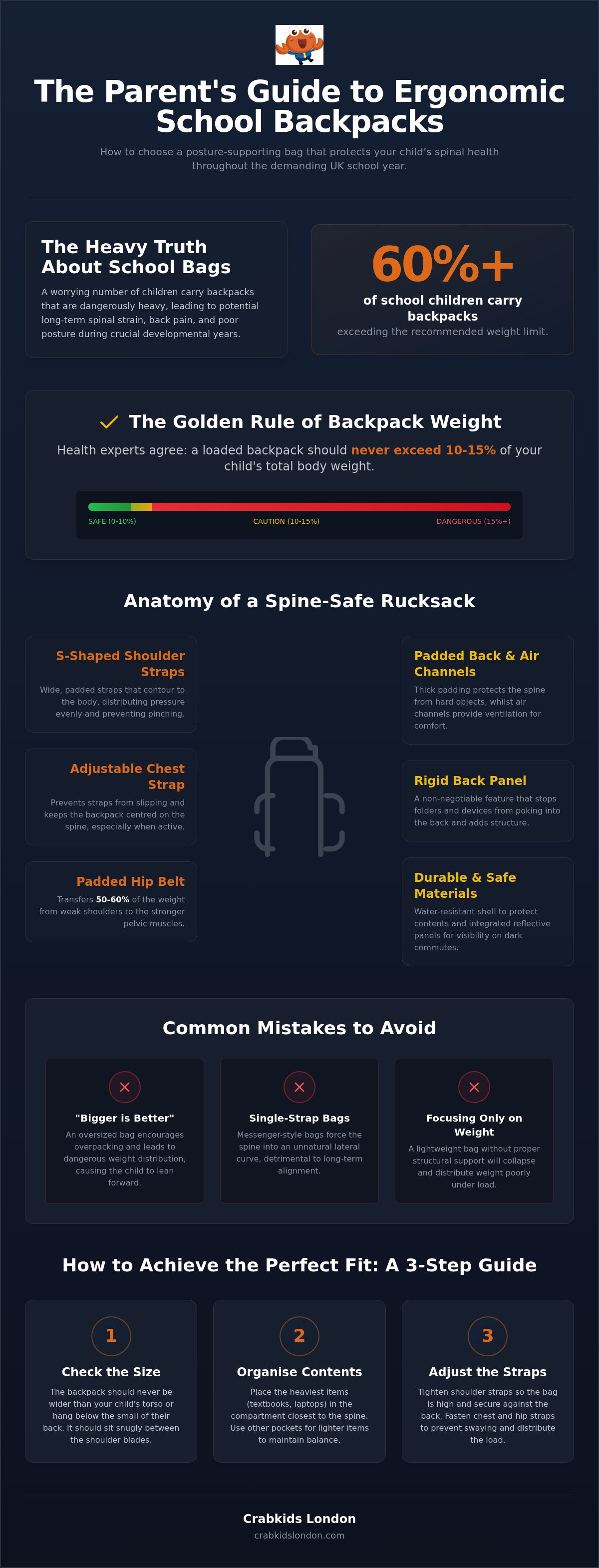
Health experts recommend a strict "10-15% rule" for school gear. A child should never carry a loaded bag that weighs more than 15% of their total body weight. Carrying more forces the neck and shoulders into unnatural positions. This often results in "textbook neck," a condition where the head sits too far forward, causing tension and headaches. By looking at the history and design of backpacks, we can see how modern engineering now prioritises spinal health over simple storage. A well-designed bag does the heavy lifting so your child's muscles don't have to.
The Anatomy of a Posture-Supporting Rucksack
A truly ergonomic bag uses specific components to manage weight effectively. Wide, S-shaped shoulder straps contour to the body to prevent pinching and distribute pressure across a larger surface area. Thick back padding provides a necessary buffer, whilst internal compartments allow you to organise heavy books closest to the spine. A rigid back panel is non-negotiable. It stops the sharp corners of folders or tablets from poking into the child's back. Air-mesh fabrics are also essential for the UK school year, keeping the child cool and comfortable during the daily commute.
Common Misconceptions About Childrens School Bags
Many parents believe "bigger is always better" to accommodate growing piles of homework and kit. In reality, an oversized bag often leads to overpacking and dangerous weight distribution. Another common mistake is choosing single-strap messenger bags for older students. These bags force the spine into a lateral curve, which is detrimental to long-term spinal alignment. Don't assume that "lightweight" is the only metric that matters. A bag must balance a low starting weight with enough structural support to hold its shape under pressure. You can find a range of robust, supportive options in our school bags collection that strike this exact balance.
Essential Design Features for Maximum Carrying Comfort
Selecting an ergonomic school backpack for kids requires looking past the surface design. You need a system that works with the body. A high-quality bag uses a "Three-Point Support" structure to stabilise the load. This involves the shoulders, chest, and hips working in unison to distribute weight evenly. Beyond posture, the UK's unpredictable climate makes water-resistant fabrics a necessity rather than a luxury. Protecting schoolbooks from a sudden downpour is essential for the longevity of the kit. For those darker winter months, high-visibility reflective strips are vital safety additions for any child walking to school.
- Water-resistant outer shell: Keeps contents dry during the British autumn and winter.
- Integrated reflective panels: Ensures visibility during the darker morning and afternoon commutes.
- Adjustable chest and hip fasteners: Secures the bag to the torso to prevent swaying.
- Deeply padded back section: Protects the spine from the hard edges of books and tablets.
The Role of Adjustable Chest and Waist Straps
Chest straps play a crucial role by preventing shoulder straps from slipping outwards. This keeps the bag perfectly centred on the spine, even when your child is running. For heavier loads, a padded waist belt is the most effective way to protect the back. It transfers between 50-60% of the bag's weight from the delicate shoulders to the stronger pelvic area. This shift in weight distribution significantly reduces the risk of muscle fatigue. When choosing a bag, ensure the buckles are sturdy yet easy for small hands to operate independently. If you're looking for gear built for the school run, our range of durable school accessories offers these mechanical benefits as standard.
Padded Back Panels and Breathable Channels
Comfort isn't just about softness; it's about temperature control. Quality ergonomic bags feature vertical air channels between the padding sections. This creates a "chimney effect," allowing warm air to rise and escape, which prevents a sweaty, uncomfortable back during long commutes. Following Backpack safety tips for parents can help you identify if the padding is sitting correctly against the lumbar region. Lumbar support is a critical feature that provides a firm cushion for the lower back, preventing the bag from pulling the child's centre of gravity backwards.
Selecting the Correct Capacity and Size by Key Stage
Choosing an ergonomic school backpack for kids is not just about picking a favourite colour. It's a matter of geometry. A bag that's too large forces the child to lean forward to compensate for the centre of gravity being pulled backwards, creating unnecessary physical strain on the neck and lumbar region. To get the fit right, the backpack should never be wider than the child's torso. It should also never hang below the small of their back. We recommend measuring from the prominent bone at the base of the neck to the top of the hip bone to find the maximum height the bag should be.
Adhering to orthopedic guidelines for backpack use ensures the bag sits high and tight against the spine. Oversized rucksacks are a common trap for parents. They provide too much space, which encourages over-packing. When there is extra room, children often fill it with unnecessary items, leading to a load that far exceeds the safe weight limits discussed earlier. A bag that fits the child's current frame, rather than one they will "grow into," is essential for spinal health.
Primary School (KS1 & KS2): Focus on Lightweight Agility
For younger children in Key Stage 1 and 2, a capacity of 15 to 20 litres is usually sufficient. At this age, the priority is a lightweight frame that doesn't overwhelm their smaller stature. Look for easy-access buckles that allow for independent use and S-shaped straps that prevent slipping. A stable posture starts from the ground up, so it's helpful to consult a shoe size guide to ensure their footwear provides the necessary support for the extra weight on their back. This foundation helps prevent the "wobble" often seen with poorly fitted gear.
Secondary School (KS3 & KS4): Balancing Load and Style
As students enter secondary school, the volume of equipment increases significantly. A capacity of 25 to 35 litres is standard for accommodating laptops, PE kits, and heavy textbooks. It's essential to look for reinforced laptop sleeves positioned against the back panel to keep the heaviest weight closest to the body's centre of gravity. Whilst style becomes more important at this stage, finding a high-quality ergonomic school backpack for kids remains the priority for long-term health. You can explore our boys' school rucksacks and girls' options to find designs that balance these academic requirements with a professional look that lasts.
How to Properly Organise and Fit Your Child’s Backpack
Even the most advanced ergonomic school backpack for kids will fail to protect a child’s spine if it isn't fitted correctly each morning. A high-quality bag is half the battle; the other half is how you manage the load. Establishing a daily routine ensures that the bag’s built-in design features actually do their job. Proper fitting isn't a "set and forget" task. It requires consistent attention to keep pace with a child’s movements and the changing weight of their school kit.
Start by tightening the shoulder straps every single morning. Straps naturally loosen over the course of a school day as children run, jump, and drop their bags on the playground. If left loose, the bag sags, pulling the shoulders backward and straining the neck. You should also perform a weekly "clutter audit." Children are notorious for collecting unnecessary items like old handouts, heavy stones, or broken stationery. Clearing these out prevents "weight creep," where the bag becomes gradually heavier without any academic benefit. Always follow the "Heavy-to-Back" rule: place the heaviest items, such as large A4 folders and textbooks, in the compartment closest to the child’s spine. This keeps the weight aligned with the body's natural centre of gravity.
Step-by-Step Fitting Guide for Parents
Achieving the perfect fit takes less than a minute but provides all-day comfort. First, position the bag so the top is level with the shoulders and the bottom sits comfortably above the waistline. Adjust the shoulder straps so there is no visible gap between the padded back panel and the child’s back; the bag should feel like an extension of their body. Finally, fasten the chest strap to pull the weight inward toward the chest. This reduces the "pendulum effect," which is the swaying motion that can throw a child off balance whilst they walk or climb stairs.
Smart Packing Strategies for Busy Mornings
Efficient packing is about balance and protection. Use side pockets for water bottles to distribute weight evenly across the horizontal axis and prevent internal leaks from reaching homework. Organise smaller, lighter items in the front pockets to keep the main compartment streamlined and easy to navigate. An organised bag prevents the centre of gravity from shifting and causing trips or falls. To ensure your child is fully prepared for the rigours of the term, browse our latest durable school accessories designed for active UK students.
The Crabkids London Difference: Durability and Postural Support
Crabkids London stands as a reliable partner for parents who value resilience and professional craftsmanship. We understand that a school bag isn't just a container; it's a piece of equipment that faces daily wear and tear. Our designs prioritise performance, using premium, scuff-resistant materials that withstand the unpredictable playground behaviour of active kids. Choosing an ergonomic school backpack for kids from our range means selecting a product built for the full lifecycle of the school year. We combine this focus on strength with a commitment to fast UK delivery, ensuring you have the right kit exactly when you need it.
Our approach to spinal health is grounded in the reality of the school run. We don't just look at the bag in isolation. We consider the entire physical experience of the student. By linking our expertise in durable school shoes with our accessory range, we provide a complete solution for postural support. A high-quality rucksack is only effective if the child is standing on a stable, supportive foundation.
A Holistic Approach: Shoes and Bags Working Together
A supportive shoe provides the stable foundation needed to carry a backpack safely. When a child carries a load, their centre of gravity shifts, placing extra pressure on the feet and ankles. If they are wearing ill-fitting or unsupportive footwear, their gait often changes to compensate for the weight. This poor alignment can exacerbate the strain caused by even the best ergonomic school backpack for kids. Consulting our leather school shoes for girls guide ensures your child has the structural support required to maintain a healthy posture from the ground up.
Investing in Longevity for the School Year
Buying quality once is always more economical than replacing cheap, flimsy bags every half-term. Low-cost alternatives often lack the reinforced stitching and structural integrity needed to survive a locker or a rainy bus stop. Our school bag collection focuses on longevity, ensuring that zips don't stick and straps don't fray under pressure. We take a no-nonsense, practical specialist approach to design. This gives parents the quiet confidence that their investment will protect their child's physical development whilst providing the resilience expected in a demanding school environment.
Equipping Your Child for a Healthy School Year
Selecting the right ergonomic school backpack for kids is a vital step in protecting their developing spine. By matching the bag's capacity to your child’s Key Stage and following the "Heavy-to-Back" packing rule, you're significantly reducing the risk of chronic strain. Consistent daily maintenance, such as tightening shoulder straps and clearing out unnecessary weight, ensures that these design features continue to provide maximum support throughout the term.
At Crabkids London, we're dedicated to providing high-quality kit that withstands the high-energy reality of childhood. Our bags are expertly designed for active children, offering long-lasting performance that you can rely on. With our fast UK delivery for last-minute back-to-school shopping, you can organise your child's essentials without the usual stress. Browse our 2026 collection of durable school rucksacks today to secure a bag that works as hard as they do. You've now got the tools to ensure your child stays comfortable, focused, and supported all year long.
Frequently Asked Questions
Is a heavier backpack always more durable for school?
Not necessarily. A heavier empty weight often indicates thick, non-technical materials rather than superior durability. Modern, high-performance fabrics provide excellent scuff-resistance without the bulk. Look for reinforced stitching at stress points and high-quality zips instead of sheer material thickness. An ergonomic school backpack for kids should be as light as possible whilst maintaining its structural integrity to survive the rigours of the playground and daily commute.
How can I tell if my child’s school bag is too heavy?
Apply the "10-15% rule" by weighing the loaded bag; it should never exceed 15% of your child's body weight. Watch for physical cues during the morning walk. If your child leans forward significantly, struggles to put the bag on independently, or has red marks on their shoulders, the load is too high. Persistent complaints of back or neck pain are clear indicators that the contents need a thorough weekly audit.
What is the best way to clean an ergonomic school backpack?
Most ergonomic bags benefit from regular spot cleaning with a damp cloth and mild detergent. Avoid using a washing machine, as the agitation can damage internal structural panels, foam padding, and water-resistant coatings. For stubborn stains, use a soft brush to gently lift dirt from the fabric. Ensure the bag is completely air-dried in a well-ventilated area, away from direct heat sources, before it's used for the next school day.
Do ergonomic backpacks really prevent back pain in children?
Yes, they play a critical role in injury prevention by distributing weight across the strongest parts of the body. Feature-rich designs use chest straps and padded waist belts to transfer the load from the shoulders to the hips. This prevents the slouching and "textbook neck" common with standard rucksacks. Whilst they can't stop a child from over-packing, an ergonomic school backpack for kids provides the mechanical support needed for a healthy posture.
Can my child use a hiking rucksack as a school bag?
Whilst hiking rucksacks offer excellent support systems, they often lack the specific dimensions and internal organisation required for school life. Technical outdoor gear is frequently too long for a child's torso, potentially causing the bag to hit the back of their legs. School-specific designs include dedicated sleeves for A4 folders and laptops, which keep the heaviest items flat against the spine. This internal structure is essential for maintaining stability.
Should I choose a backpack with a built-in laptop sleeve?
Yes, but ensure the sleeve is positioned against the back panel. Placing a heavy laptop in a padded section closest to the spine is a key principle of "Heavy-to-Back" packing. This prevents the device from pulling the child's weight backwards and protects the expensive hardware from being crushed by textbooks. A built-in sleeve also provides a rigid layer that stops other items from poking into the back, enhancing overall daily comfort.
How often should I adjust the straps on my child’s rucksack?
You should check and adjust the straps every morning. Shoulder straps naturally loosen as children move, run, or swing their bags during the day. A quick tug each morning ensures the bag remains high on the back and tight against the shoulders. You should also re-evaluate the fit whenever your child changes their clothing layers, such as switching from a light jumper to a thick winter coat, to maintain the correct alignment.
What is the difference between a rucksack and a backpack for school?
In a modern school context, the terms are often used interchangeably. Historically, a rucksack refers to a larger, more rugged bag used for carrying heavier loads over longer distances, often featuring more technical support like waist belts. A backpack is a more general term for any bag carried on the back. For school gear, the name matters less than the presence of ergonomic features like S-shaped straps, padded back panels, and adjustable fasteners.