

Children's Shoe Size Guide UK: The Definitive 2026 Fitting Handbook
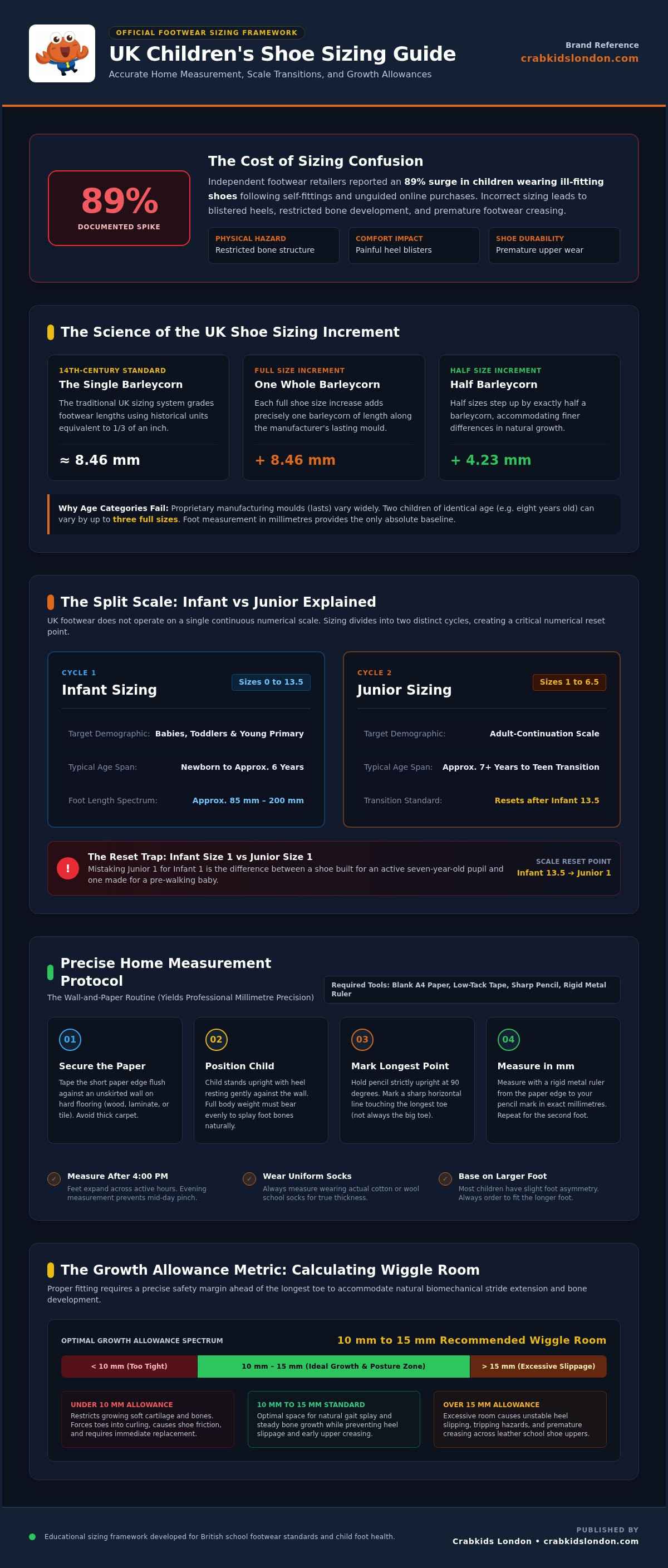
An independent footwear retailer documented an 89% spike in children wearing ill-fitting shoes following self-fittings and online purchases. Sizing confusion is genuinely exhausting for busy households. Deciphering the sudden jump from infant to junior sizing, second-guessing width, and managing repeat postal returns leaves parents constantly worried about blistered heels or restricted bone development. Skipping high-street queues shouldn't mean sacrificing comfort; finding a reliable children's shoe size guide UK families can depend on is essential for growing feet.
Getting the dimensions right on the first try protects natural posture and prevents premature shoe wear. In this guide, you'll learn how to measure foot length and width accurately at home in millimetres, account for the crucial 10 to 15 millimetres of wiggle room, and convert those measurements to standard UK shoe sizes with total confidence. We break down simple measuring routines, clear conversion charts, and professional fitting checks to secure comfortable school shoes that support healthy, active days.
Key Takeaways
- Master the distinction between UK infant and junior sizing scales to avoid ordering the wrong size bracket.
- Learn a simple wall-and-paper tracing technique to capture precise foot length and width measurements in millimetres at home.
- Consult our comprehensive children's shoe size guide UK conversion table to align millimetre foot measurements seamlessly with UK and European sizing.
- Calculate the correct growth allowance to protect growing bones while preventing blister-causing heel slippage and premature shoe creasing.
- Identify durable leather school shoe styles and practical fastenings that withstand daily playground wear and tear.
Understanding the UK Children's Shoe Sizing System
British footwear sizing rests on an unusual historical standard. The traditional UK shoe size system originated in the 14th century, using the length of a single barleycorn, equivalent to one-third of an inch or roughly 8.46 millimetres, as the basic grading increment. Full sizes represent one barleycorn of length, while half sizes step up by half a barleycorn. While shoe construction has evolved dramatically, this imperial legacy still underpins modern sizing. High-street brands frequently plaster approximate ages across shoe boxes, but relying on age categories creates costly guesswork. A dependable children's shoe size guide UK families can rely on starts with understanding how these traditional numbers operate.
Infant Sizes vs Junior Sizes Explained
The most frequent point of confusion for parents is the abrupt split scale between infants and juniors. UK children's footwear does not run in a single, continuous numerical sequence. Instead, it operates across two distinct cycles:
- Infant Sizing (Size 0 to 13.5): Covers babies, toddlers, and younger primary school children up to approximately six years of age. It starts at newborn booties (roughly 85 millimetres) and progresses up to Infant 13.5 (roughly 200 millimetres).
- Junior Sizing (Size 1 to 6.5): Represents adult-continuation sizing. Once a child outgrows Infant 13.5, the numerical counter resets to Junior 1, continuing upward until transitioning into adult ranges.
Mistaking a Junior Size 1 for an Infant Size 1 is an easy slip, yet it means the difference between a shoe built for an active seven-year-old and one designed for a pre-walking baby.
Why Foot Length in Millimetres Matters Most
Shoe manufacturers construct uppers over proprietary foot moulds known as lasts. Because these lasts differ significantly across brands, a nominal size 12 from one maker often fits differently than a 12 from another. Age-based shoe sizing is even less reliable; two eight-year-olds can easily differ by three full shoe sizes.
Relying on foot length in millimetres provides a fixed, objective metric that bypasses brand inconsistencies. Measuring length along with overall shape ensures the footwear accommodates natural ball width and instep height without pinching. Consult our comprehensive shoe size guide to match exact millimetre measurements directly to the correct size bracket for school footwear.
How to Measure Your Child's Feet Accurately at Home
Bypassing busy weekend shopping queues starts with reliable at-home measuring. While high-street shops steer parents toward plastic measuring devices or in-store appointments, a precise sheet of paper and a flat wall yield professional results. Gathering a few standard household items takes seconds: a sheet of blank A4 paper, low-tack masking tape, a sharp pencil, and a rigid metal ruler. Establishing your own routine eliminates the guesswork of online ordering, giving you an exact metric to reference against any children's shoe size guide UK retailers provide.
Step-by-Step Tracing and Measuring Guide
Precision requires proper stability. Follow these steps to capture the true dimensions of your child's feet:
- Secure the paper: Tape the short edge of the paper flush against an unskirted wall on hard, uncarpeted flooring such as wood, laminate, or tile.
- Position your child: Have your child stand straight on the paper with their heel resting gently against the wall. Both feet must bear their full body weight evenly so the bones and soft tissues naturally splay.
- Mark the longest point: Hold your pencil completely upright at a strict 90-degree angle. Draw a single, sharp horizontal line touching the tip of the longest toe, which is not always the big toe.
- Measure the distance: Use your ruler to measure the exact millimetres between the straight paper edge and your pencil mark. Repeat this process for the second foot.
Best Practices for Reliable Home Measurements
Timing alters foot dimensions noticeably. Feet naturally swell across active hours, expanding by several millimetres by late afternoon. Measuring after 4:00 PM ensures you don't purchase shoes that feel uncomfortably tight halfway through the school day.
Always conduct this check whilst your child wears the exact thickness of cotton or wool uniform socks they'll wear on school days. Nearly all children have slight asymmetry, meaning one foot is slightly longer or wider than the other. Always take the larger measurement as your primary baseline to protect the longer foot from compression. Once you have your numbers, check our practical shoe size guide for brand-specific sizing measurements before exploring hard-wearing footwear from Crabkids London.
UK Children's Shoe Size Conversion and Width Chart
Converting bare-foot millimetre measurements into production sizes requires an accurate comparison scale. Continental European sizing steps up in intervals of 6.67 millimetres (known as Paris points), whereas British sizing increases by 8.46 millimetres per full size. Because these two systems never align uniformly, referencing a precise children's shoe size guide UK comparison matrix eliminates rounding errors when ordering school footwear.
Comprehensive UK, EU, and Millimetre Size Matrix
Aligning raw foot lengths with the correct size ensures you choose footwear with adequate room for development. Use these primary reference brackets when converting measurements:
- UK Infant 3 to 6: Covers 115 mm (UK 3 / EU 19) to 140 mm (UK 6 / EU 23). Suitable for early nursery and active toddler steps.
- UK Infant 7 to 9.5: Covers 149 mm (UK 7 / EU 24) to 170 mm (UK 9.5 / EU 27.5). Standard nursery and reception entry sizing.
- UK Children 10 to 13.5: Spans 174 mm (UK 10 / EU 28) up to 204 mm (UK 13.5 / EU 32.5). Primary school infant tier.
- UK Junior 1 to 6.5: Progresses from 208 mm / 20.8 cm (Junior 1 / EU 33) to 254 mm / 25.4 cm (Junior 6.5 / EU 40). Covers key stage 2 and secondary transition stages.
Assessing Width and Instep Volume at Home
Length is only half the equation. Shoe volume dictates whether a shoe pinches or slips off during morning playtime. British footwear traditionally utilises an alphabetical letter system to denote width fittings:
- E Fitting (Narrow): Designed for slim feet with shallow insteps.
- F Fitting (Standard): The standard profile fitting roughly 70% of British school children comfortably.
- G Fitting (Wide): Offers additional circumference across the metatarsal joints and extra height over the instep.
- H Fitting (Extra-Wide): Accommodates broad, fleshy feet or high-volume arches needing substantial internal volume.
Checking width at home requires only a flexible tailor's tape. Wrap the tape gently around the widest part of your child's bare foot, situated across the prominent joints at the base of the big and little toes. If a standard shoe produces lateral bulge, skin redness along the outer edges, or stretching seams, move up to a wider fitting rather than purchasing an excessively long size.
Fitting Rules: Calculating Growth Room and Checking Comfort
Buying children's school shoes isn't just about matching current length; it's about anticipating dynamic foot movement. A resting foot expands significantly when bearing weight during a sprint across the playground. An authoritative children's shoe size guide UK parents can trust must account for this elongation. While tempting, sizing up excessively to make shoes last two school years causes severe issues. Overly long footwear creates tripping hazards, sparks heel blisters, and causes deep structural creasing across the leather vamp, ruining the shoe prematurely.
The Science of the Thumb Rule and Toe Clearance
Industry standards specify an allowance of 10 to 15 millimetres between the tip of the longest toe and the internal end of the shoe. An allowance of 12 to 14 millimetres serves as the practical sweet spot for school footwear:
- Functional Movement (approx. 5 mm): When a child pushes off during stride transitions, the foot elongates and the toes spread laterally. Without this initial gap, toes strike the hard internal toe puff with every step.
- Natural Growth Room (approx. 7 to 9 mm): Toddler feet can leap a full size every two to three months, while children aged seven to ten grow half to a full size every five to six months. This space accommodates healthy growth without constricting soft cartilage.
Perform the classic thumb check while your child stands straight. Press down gently sideways across the front edge: you should feel approximately half an adult thumb-width of clear space ahead of the longest toe. Read our analysis on how school shoe fit affects durability to understand how proper clearance protects internal shoe structure from early collapse.
Telltale Signs Shoes Are Too Tight or Too Loose
Children rarely complain about painful shoes early on because their nerve endings are still developing alongside soft bones. You must assess fit through physical inspection and movement checks indoors on clean surfaces:
- Gait irregularities: Watch your child walk across hard floors. Clumping steps, heel slippage, or dragging feet indicate excessive length. Stiff, cautious steps often point to pinched toes.
- Physical indicators: Red pressure marks across the instep, curled toes, or red patches at the Achilles tendon show severe friction.
- Premature wear: Look underneath the shoe. Heavy scuffing concentrated purely at the toe tip or excessive creasing across the forefoot reveals a poor fit.
Secure the right balance between comfort and lasting durability by ordering supportive school footwear from Crabkids London.
Choosing the Right School Shoes Online with Confidence
Selecting durable footwear online doesn't need to involve speculative multi-size orders or endless post office returns. Armed with precise millimetre measurements, you can bypass crowded shopping centres and pick hard-wearing pairs built for rigorous playground activity. High-grade leather uppers remain the benchmark for school footwear because genuine leather moulds naturally to foot contours while maintaining breathability across long school days. Sturdy leather construction also prevents unsightly structural creasing, extending footwear lifespan significantly. Using an accurate children's shoe size guide UK families can secure school-ready shoes that protect developing feet straight out of the box.
Fastening Types and Ankle Support Considerations
Fastenings play a vital role in maintaining heel stability and midfoot support throughout active school routines:
- Rip-tape straps: Ideal for younger pupils in reception and key stage 1, double or triple hook-and-loop straps encourage independent dressing for PE whilst providing quick, adjustable midfoot support.
- Lace-up styles: Traditional Oxford or Derby lace-ups suit older juniors who need customised instep tension to stop forward foot slippage during active play.
- Classic buckles: Mary Jane and T-bar fastenings keep shoes securely anchored at the ankle collar, preventing frustrating heel slippage.
Explore our resilient collections of boys' school shoes and girls' school shoes engineered specifically to handle daily playground wear and tear.
Establishing a Regular Sizing Routine
Children's bones remain soft and pliable throughout childhood, meaning substantial growth spurts often arrive without complaints of pain. Establishing a proactive calendar routine keeps footwear comfortable and compliant:
- Toddlers and infants (under 4 years): Check foot length every two to three months, as rapid development can see feet jump an entire size in twelve weeks.
- Primary and junior pupils (ages 4 and above): Re-measure feet every three to four months to preempt toe compression before a new school term begins.
Keeping a regular log of millimetre measurements ensures you order replacements before tight toe boxes cause blisters or affect natural bone alignment. Discover durable, playground-tested footwear across our latest new arrivals to keep your child comfortable every day of term.
Equip Growing Feet for School Success
Accurate home measuring removes the stress and uncertainty of online footwear shopping. Grounding your choices in exact millimetre measurements, assessing instep volume, and reserving that crucial 12 to 14 millimetres of toe clearance protects developing bones whilst preventing blister-causing friction. By following a reliable children's shoe size guide UK parents can bypass sizing guesswork, prevent premature shoe creasing, and guarantee all-day classroom comfort.
Long-lasting footwear starts with robust craftsmanship designed to endure rough tarmac and energetic breaktimes. Pairing verified foot dimensions with playground-tested durable leather construction engineered for active UK school days ensures footwear holds its structural shape term after term. Supported by reliable UK-wide delivery for busy families, outfitting growing children is completely stress-free. Find the perfect fit with durable school shoes at Crabkids London and give your child the dependable support they need to thrive.
Frequently Asked Questions
How often should I measure my child's feet for school shoes?
Measure your child's feet every two to three months for toddlers under four, and every four to six months for primary and secondary school pupils. Children's feet develop in sudden growth spurts rather than continuous, gradual shifts. Establishing a regular measuring schedule ahead of each school term prevents painful toe compression and ensures leather school footwear retains its structural integrity without premature stretching.
What is the difference between infant and junior shoe sizes in the UK?
UK infant sizes run from size 0 to size 13.5, after which the numbering scale resets to junior size 1. Infant shoes cater to nursery toddlers and reception starters up to approximately six years of age. Junior sizes represent adult-continuation sizing for children aged seven and older. Referencing a verified children's shoe size guide UK chart prevents confusing an infant size 1 with a junior size 1.
How much extra room should you leave in children's shoes for growth?
You should leave between 10 and 15 millimetres of clear space, roughly half an adult thumb-width, between your child's longest toe and the end of the shoe. An allowance of 12 to 14 millimetres is ideal for everyday school shoes. This space accommodates natural foot elongation during walking strides while providing room for healthy bone development without creating a loose tripping hazard.
Can I use an adult ruler or tape measure to find my child's shoe size?
Yes, a standard rigid metal ruler paired with blank paper provides dependable foot length measurements in millimetres. While flexible tailor's tapes work well for measuring joint circumference, measuring foot length requires a flat, unbending edge. Place paper flush against a wall, mark the longest toe while your child stands upright bearing full weight, and measure from the paper's edge to secure an accurate baseline.
How do I know if my child needs wide fit school shoes?
Your child likely requires a wide fitting (G or H) if their shoes show bulging leather along the sides, red marks across the metatarsal joints, or straining upper seams. If a shoe matches your child's length perfectly but pinches across the widest part of the foot, choose a wider fitting. Never simply size up in length, as excess toe space causes heel slip and severe blistering.
What should I do if one of my child's feet is bigger than the other?
Always purchase footwear based on the exact dimensions of your child's larger foot. Natural foot asymmetry is common in growing children. Sizing to the smaller foot forces toes into cramped quarters on the larger side, restricting healthy joint growth. To secure the fit on the slightly smaller foot, select shoes with adjustable rip-tape straps or laces to stabilise the instep securely.
Are UK children's shoe sizes identical to EU shoe sizes?
No, UK children's sizes do not align identically with Continental European sizing because each system uses different measurement intervals. British sizing increases by 8.46 millimetres per full size, whereas European sizing expands by 6.67 millimetres per Paris point. Because of this mathematical discrepancy, direct conversions vary across half-sizes, making an accurate children's shoe size guide UK conversion table essential before purchasing.