

Breathable School Shoes for Sweaty Feet: A Parent's Guide
At the end of the school day, your child takes off their shoes and their socks feel damp. It’s uncomfortable, and a pair labelled “breathable” doesn’t always make it clear what to look for. Breathable school shoes for sweaty feet can help, but comfort depends on more than the shoe alone.
Fit, the materials around the foot, socks and daily care all play a part. Shoes that feel too snug may leave little room for toes, while socks that hold on to moisture can feel uncomfortable. School rules and everyday wear matter too: a practical choice needs to suit the uniform and cope with an active day.
This guide explains how to assess shoe materials and fit, choose socks with comfort in mind, and air and care for footwear between wears. You’ll also find a practical way to weigh breathability against durability and school requirements, so you can make a considered choice for your child’s routine.
Key Takeaways
- Breathability describes how heat and moisture may escape, but a label alone can’t tell you how a shoe will feel during a school day.
- Compare uppers, linings and internal space when weighing breathable school shoes for sweaty feet against durability and school requirements.
- Check that the shoe fits comfortably, with room for toes and a fastening your child can manage.
- Consider socks as part of the comfort picture, and air shoes between wears so they have time to dry.
- Use a practical checklist to balance fit, construction, materials and school suitability rather than relying on one feature.
Why do children’s feet get sweaty in school shoes?
Warm, damp socks at home time are a familiar frustration for parents. A school day can involve walking between lessons, running at break and sitting in warm classrooms, all while wearing enclosed footwear for hours. Some warmth and perspiration can be part of an active day. The practical question is whether the shoes, socks and daily routine help moisture escape or leave feet feeling uncomfortable.
Breathability describes how footwear allows heat and moisture to escape from around the foot. It’s a useful way to think about shoe comfort, but it doesn’t guarantee that feet will stay cool or dry. Fit, construction, socks and how long shoes are worn all affect how they feel.
What makes feet feel hot and damp during the school day?
Movement generates warmth, and feet naturally perspire. Inside an enclosed shoe, warmth and moisture can build up, particularly if the fit feels restrictive or socks stay damp. The effect varies from child to child. One may spend break running outside, while another spends more time indoors; they may also wear their shoes for different lengths of time.
Ordinary sweating after activity is different from symptoms that persist or cause concern. This guide can’t diagnose a cause. If sweating seems excessive, continues outside the usual school routine or comes with other worrying symptoms, seek advice from a GP or another suitable health professional. Plantar hyperhidrosis is a medical term for excessive sweating affecting the soles, but a damp sock alone doesn’t establish that condition.
Does a breathable label guarantee comfortable school shoes?
No. A label doesn’t tell you how the shoe fits your child, how its lining feels, how it’s constructed or how it will suit their particular school day. A shoe may have a feature intended to support airflow, yet still feel uncomfortable if it’s too tight, doesn’t suit your child’s activity or is worn with socks that become damp.
Look at the whole shoe rather than relying on one marketing phrase. Check that the fit gives toes room, consider how the upper and lining feel, and see whether the fastening holds the shoe securely without pressure. Then consider the routine around it: comfortable socks, time for shoes to air between wears, and care that keeps them ready for daily use.
This joined-up approach is a useful starting point for choosing breathable school shoes for sweaty feet. The next sections look at materials and construction, then compare practical features without treating any one of them as a universal solution.
Which school-shoe materials and features can help manage moisture?
The upper, lining and shape of a school shoe all affect how it feels during wear. Product descriptions may mention leather, mesh or other textiles, but a material name alone can’t tell you how much heat or moisture will escape. Construction matters too: the thickness of the lining, how enclosed the shoe is and the space around the foot can all influence comfort.
Materials and construction can affect how a shoe feels, but they don’t guarantee a cooler foot. Treat claims about breathability as a reason to look closer, not proof that a pair will suit every child. Fit and socks matter as well, so assess the complete combination.
How should parents compare shoe uppers and linings?
Look for product descriptions that identify the upper and lining materials, rather than relying on broad phrases such as “breathable design”. Consider how the inside feels and whether the shoe’s construction seems heavily enclosed or leaves more open space around the foot. Neither approach is right for every child. Weigh comfort against the school’s rules, the conditions the shoes will be worn in and the demands of an active day.
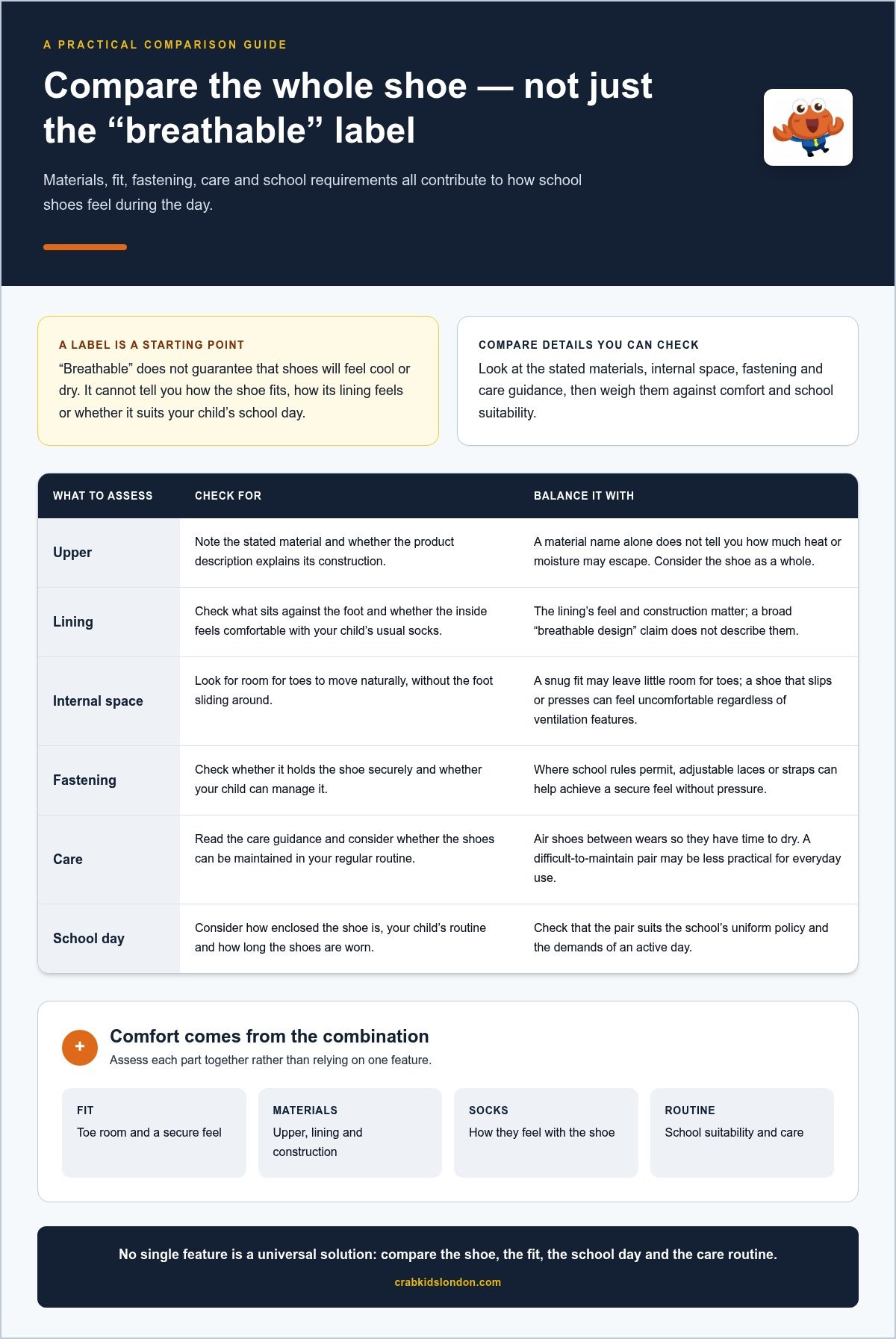
Use these checks to make product details more useful:
- Upper: Note the stated material and whether the description explains its construction.
- Lining: Check what sits against the foot and whether the inside feels comfortable with your child’s usual socks.
- Internal space: Look for room for toes to move without the foot sliding around.
- Care: Consider whether the shoe can be maintained as part of your regular routine.
What shoe features matter beyond breathability?
A comfortable fit should let toes move naturally while keeping the shoe secure. The fastening matters too: adjustable laces or straps, where permitted, can help achieve a secure feel, while a fastening your child can manage supports everyday independence. A shoe that slips or presses in the wrong place may feel uncomfortable regardless of its ventilation features.
School shoes also need to cope with regular wear. Check the construction and care guidance, then consider whether the pair suits your child’s routine and meets the school’s uniform policy. An option that is difficult to maintain may not be practical for everyday use, even if its description sounds appealing.
For a balanced choice, consider fit, construction, socks and care together instead of treating one feature as the answer. You can explore children’s school shoes as part of that practical comparison.
How do you compare breathable school shoes for sweaty feet?
A side-by-side check makes product descriptions easier to assess. Compare details you can verify, such as stated materials, fastening type and care instructions. Treat broad claims like “keeps feet cool” as claims to evaluate, not proof of performance. No single feature suits every child: comfort depends on the shoe, the fit, the school day and the care routine.
Which questions help you assess a school shoe?
Start with three practical questions: does the description explain the materials and construction, can your child move their toes comfortably while the shoe stays secure, and does the design suit school rules and everyday activity? A clear description gives you more to compare. Claims about cooling or moisture control need supporting detail before you can judge what they mean in practice.
| What to compare | What to check | How to weigh it |
|---|---|---|
| Fit | Room for toe movement; heel feels secure | Comfort matters, but the shoe shouldn’t slip |
| Materials | Stated upper materials and construction | Use specifics to compare; don’t assume a material guarantees cooler feet |
| Lining | What sits against the foot | Consider how it feels with your child’s usual socks |
| Fastening | Type and adjustability | Look for a secure fit your child can manage |
| Care | Cleaning and upkeep instructions | Choose a routine that fits everyday use |
| School suitability | Colour, design and uniform requirements | Check the school policy before choosing |
How should comfort and durability be weighed together?
Think through a full school day: walking, lessons, playtime and the journey home. A shoe needs to feel comfortable for your child and cope with regular wear. Care instructions help you judge whether upkeep fits your routine, but a product description can’t promise how long a pair will last. Balance the details rather than choosing solely for a breathability claim or a hard-wearing appearance.
Once you’ve checked your school’s requirements, compare the relevant girls’ school shoes using the same checklist. Boys’ school shoes can be assessed in the same way. Look for a combination of comfortable fit, suitable construction, manageable care and school-appropriate design.
How can fit, socks and daily care help keep feet more comfortable?
A few consistent habits can make school shoes feel more comfortable and help prevent dampness being trapped between wears. Use this routine as a starting point for your child’s breathable school shoes for sweaty feet.
- Check the fit with school socks on. Try shoes with the socks your child usually wears, ideally later in the day when feet may be larger. Check that toes can move comfortably and the heel feels secure, without tightness or slipping. The shoe size guide offers a fuller measuring walkthrough.
- Notice how the fastening feels. Fasten the shoes as your child would wear them to school. They should feel secure without pressing uncomfortably across the foot. A fastening your child can manage also makes getting ready easier.
- Choose socks for comfort. Socks affect how shoes feel against the skin and how comfortable feet feel through the day. Look for a comfortable fit and a fabric that suits your child’s routine. There isn’t one fibre that works best for every child, so pay attention to how the socks feel during wear.
- Change damp socks when practical. If socks are noticeably wet after school or activities, a dry pair may feel more comfortable. Keep the routine simple and suited to your family.
- Air shoes between wears. Remove them after school and leave them somewhere ventilated so they can dry fully before the next wear. Avoid putting damp shoes straight into a closed bag or cupboard.
School socks are a practical part of the overall choice, not an afterthought. Browse the school socks collection to find options to consider alongside your child’s footwear. Follow the shoe-care guidance for the pair, and allow time for drying rather than using direct heat, which may damage some materials.
Comfort comes from the combination of fit, socks and a repeatable care routine. For another look at children’s school shoes and socks, explore Crabkids London.
Choosing breathable school shoes: a practical buying checklist
Use this checklist to compare options without relying on a “breathable” label alone. The aim is to find school shoes that suit your child’s feet, school rules and daily routine, with materials and construction you can assess from the product details.
What should go on your school-shoe shortlist?
- Fit: Try the shoes with the socks your child wears to school. Check for comfortable toe movement and a secure heel, without tightness or slipping.
- Construction: Look for a clear description of the upper and lining. Treat claims about airflow or moisture control as details to assess, not a guarantee of comfort.
- Materials: Note what the product description says the shoe is made from. Consider how the inside feels, and don’t assume one material suits every child.
- Fastening: Choose a fastening that holds the shoe securely and is manageable for your child during the school routine.
- Socks: Include socks in your comfort check. Choose a pair that feels good on your child’s feet and works for their day.
- Care: Read the care guidance and consider whether you can follow it. Make room in the routine for shoes to air and dry between wears.
- School suitability: Check that the colour and design meet the school’s uniform requirements and suit everyday activity.
Comfort is a combination of choices, not a single feature. A well-fitting shoe may still feel warm if socks become damp or footwear doesn’t dry between wears. Equally, a product description that mentions breathability can’t tell you exactly how the shoe will feel on your child’s foot throughout a full school day. Use the checklist as a whole, balancing comfort, school suitability and the durability needed for regular wear.
Where can parents browse school shoes?
Crabkids London offers boys’ and girls’ school shoes, with durable footwear designed for active school life. Compare the available options against your checklist, focusing on the product details rather than assuming a particular material or breathability feature.
Once you know what matters for your child, browse children’s school shoes and make a considered choice for the school routine.
Make a confident choice for the school day
Choosing breathable school shoes for sweaty feet means looking beyond the product label. Check how the shoe fits, what its product description says about materials and construction, and whether its fastening and design suit school rules and your child’s routine.
Comfort also depends on what goes with the shoe. Socks should feel comfortable through the day, and airing footwear between wears gives it time to dry. These practical steps can support comfort without relying on one feature as a fix for every child.
Crabkids offers boys’ and girls’ school shoes for active school life, alongside school socks and shoe-care products. Browse the range and use the points in this guide to compare options for your child.
Browse children’s school shoes and choose a pair that suits your child’s school routine.
Frequently Asked Questions
What makes school shoes breathable?
Breathability describes how a shoe’s construction may allow heat and moisture to escape from around the foot. It doesn’t guarantee comfort: fit, lining, socks and activity all affect how shoes feel through the school day. For breathable school shoes for sweaty feet, look for clear details about the upper and lining, then assess the complete shoe with your child’s usual socks and routine. Don’t rely on a breathability claim alone.
Are leather school shoes breathable for sweaty feet?
Leather is one material parents may encounter, but how a shoe feels depends on its full construction and lining. Leather won’t necessarily prevent sweating, and it isn’t the best choice for every child. Read the product’s material details, check the fit and consider your child’s activity during a typical school day. Balance comfort with the care required, expected wear and your school’s footwear requirements.
Can socks make children’s feet sweat more in school shoes?
Socks can affect how feet feel inside shoes, but there’s no single fibre or style that suits every child. Choose a comfortable, school-appropriate pair, and check that it doesn’t bunch inside the shoe or feel damp during wear. Changing damp socks when practical may help your child feel more comfortable. Explore the school socks collection as you consider footwear and socks together.
How should school shoes fit if a child has sweaty feet?
School shoes should feel secure without pinching, with comfortable room for the toes to move. A suitable fit won’t stop sweating, but shoes that feel tight or uncomfortable can add to irritation during the day. Check the fit with the socks your child wears to school, and reassess as their feet grow. For a measuring walkthrough, use the shoe size guide.
How do you dry school shoes after a sweaty day?
Remove visible dampness and leave shoes to air in a dry, ventilated place until they’re fully dry before the next wear. Don’t store damp shoes straight away, as they need time to dry out. If your family has another suitable pair, alternating footwear can give each pair longer between wears. Regular care helps keep shoes ready for school, but it doesn’t replace choosing a comfortable fit.
Are mesh school shoes suitable for school uniforms?
That depends on your school’s footwear rules, the shoe’s overall design and your child’s daily routine. Mesh is one material you may see in product descriptions, but it doesn’t prove a particular level of breathability or durability. Check the school’s requirements and read the shoe details carefully. Then weigh comfort, fit and suitability for regular wear before deciding whether that design works for your child.
When should I seek advice about my child’s sweaty feet?
Perspiration can vary with activity and conditions, but persistent or concerning symptoms deserve individual attention. If sweating continues, causes your child distress or comes with other concerns, speak with an appropriate healthcare professional. This guide can help with practical footwear choices, but it can’t identify or diagnose a medical cause. Keep shoe, sock and drying routines in view while seeking professional advice for symptoms that worry you.