

Best School Shoes for Boys with High Insteps: The 2026 Parent’s Guide
It is 8:15 am, and you are once again wrestling with a riptape strap that simply refuses to meet its fastening. Your son complains of a sharp pinch across the top of his foot, yet the shoe is technically the correct size. This morning struggle is a classic sign of a high instep, where vertical volume matters just as much as length. Finding the right school shoes for boys with high insteps often feels like an expensive game of trial and error that ends in wasted money and sore feet.
We understand the frustration of investing in quality leather only to find it lacks the necessary depth for a comfortable fit. You need a solution that balances formal school requirements with the high-energy reality of the playground. This guide provides the tools to identify high insteps accurately and select durable footwear that offers all-day comfort without the pressure. We will walk you through simple home measurement techniques and highlight the adjustable designs that ensure a perfect, pinch-free fit for the entire 2026 school year.
Key Takeaways
- Learn how to identify high insteps by recognising the need for vertical volume and spotting common signs like red pressure marks on the top of the foot.
- Discover why deep toe boxes and high-cut vamps are essential features when selecting school shoes for boys with high insteps to ensure all-day comfort.
- Compare the benefits of adjustable riptape and customisable laces to find the most secure and flexible fastening for high-volume feet.
- Master simple at-home fitting techniques, such as the "finger test," to verify that new shoes provide enough space without causing pressure.
- Understand how high-quality leather construction provides a natural stretch that allows footwear to mould to a unique foot shape whilst resisting playground wear.
Understanding High Insteps: Why Standard Boys’ School Shoes Pinch
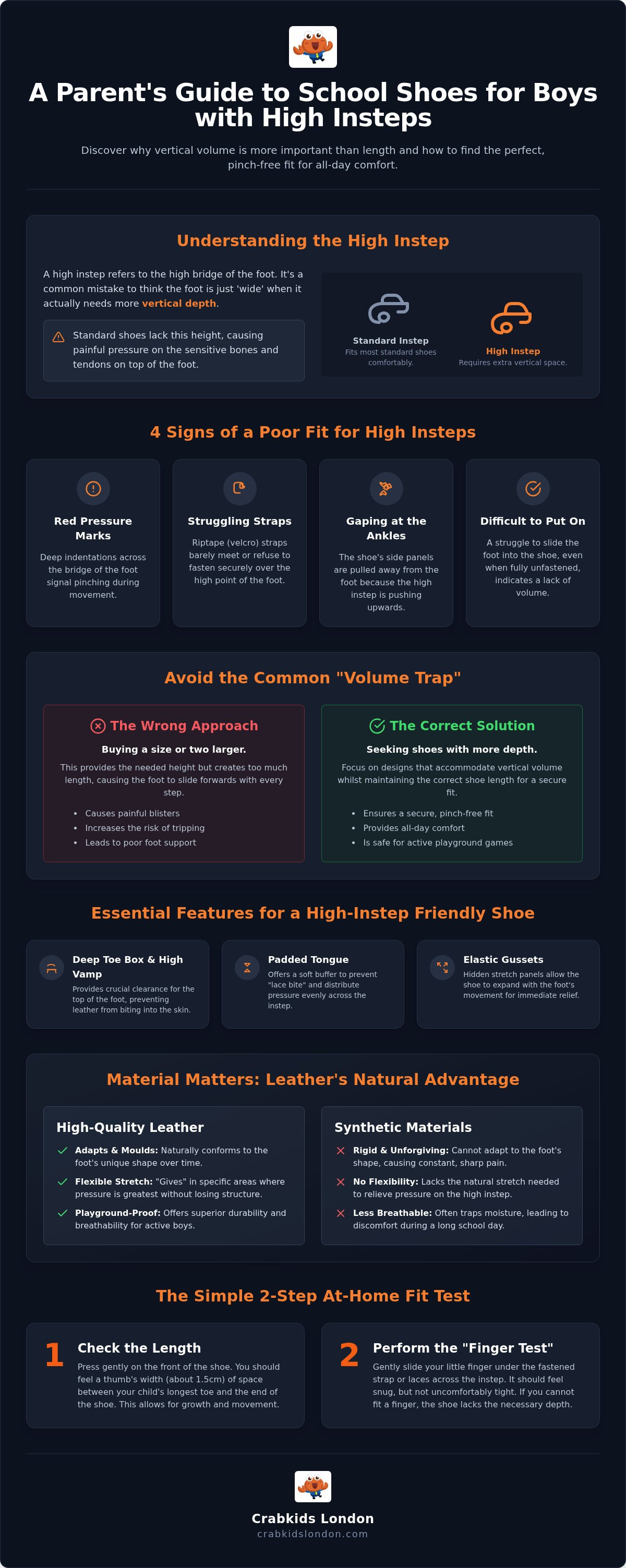
A high instep refers to the bridge of the foot, specifically the upward-facing area located between the toes and the ankle. Many parents mistakenly believe their son has a wide foot when he actually has a high instep. While a wide foot requires extra room across the ball of the foot, a high instep demands vertical depth. If a shoe lacks this height, the leather presses directly onto the sensitive bones and tendons on the top of the foot. This constant pressure is the primary reason standard school shoes for boys with high insteps often cause significant discomfort by the first morning break.
Falling into the "volume trap" is a common mistake during the back-to-school rush. When a shoe feels tight across the top, the natural instinct is to buy one or two sizes larger. This provides the necessary height but leaves far too much room at the front and heel. A shoe that is too long causes the foot to slide forward with every step, leading to painful blisters and increasing the risk of tripping during active playground games. You need depth, not just length, to achieve a secure fit.
The Anatomy of a High-Volume Foot
The physical structure of a high instep often involves a more pronounced bone alignment. For a clinical perspective on how foot structure impacts footwear choice, Understanding High Insteps and high arches can help explain why certain styles simply won't work. Loafers and slip-on styles are notoriously difficult for these children because they lack an adjustable "throat". Without laces or straps to open the shoe wide, the foot cannot enter the shoe comfortably. Choosing a design with a deep throat allows the foot to sit properly within the footbed, preventing the leather from biting into the skin.
Signs of Poor Fit in Active Boys
Identifying a poor fit requires looking beyond the toes once the shoes come off at the end of the day. Check your son's feet for red indentations or deep marks across the bridge of the foot. These marks signal that the shoe is pinching the skin during movement. You might also notice a "gaping" effect at the ankles; this happens when the high bridge of the foot pushes the top of the shoe upward, pulling the side panels away from the foot. To ensure you are starting with the correct baseline, always use a dedicated shoe size guide before making a purchase. If he struggles to slide his foot into the shoe even when it is fully unfastened, the design lacks the necessary vertical volume. Finding the right school shoes for boys with high insteps means prioritising this depth to ensure lasting comfort and durability throughout the school year.
Key Features to Look for in School Shoes for High Insteps
Choosing school shoes for boys with high insteps requires a shift in focus from horizontal width to vertical depth. Standard designs often press down on the bridge of the foot, causing discomfort that worsens as the day progresses. You should look for shoes with a high-cut "vamp"—the part of the shoe that covers the top of the foot. A deeper vamp provides the necessary clearance for a high-volume foot to sit comfortably without the leather biting into the skin. Combining this with a deep toe box ensures the entire foot has room to move naturally during lessons and play.
Specific design details can make a significant difference in daily comfort. Consider these essential features:
- Padded Tongues: These provide a soft buffer between the laces and the delicate top of the foot, preventing "lace bite."
- Elastic Gussets: Hidden stretch panels allow the shoe to expand as the foot moves, offering immediate relief for high-volume feet.
- High-Quality Leather: Natural materials provide a degree of stretch that synthetic alternatives simply cannot match.
The Role of Premium Leather
High-quality leather is essential for active boys. Synthetic materials are rigid and unforgiving, often causing sharp pain where the foot is highest. Leather naturally moulds to the foot's unique shape whilst maintaining its structural integrity. This adaptability is crucial for boys with high insteps, as the material "gives" in the specific areas where pressure is greatest. To keep the leather supple and prevent it from hardening over time, applying a leather shoe cleaning lotion helps maintain the natural flexibility of the upper. This ensures the shoes remain comfortable throughout the entire school year.
Removable Insoles and Depth
Many specialised school shoes for boys with high insteps feature removable insoles. Removing the standard footbed creates "hidden" depth, instantly providing more vertical room without needing to size up. This is particularly useful for boys who use specialist orthotics, as it allows the insert to sit lower in the shoe. Despite the need for extra volume, a sturdy heel counter remains vital. It locks the foot in place and prevents the heel from slipping out of the shoe during high-energy playground activity. Understanding How to Measure and Test for Instep Fit will help you determine if a shoe provides enough internal height. You can explore our collection of durable boys' school shoes to find designs specifically built with these supportive features.
Fastening Styles: Laces vs Riptape for High-Volume Feet
The way a shoe fastens dictates how much vertical volume it can accommodate. For boys with high insteps, fixed openings are the primary enemy of comfort. Slip-on styles, such as loafers, are generally the most difficult to master because they rely on a fixed "throat" height. This height rarely accounts for the extra bridge height of a high-volume foot. If the foot cannot slide in easily, forcing it will only lead to pain and damaged shoe counters. You need a fastening system that allows the shoe to open wide and adjust to the unique height of the bridge.
Before committing to a new pair, always perform the "Strap Test." Fasten the shoe and check how much of the riptape is actually engaged. At least 80% of the strap should be in contact with the loop side to ensure it doesn't pop open during a football match at lunchtime. If the strap barely meets, or if the foot looks "squeezed" from the side, the shoe lacks the necessary depth for your son's foot shape.
Adjustable Riptape Straps
Riptape is a lifesaver for younger children who haven't yet mastered laces. However, standard straps are frequently too short for high insteps, leaving the prickly hook side exposed or failing to reach the loop side entirely. Look for designs with specifically lengthened straps that provide a secure close over a higher bridge. A double-strap system is particularly effective as it allows you to tighten the lower strap for stability whilst leaving the upper strap looser to accommodate the instep. You can find several adjustable options in our boys school shoes collection that prioritise this essential strap length.
The Customisation of Laces
Laced shoes offer the ultimate level of adjustment for school shoes for boys with high insteps. Unlike riptape, which has a fixed anchor point, laces can be loosened at specific points along the foot to relieve pressure. "Parallel lacing," or straight bar lacing, is often superior to the traditional criss-cross pattern. By running the laces straight across, you reduce the number of crossover points where pressure typically builds up on the highest point of the foot. Always ensure the laces are long enough to tie securely without being under constant tension. Tight laces can restrict circulation and cause discomfort during a long school day, so choosing the right length is as important as the shoe itself.
How to Measure and Test for Instep Fit at Home
Finding the right school shoes for boys with high insteps begins with a reliable baseline. Length measurements alone don't tell the full story of vertical volume, as a high bridge requires significantly more internal depth than a standard foot. To get the most accurate results, use a shoe size guide to confirm his current size before assessing how the shoe sits across the bridge of his foot. Measuring in the afternoon is vital, as feet naturally expand throughout the day due to heat and activity.
Always test new footwear with proper school socks. Testing with thin weekend socks or bare feet provides a false sense of space that disappears once he's dressed for the classroom. This ensures the fit accounts for the actual thickness he will wear for six hours a day, preventing unexpected pinching, redness, or blistering during the first week of term. If a shoe feels tight with the correct socks, it lacks the necessary volume for a high instep.
Step-by-Step Home Fitting
Measure the foot in the afternoon when it is at its largest and most expanded. Perform the "Finger Test" by trying to slide your pinky finger between the foot and the top of the shoe (the vamp) while it is unfastened. If there is no room at all, the shoe lacks vertical depth. Next, check the "pinch test" by gently gripping the leather across the bridge; there should be a slight ripple of material. If the material is drum-tight, the instep is too high for that specific model. Ensure he can wiggle his toes freely whilst the fastening remains secure.
The "Walk Test" for Active Boys
Encourage the boy to jump and run to check for heel slippage or top-of-foot rubbing. Movement reveals fit issues that a static test misses. Watch for "bulging" at the sides, which indicates the foot is fighting for space against the leather uppers. Also, check for "gapping" at the ankle; if the shoe fits the bridge but gaps at the heel, the volume is poorly distributed for his foot shape. "A school shoe should feel like a second skin, not a cage for the foot."
Movement is the ultimate test for school shoes for boys with high insteps. Watch for any redness on the bridge of the foot after he has spent five minutes moving around the house. If the shoes pass the jump test without the heel slipping or the top of the foot pinching, you've found a winner. For a selection of durable, high-depth options, view our full collection of leather school shoes.
Durable Solutions: Why Crabkids London Suits High Insteps
Choosing school shoes for boys with high insteps shouldn't mean compromising on durability or style. At Crabkids London, we prioritise high-quality leather construction that provides the natural stretch required for high-volume feet. Unlike rigid synthetic alternatives, our leather uppers mould to the unique contours of the bridge over time. This ensures a custom fit that maintains its smart appearance whilst offering the flexibility needed for active school days. Our commitment to longevity means these shoes are built to survive the entire school year, not just the first term.
Our design philosophy centres on the high-energy reality of childhood. We balance strict school uniform requirements with the practical necessity of accommodating growing feet. By incorporating adjustable fastenings and deeper vamps, we ensure that the pressure points common in standard footwear are eliminated. This no-nonsense approach to craftsmanship means you spend less time worrying about morning discomfort and more time focusing on the school year ahead. Fast UK-wide delivery ensures you can find the right fit quickly, providing peace of mind during the busy back-to-school season.
Built for the Playground
Resisting scuffs and scrapes is essential for any shoe that spends hours on the playground. Our new arrivals feature reinforced soles and specifically treated leather designed to withstand the rigours of daily football matches and active play. These materials maintain their structural integrity even when subjected to constant movement. For a deeper look at how we engineer our footwear for resilience, read our Durable Boys’ Leather School Shoes: The 2026 Buying Guide. This focus on scuff-resistance and sturdy construction ensures your investment remains smart and functional for months to come.
Expert Support for Parents
We understand the nuances of the British school environment, from formal assembly codes to the demands of the rain-soaked playground. Finding the right school shoes for boys with high insteps is made easier through our range of online resources, helping you troubleshoot fit issues from the comfort of your home. We act as a reliable partner, delivering expert guidance alongside our high-performance products. By choosing a brand that understands the physical demands of the school day, you ensure your son stays comfortable and confident. Shop the Boys’ Collection for High Instep Solutions today to secure durable, professional footwear designed for the active life of a modern student.
Step Into All-Day Comfort This Term
Finding the right school shoes for boys with high insteps doesn't have to be a morning struggle. You now know that vertical volume and adjustable fastenings are the real secrets to a pinch-free fit. By prioritising deep vamps and supple, high-quality leather, you ensure your son stays comfortable from the first bell to the final playground game. Remember to test new shoes in the afternoon with proper school socks to verify that the bridge of the foot has the space it needs to move naturally.
We are here to support you with footwear that meets the Red Dot standard for durability and resilience. Our designs focus on longevity, providing a reliable solution for even the most active boys. With our fast UK-wide delivery, you can secure the right size well before the new term begins. Find the Perfect Fit in Our Boys’ School Shoe Collection and give your son the confidence of a shoe that supports every step. We look forward to helping you make this school year his most comfortable one yet.
Frequently Asked Questions
What is the best type of school shoe for a boy with a high instep?
Lace-up models or adjustable riptape designs with specifically lengthened straps are the best type of school shoes for boys with high insteps. These styles allow the "throat" of the shoe to open wide, accommodating the vertical height of the bridge comfortably. Avoid slip-ons or loafers, as they have a fixed height that often pinches the top of the foot. Look for high-quality leather that offers natural stretch and a deep toe box to ensure all-day comfort.
Can I buy wide-fit school shoes for a high instep?
Wide-fit shoes can help, but they aren't always the complete solution for vertical pressure. While a wide-fit shoe provides more horizontal room, a high instep specifically requires vertical depth. Some wide-fit models naturally include more volume throughout the shoe, which may provide some relief. However, it's better to prioritise shoes designed with a high-cut vamp or adjustable fastenings that handle the height of the bridge rather than just the width of the sole.
How do I know if my son has a high instep or just wide feet?
A high instep refers to the vertical height of the bridge. Wide feet refer to the horizontal distance across the ball of the foot. You can identify a high instep if standard shoes feel tight across the top or if the "throat" of the shoe gaps at the sides when walking. Wide feet usually cause pressure at the pinky toe or the base of the big toe instead of the bridge area.
Why do riptape straps on school shoes always pop open on high insteps?
Riptape straps pop open because the vertical volume of a high instep pushes the strap upward. This movement leaves insufficient surface area for the hook-and-loop sections to grip. If the strap barely reaches the other side, the tension from walking causes it to fail. When choosing school shoes for boys with high insteps, look for designs with specifically lengthened straps or double-strap systems that distribute pressure more effectively across the bridge of the foot.
Are lace-up school shoes better than riptape for high-volume feet?
Lace-up school shoes generally offer a more customisable fit because you can adjust the tension at every eyelet. This allows you to leave more room exactly where the bridge of the foot is highest. Riptape is more convenient for younger children, but only if the straps are long enough to accommodate the extra height. For the most precise fit on high-volume feet, laces are the superior choice as they prevent the foot from being squeezed.
Will leather school shoes stretch to accommodate a high instep?
High-quality leather will naturally mould to the shape of the foot over time through warmth and movement. Unlike synthetic materials, leather is a flexible, organic material that "gives" in response to pressure. This natural stretch is particularly beneficial for high insteps, as the material will gradually adapt to the height of the bridge. Regular maintenance with leather lotion helps keep the material supple and prevents it from becoming rigid or cracking during the school year.
How can I measure the depth of my child’s foot at home?
You can measure depth by using a flexible tape measure to find the circumference around the highest part of the bridge. Alternatively, use the "finger test" when your son is wearing his shoes. Try to slide your pinky finger between the foot and the top of the unfastened shoe. If there is no space, the shoe lacks the necessary depth. Always measure in the afternoon when feet are at their largest size.
Should I remove the insole if my son’s school shoes are too tight on top?
Removing the insole is a practical way to create "hidden" depth if a shoe feels slightly too tight on top. Many modern designs include a removable footbed specifically to allow for extra volume or orthotic inserts. If removing the insole solves the pinching without making the shoe feel unstable at the heel, it's a safe adjustment. Ensure the remaining interior is still comfortable and provides adequate cushioning for the rigours of the school day.