

Best School Bags 2026: Durability & Comfort Guide
How many times have you replaced a ripped backpack before the Christmas holidays even arrived? It's a familiar frustration for many parents: frayed seams, jammed zips, or a damp maths book caused by a leaking water bottle. You need a bag that doesn't just look the part on the first day, but survives the rough-and-tumble of the playground until the final bell in July. Finding high-quality school bags that balance rugged durability with spinal support shouldn't be a gamble.
We understand that a bag is a piece of ergonomic equipment, not just a fashion choice. It must handle heavy textbooks and PE kits while protecting your child's growing spine. You will discover how to select a school bag that survives the playground, protects your child's posture, and organises their busy academic life. We will break down the essential features of the 2026 collections, from reinforced stitching for longevity to padded straps for spinal comfort, ensuring your child stays prepared and comfortable throughout the year.
Key Takeaways
- Identify the technical markers of durability, such as high-denier fabrics and reinforced stitching, to prevent mid-term rips.
- Prioritise spinal health by selecting designs with contoured, padded straps that safely distribute the weight of heavy textbooks.
- Streamline the morning rush with smart organisation features like dedicated tech compartments and external water bottle pockets.
- Understand why high-quality school bags are a vital investment for protecting your child's posture and academic equipment.
- Learn to spot 'bartack' stitching at high-stress points to ensure your purchase lasts for the full 2026 academic year.
Why Investing in a High-Quality School Bag is Vital for 2026
The 2026 school day is physically demanding. Students now carry a complex mix of digital devices, heavy textbooks, and sports equipment. This shift means the load on a child's back is heavier and more varied than ever before. Choosing the right school bags is a vital task for any parent. It isn't just about finding a stylish accessory; it's about selecting a tool that supports a child's physical health and academic success. A high-quality bag acts as a reliable partner, handling the daily commute while keeping essentials safe and accessible.
Balancing Academic Needs with Physical Health
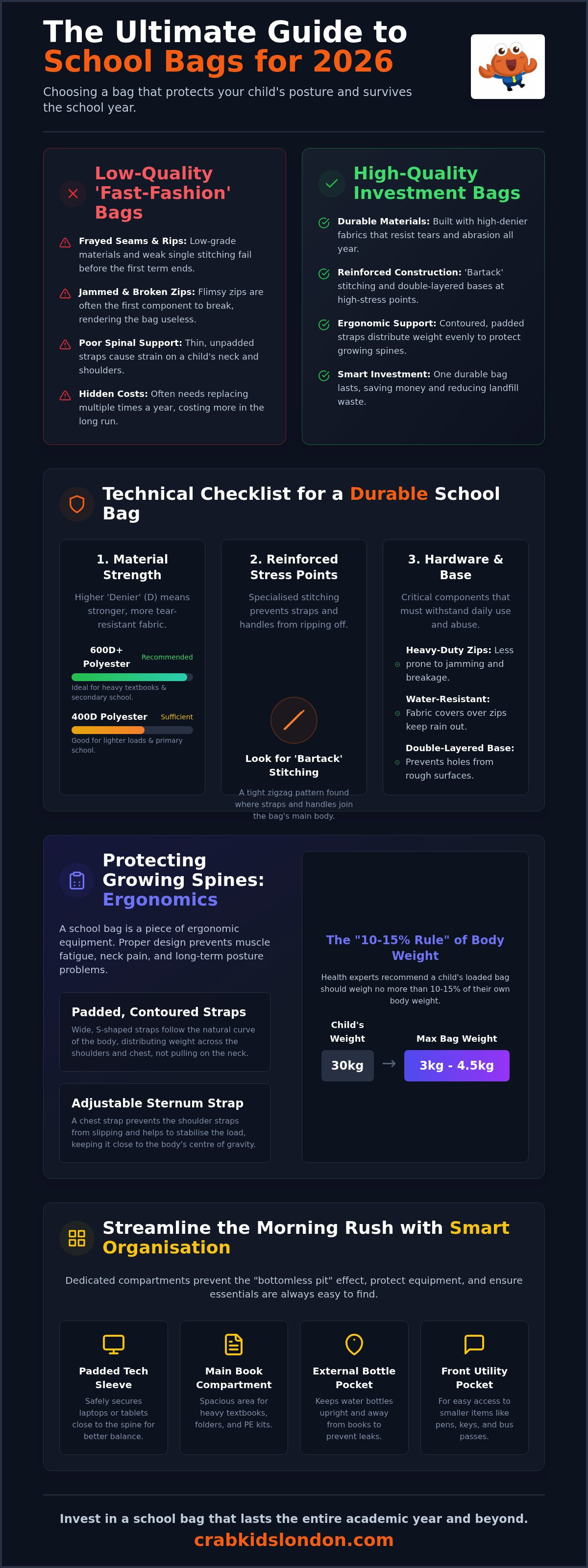
Academic kits have evolved to include laptops and heavy sports gear. This weight adds up. Poorly designed bags pull on the shoulders and force the spine into an unnatural curve. To protect growing bodies, health experts recommend following the "10-15% rule." This guideline suggests a child's loaded bag should weigh no more than 10-15% of their body weight. High-quality designs use contoured straps to ensure this weight sits correctly, preventing long-term posture problems.
The Hidden Costs of 'Disposable' Fast-Fashion Backpacks
Cheap supermarket alternatives rarely survive the first term. Low-grade materials and weak construction lead to stitching failures and broken fasteners. Replacing a broken bag three times a year is more expensive than buying one sturdy version. There is also a significant environmental cost. Understanding different Backpack designs and materials is the first step in avoiding these wasteful purchases that inevitably end up in landfill.
Organisation plays a huge role in reducing daily friction for both parents and students. A bag with dedicated compartments for tech and stationery prevents the "bottomless pit" effect where pens and chargers disappear. It stops lunch boxes from crushing homework and keeps heavy books close to the spine for better balance. When everything has a place, the morning rush becomes much smoother and more predictable. Choosing from a curated range of high-performance school bags means you are investing in a product designed for the reality of the British school year. This small change can significantly reduce the mental load on busy families.
The Technical Checklist for Durable School Bags
A school bag is only as reliable as its weakest seam. When you're choosing school bags, you need to look past the colours and patterns. Focus on the technical specifications that guarantee longevity. High-quality construction ensures the bag survives the daily grind of being tossed into lockers and dragged across playground concrete. Durable materials aren't just a luxury; they're a necessity for a product that gets used for 190 days a year.
Material Strength: Beyond Basic Fabrics
600D polyester is the industry benchmark for a reason. Denier refers to the linear mass density of the fibres. Higher denier counts mean superior tear resistance and a longer lifespan. For primary school students, a slightly lighter 400D fabric often suffices to keep the overall weight manageable. Secondary students, however, require the rugged 600D or higher to support the weight of laptops and heavy science textbooks. Look for easy-wipe internal linings too. They make cleaning up leaked lunchboxes or exploded pens a simple task rather than a disaster.
Reinforced Stress Points and Stitching Quality
Durable bags don't just use better fabric; they use better assembly methods. Look for 'bartack' stitching. These are the tight, zigzag reinforcements found at high-stress points like strap attachments and handle joins. Without them, straps will eventually pull away from the main body under heavy loads. Check the base of the bag as well. A reinforced, double-layered base prevents holes from forming when the bag is placed on rough floors. If your premium bag features leather accents, using a leather shoe cleaning lotion can keep those details looking fresh and supple for years.
Zips are often the first component to fail. Opt for heavy-duty zips with fabric 'garages' or covers. These prevent water from seeping through the teeth during a British downpour. Before making a final choice, it's wise to consult an ergonomic backpack safety checklist to ensure the technical build matches your child's physical needs. For a range of options that meet these high standards, explore our collection of durable school bags designed for active students. Quality zips and water-resistant coatings are essential for keeping homework dry whilst commuting.
Prioritising Ergonomics: Protecting Growing Spines
Children's spines are flexible and still developing. Carrying poorly designed school bags can lead to muscle fatigue and chronic neck pain. Ergonomics is not just a technical marketing term; it is a vital safety feature for any student. A well-designed bag uses contoured straps that follow the natural shape of the body. This design ensures the weight is distributed across the shoulders and back rather than pulling on a single point. It keeps the centre of gravity stable, which is essential for active students moving between classrooms.
The Importance of Padded Straps and Back Panels
High-density foam padding is essential for long-term comfort. It prevents straps from 'digging in' to the shoulders when the bag is fully loaded with heavy textbooks. Padded back panels serve a dual purpose. They provide a soft buffer against the sharp edges of hardback books and laptops whilst maintaining the bag's shape. Quality designs also include air-flow channels. These channels allow heat to escape, keeping students cool during their commute. Just as finding the right fit is essential in our shoe size guide, ensuring a bag fits the torso properly is critical for daily comfort. A bag that is too large for the child's frame will cause them to hunch forward to compensate for the weight.
Distributing Weight: Proper Fit and Positioning
Correct positioning is often overlooked but easily managed. A bag should never hang more than 10cm below the child's waistline. If it sits too low, it pulls the shoulders back and strains the lower spine. Adjustable straps allow you to pull the load closer to the body, which improves balance and reduces the perceived weight of the kit. It is also important to encourage students to use both straps. 'One-shouldering' a bag causes a sideways lean that can lead to muscle imbalances over time.
For parents concerned about long-term health, seeking expert advice on preventing backpack injury is a proactive step. Chest straps are another valuable feature to look for in 2026 collections. They stabilise the bag during active movement, such as running for the bus or walking up stairs. Breathable mesh fabrics on all contact points further enhance the experience. These fabrics regulate temperature and prevent moisture build-up against the back. By choosing a bag with these ergonomic features, you ensure your child stays focused on their lessons rather than their physical discomfort.
Smart Organisation: Features That Simplify the School Day
A chaotic bag is more than just a nuisance; it's a risk to expensive academic equipment. Modern school bags must serve as portable filing cabinets, separating heavy textbooks from delicate tablets whilst keeping small essentials within reach. This structural organisation prevents damage and reduces the daily scramble for bus passes or house keys. When a bag is well-organised, it protects the contents and ensures the weight stays balanced against the student's back.
Dedicated Compartments for Tech and Textbooks
Internal sleeves are vital for keeping A4 folders crisp and unbent. Without these dedicated slots, loose papers and workbooks quickly become dog-eared and unreadable. Modern classrooms frequently utilise laptops or tablets, which require specific padded zones to prevent screen cracks or impact damage. These compartments should be positioned closest to the back panel to keep the heaviest items near the body's centre of gravity. You can even use smaller internal pockets to store a spare pair of school socks, ensuring they stay clean and dry until PE begins.
Managing Mess: PE Kits and Water Bottle Holders
External mesh pockets are a non-negotiable feature for the British school day. They keep water bottles outside the main compartment, protecting electronics and homework from condensation or accidental leaks. Internal dividers also help manage daily mess by separating muddy PE kits from clean textbooks. Teaching children to use these specific zones builds independence and encourages them to take responsibility for their own equipment. It simplifies the transition between different lessons and ensures nothing gets left behind in the cloakroom.
Visibility and accessibility are the final pieces of the organisation puzzle. Reflective strips or piping are essential for safety during dark winter afternoons in the UK, ensuring students remain visible to drivers. Small front pockets provide quick access to high-frequency items like house keys or travel cards, preventing the need to dig through the main load at the school gate. Investing in a bag with smart architecture pays off in protected equipment and a smoother daily routine. Browse our full range of organised school essentials to ensure your child is fully prepared for the academic year ahead.
Discover the Crabkids London School Bag Collection
Crabkids London serves as a dedicated partner for families across the UK. We understand that school equipment faces a high-energy reality every day, from the morning commute to the final bell. Our curated collection of 11 durable school bags offers a grounded solution for parents seeking longevity and reliability. We focus on resilience and ease, ensuring every product stands up to the daily wear and tear of a busy academic schedule. By choosing a specialist brand, you avoid the pitfalls of high-street fashion bags that aren't built for the weight of a full curriculum.
Why Our Designs Stand Out for Students
Our designs prioritise function over fleeting trends, focusing on the features that actually matter to students. We use high-denier polyester that resists tears during active playground play, ensuring the bag remains a sturdy mainstay of the school wardrobe. The interiors feature a spacious design perfectly suited for standard UK A4 folders and workbooks. Every bag includes a padded strap system to distribute weight safely across the shoulders, as discussed in our ergonomics guide. These high-performance bags also perfectly complement our range of boys' school shoes and girls' school shoes, providing a complete, durable kit for the term.
Choosing Your Perfect Match from Our 2026 Range
Selection depends on the student's specific load and physical size. Secondary students benefit from our larger backpacks with multiple compartments to separate laptops from PE kits. Primary students require smaller options that provide the same organisational benefits on a scale suited to their growing frames. These bags feature spacious interiors and multiple pockets to ensure that stationery and lunchboxes stay exactly where they should. We encourage you to browse our New Arrivals to see the latest 2026 designs and technical features.
Fast national delivery across the UK ensures your child is ready for the new term without the wait. Each bag is designed to last the full academic year, alleviating the stress of mid-term replacements or broken zips. With Crabkids London, you get the quiet confidence of quality craftsmanship and a design that truly understands the British school environment. We handle the heavy lifting so you don't have to. Shop the full Crabkids London School Bag collection here and prepare for a successful year ahead.
Equip Your Child for Academic Success in 2026
Selecting the right gear is about more than just aesthetics; it's about ensuring your child stays supported through every lesson and playground adventure. By focusing on high-denier materials and technical bartack stitching, you avoid the frustration and waste of frequent mid-term replacements. Prioritising ergonomic designs with contoured, padded straps protects their developing spinal health, whilst smart internal organisation keeps their academic life in order. High-quality school bags act as a silent partner in their daily routine, significantly reducing the mental load on busy parents.
Crabkids London provides spacious and ergonomic designs specifically built for the high-energy reality of active school life. Our collection balances professional reliability with the practical needs of modern students, ensuring their tech and textbooks stay safe. With fast UK-wide delivery, you can secure the perfect fit for your child without the stress of a last-minute high-street rush. We do the heavy lifting so you don't have to, delivering products that stand up to the rigours of the full academic year. Browse the Durable School Bag Collection for 2026 and give your child the comfort they deserve. Let's make this year their most organised and confident one yet.
Frequently Asked Questions
What is the best size school bag for a primary school child?
A primary school bag should typically have a capacity of 15 to 20 litres. It must be large enough to hold A4 folders and a lunchbox without being so bulky that it overwhelms the child's frame. Ensure the bag sits comfortably between the shoulders and the waistline to maintain a stable centre of gravity during active play.
How can I tell if a school bag is truly waterproof or just water-resistant?
Most high-quality school bags are water-resistant rather than fully waterproof. Water-resistant fabrics, like high-denier polyester, shed light rain and splashes but may eventually soak through in a heavy downpour. Truly waterproof bags feature heat-sealed seams and rubberised zips. Look for fabric "garages" over the zips to provide extra protection against the unpredictable British weather.
Are backpacks better for back health than messenger bags?
Backpacks are significantly better for long-term spinal health because they distribute weight evenly across both shoulders. Messenger bags place all the pressure on one side, which often leads to muscle imbalances and a tilted posture. Using a backpack with two padded straps ensures the load stays centred and reduces the risk of chronic neck or shoulder pain.
How often should I replace my child's school bag?
A premium bag should last at least one full academic year, though many durable designs survive much longer. You should consider a replacement if you notice frayed seams, failing zips, or if your child has outgrown the bag's ergonomic fit. Regularly check the internal lining for wear to ensure the bag continues to protect textbooks and expensive digital devices.
Can school bags be washed in a washing machine?
Machine washing is generally not recommended as the agitation can strip away water-resistant coatings and damage internal foam padding. Instead, use a damp cloth and mild detergent to spot-clean the exterior and easy-wipe linings. This methodical approach maintains the bag's structural integrity and ensures the technical features, like reflective piping, stay effective for longer.
What features should I look for in a bag for secondary school?
Secondary school students require a larger capacity, typically 25 to 30 litres, to accommodate multiple subjects and sports gear. Look for dedicated, padded compartments for laptops or tablets and reinforced bases that handle heavier loads. Multiple internal dividers are essential for keeping varied textbooks organised and preventing delicate items from being crushed by heavy equipment.
How do I adjust the straps correctly for my child's height?
Tighten the shoulder straps so the bag sits snugly against the child's upper back rather than sagging towards the hips. The base of the bag should never hang more than 10cm below the waistline. Correct adjustment prevents the bag from swaying, which reduces the strain on the lower spine and makes the load feel lighter whilst walking.
What is the maximum weight a child should carry in their school bag?
A loaded bag should never exceed 10% to 15% of your child's total body weight. Carrying more than this increases the risk of back injury and forces the child to hunch forward to compensate. Regularly clear out unnecessary items to keep the weight manageable and ensure the heaviest books are always packed closest to the back panel.