

Best Ethical School Shoe Brands UK: The 2026 Parent’s Guide
An ethical school shoe is completely useless if it falls apart before the October half-term. For parents researching ethical school shoe brands UK retailers offer, the back-to-school shop often feels like a frustrating trade-off between flimsy greenwashed synthetics and strict uniform policies demanding durable, polishable black footwear.
You shouldn't have to replace detached soles every term just to stand by your environmental principles, nor should you have to guess whether vegan alternatives are merely short-lived plastics in disguise. True sustainability starts with craftsmanship that keeps shoes on feet and out of household bins. In this 2026 guide, you'll discover the leading brands successfully balancing transparent sourcing with playground-ready durability. We examine how different materials impact daily longevity, break down uniform-compliant designs, and provide everything you need to invest in a pair that genuinely lasts the full academic year.
Key Takeaways
- Durability is the true cornerstone of sustainability, ensuring a single resilient pair prevents recurring landfill waste.
- Evaluating the leading ethical school shoe brands UK families trust makes it simple to choose responsibly made footwear built for active playground wear.
- Understanding material differences clarifies the practical trade-offs between breathable, polishable leather and short-lived synthetic alternatives.
- Navigating strict dress codes is straightforward when choosing classic black styles engineered to satisfy formal uniform policies without compromising on ethics.
- Routine maintenance and simple protective care guard against tarmac grit, keeping uppers in service for the entire academic year.
What Defines an Ethical School Shoe Brand in the UK?
Marketing campaigns often reduce sustainability to recycled cardboard packaging or token percentages of reclaimed plastic. True responsibility runs deeper. For discerning families evaluating ethical school shoe brands UK makers must prove that ethical production spans fair human labour, non-toxic sourcing, and physical resilience. Children subject footwear to intense daily friction. If a pair separates at the sole after twelve weeks, its ecological credentials become irrelevant.
The wider movement towards sustainable fashion highlights that manufacturing ethics cannot focus purely on materials while ignoring the human element. A genuinely ethical brand maintains full visibility over its supply lines, rejects exploitative workshops, and builds footwear capable of enduring tarmac playground games without disintegrating.
Fair Labour and Supply Chain Transparency
Footwear assembly remains an intricate, hands-on trade. Reputable brands ensure their international workshops provide safe working conditions, capped working hours, and fair living wages. Independent third-party audits verify these factory standards, ensuring that corporate promises match daily floor reality. Smaller, specialised family brands often hold an advantage here, maintaining direct oversight of production runs rather than outsourcing through layers of anonymous subcontractors.
The Durability Imperative: Ending the Termly Replacement Cycle
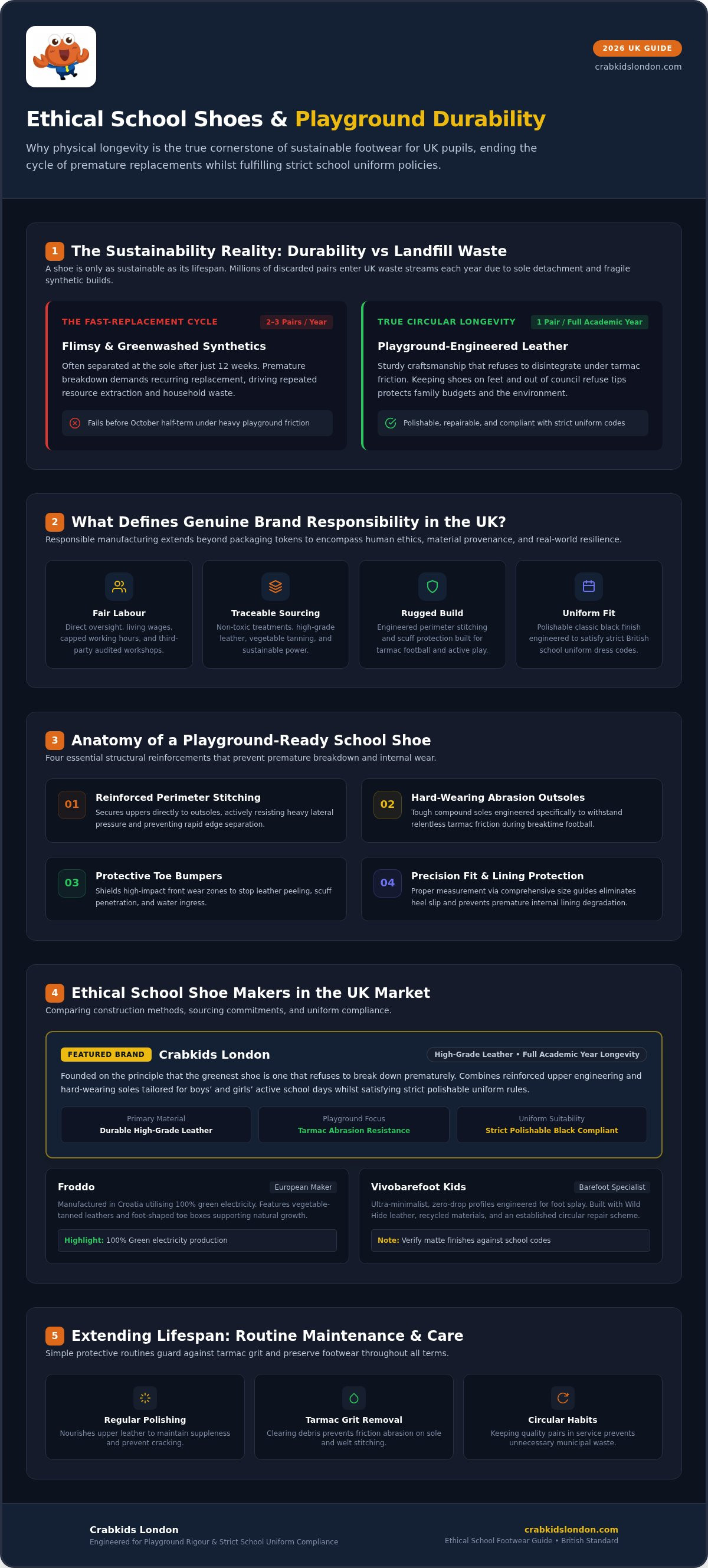
The greenest shoe is the one that stays out of council refuse tips. Discarding two or three poorly made pairs across a single school year generates substantial landfill waste, demanding repeated resource extraction for cheap replacements. Responsible manufacturing tackles this issue through sturdy engineering:
- Reinforced perimeter stitching: Keeps uppers secured to outsoles under heavy lateral pressure.
- Hard-wearing outsoles: Resists rapid tarmac abrasion during breaktime football.
- Protective toe bumpers: Shields high-wear zones from scuffing and leather peeling.
- Precision fit: Consulting a thorough shoe size guide prevents irregular heel friction and premature internal lining wear.
When searching for ethical school shoe brands UK parents can trust, durability serves as the ultimate benchmark. A robust pair made with high-grade materials reduces long-term consumption, protects household budgets, and keeps children moving comfortably throughout the entire school year.
Leading Ethical School Shoe Brands for UK Pupils in 2026
Finding the right balance between ethical principles and playground practicalities narrows the footwear field quickly. According to UK footwear industry sustainability evidence, millions of pairs of discarded shoes enter waste streams every year, largely driven by premature sole separation and non-recyclable composite components. Evaluating the leading ethical school shoe brands UK families rely on requires examining both material provenance and the daily durability that keeps footwear in service across consecutive terms.
Crabkids London: Playground Durability and Responsible Longevity
Crabkids London operates on a practical environmental premise: the most sustainable product is one that refuses to break down prematurely. Engineered to withstand daily scuffs on tarmac playgrounds whilst satisfying strict dress codes, their shoes feature durable, high-grade leather construction tailored specifically for active school days. Parents can select dedicated boys’ school shoes built with reinforced uppers or explore hard-wearing girls’ school shoes designed for supportive day-long comfort. Focusing on rugged build quality ensures each pair stays on active feet and out of landfill bins.
Specialist Sustainable and Barefoot Alternatives
For families prioritising natural foot mechanics alongside responsible manufacturing, specialised European makers offer distinctive alternatives. Froddo manufactures in Croatia using 100% green electricity, incorporating vegetable-tanned leathers and foot-shaped toe boxes. Vivobarefoot Kids provides ultra-minimalist, zero-drop profiles that encourage natural foot splay, using Wild Hide leather, recycled elements, and an established repair programme. When considering barefoot profiles, parents should verify whether specific lugged outsoles and matte finishes meet their school's traditional black, polishable footwear guidelines.
Heritage Brands and Modern Environmental Commitments
Established footwear makers across the British market are increasingly updating their supply chains, with several adopting standards certified by independent leather environmental groups. These operations frequently incorporate post-consumer recycled linings and eliminate harmful chrome agents. While broad high-street availability remains convenient, parents must scrutinise whether mass-market retail construction delivers the multi-term structural resilience required for strenuous play. Choosing amongst ethical school shoe brands UK stockists supply ultimately means selecting footwear robust enough to prevent repeated termly replacements.
Before the new academic year begins, consider exploring Crabkids London to find uniform-ready footwear engineered for continuous daily resilience.
Sustainable Materials vs Playground Rigour: Understanding the Trade-Offs
Choosing children's footwear requires balancing green credentials against the brutal abrasion of daily playground games. While marketing claims often present material choices as simple moral decisions, the physical reality is more complex. Selecting uppers and soles demands an honest look at water resistance, flex durability, and how materials behave under constant outdoor friction. A truly conscious purchase accounts for how long those materials will survive six hours of daily activity.
Responsibly Sourced Leather vs Synthetic Vegan Alternatives
Many synthetic vegan leathers marketed today are essentially petroleum-derived polyurethane (PU) or polyvinyl chloride (PVC). These synthetic coatings do not breathe well, trapping sweat during active physical play. Worse still, when dragged across rough concrete, synthetic polymers flake and tear rather than buffing smooth. As they wear down, they shed microplastics directly into local drains and soil. Once the top plastic film cracks, water leaks into the toe box, rendering the footwear unwearable.
High-grade leather offers a distinct, natural advantage. Sourced through certified tanneries that treat wastewater and eliminate harmful chemicals, natural grain hide remains exceptionally durable and supple. Leather moulds to your child's feet, breathes naturally throughout the school day, and accepts restorative waxes. Rather than discarding scuffed shoes, parents can polish natural leather repeatedly to restore both water resistance and appearance.
Outsoles: Natural Rubber, Recycled Compounds, and Grip
Upper durability matters little if the foundation underfoot fails. A shoe's outsole dictates whether a child slips on wet autumn leaves or wears down the heel within eight weeks. The material structure makes all the difference:
- Vulcanised rubber compounds: Deliver dense abrasion resistance on coarse tarmac, outlasting lightweight foamed EVA outsoles that shave flat under foot dragging.
- Non-marking tread patterns: Provide vital indoor grip on polished assembly hall floors without leaving black scuff streaks that breach school dress codes.
- Integrated toe caps: Wrap dense rubber up over the front welt, protecting upper leather stitches from blowing out during playground football.
When shortlisting ethical school shoe brands UK parents should recognise that natural durability prevents premature material failure. Footwear built with supple leather uppers and resilient vulcanised rubber soles outlasts synthetic alternatives, delivering dependable performance that keeps children protected and comfortable.
How to Choose the Right Ethical Pair for Your Child’s School
Buying conscious footwear requires balancing home values against stringent school dress codes. British academies and local authority schools maintain rigid footwear standards, often rejecting casual silhouettes outright. Selecting between ethical school shoe brands UK stockists offer means verifying that every pair satisfies headteachers on the first morning of term whilst meeting your environmental benchmarks.
Checking School Uniform Compliance Rules
Most British schools insist on plain black, polishable leather shoes. Visible athletic branding, contrast stitching, and chunky lugged trainer soles frequently result in uniform violations. While modern guidance aims to keep overall costs manageable, individual governing bodies retain authority over daily dress codes. Inspect potential shoes for clean profiles, matte or semi-sheen black finishes, and subtle seams that comply fully with formal guidelines.
Getting the Fit Right to Maximise Wear Life
An improper fit ruins even the best-constructed shoes. Excess room causes the foot to slide forward, placing abnormal pressure on toe seams and grinding the internal heel lining against the counter. Conversely, tight shoes cause rapid leather stretching and painful blisters. Follow these practical steps when sizing at home:
- Measure both feet: Use our printable shoe size guide in the afternoon, when children's feet are naturally at their widest.
- Account for proper growth: Maintain roughly 10 to 12 millimetres of clearance between the longest toe and the front edge of the shoe.
- Assess width carefully: Check that the upper leather rests comfortably across the ball of the foot without bulging over the sole perimeter.
Selecting Fastenings: Rip-Tape vs Classic Laces
The right fastening preserves structural integrity across active mornings. Rip-tape straps give younger primary pupils complete independence, allowing quick adjustments before and after physical education. For older juniors and secondary students, traditional waxed laces deliver fine-tuned tension across the instep, securing narrower heels in place. Always ensure eyelets feature reinforced backing washers to prevent uppers from stretching during rushed morning departures.
Ready to equip your child for the terms ahead? Explore our uniform-compliant school shoes to secure durable, expertly crafted pairs delivered directly across the UK.
Extending Shoe Lifespan: Care, Maintenance, and Circular Habits
The most sustainable school shoe is always the pair already in active daily service. Investing in ethical school shoe brands UK parents trust provides the foundation, but routine maintenance determines whether that footwear survives one term or an entire academic year. Mud, playground dust, and winter pavement salts constantly attack natural fibres, breaking down adhesives and leather grain unless checked by simple weekly care.
Weekly Cleaning and Nourishing Routines
Tarmac grit acts like sandpaper against upper leather. Allowing caked mud to dry draws out essential oils, leaving hide brittle and prone to flex cracking across the toe box. Dedicating ten minutes every weekend keeps materials supple and water-resistant:
- Clear surface grit: Brush dried mud away using a firm bristle brush before wiping uppers with a damp cloth.
- Lift ingrained dirt: Apply a specialised leather shoe cleaning lotion to remove road salt and grime without dehydrating the leather hide.
- Replenish protective oils: Buff with a matching black wax polish to restore deep colour and rebuild the surface barrier against wet playground tarmac.
Proper Drying and Storage Between Terms
Sudden downpours are unavoidable during British walk-to-school mornings. When shoes get drenched, never dry them directly on household radiators or beside fan heaters. Intense direct heat bakes the leather, causing severe grain cracking and softening internal sole adhesives. Instead, pack wet toe boxes firmly with unprinted paper to draw moisture out from the inside. Allow them to dry slowly at room temperature. Over half-term breaks, store clean, polished shoes in dry, ventilated spaces rather than damp utility rooms.
Donation, Hand-Me-Downs, and Shoe Recycling
Children frequently outgrow well-made footwear before wearing it out. Passing down a resilient pair to a younger sibling completes an authentic circular lifecycle, halving the environmental burden of producing replacement items. Before handing shoes down, check that the outsoles haven't worn excessively to one side and that the internal footbed remains supportive.
For serviceable pairs your family no longer needs, donate them to community uniform banks to help local pupils start the term smartly. When soles finally wear through after years of hard service, deposit them at UK textile recycling banks rather than the household bin. Responsible consumption among ethical school shoe brands UK families support means keeping quality materials working as long as possible.
Invest in School Shoes Built for the Long Run
Navigating back-to-school preparation shouldn't mean replacing split soles every term. When researching ethical school shoe brands UK parents quickly discover that genuine sustainability isn't found in short-lived synthetics. It's built into tough, repairable materials that withstand daily playground friction whilst satisfying traditional uniform codes.
Selecting durable construction, ensuring a proper fit, and committing to simple weekly care keeps a single pair performing brilliantly from autumn right through summer. To take the guesswork out of uniform shopping, explore durable, high-quality school shoes at Crabkids London. Featuring hard-wearing leather uppers designed specifically to endure rigorous British school playgrounds, alongside reliable nationwide UK dispatch ensuring prompt delivery directly to your door, equipping your child with responsible, long-lasting footwear is easier than ever.
Frequently Asked Questions
What makes a school shoe brand truly ethical in the UK?
A truly ethical school shoe brand pairs fair working conditions and traceable materials with robust structural durability. It isn't just about eco-friendly badges or recycled packaging; it's about proving workers earn living wages and crafting shoes resilient enough to avoid premature landfill disposal. For families evaluating ethical school shoe brands UK makers must deliver transparent production standards that survive rigorous playground wear across multiple terms.
Is genuine leather or vegan faux leather more sustainable for school shoes?
High-grade, responsibly sourced leather is generally more sustainable for everyday school wear because it outlasts synthetic alternatives. Most vegan faux leathers are petroleum-based plastics that tear easily under friction and crack within months, shedding microplastics into waterways. Natural leather breathes comfortably during long classroom hours, resists heavy tarmac abrasion, and accepts wax polish to restore water resistance and appearance repeatedly.
Are ethical school shoes compliant with strict UK uniform policies?
Yes, reputable ethical footwear makers design classic styles specifically to meet formal UK school guidelines. While some sustainable labels focus on casual barefoot trainers or canvas plimsolls, leading makers produce plain, polishable black leather shoes free from exterior sports logos. Checking your school’s written dress code before buying ensures your chosen pair complies with regulations on sole thickness, upper colours, and traditional fastenings.
How long should a well-made pair of school shoes typically last?
A well-constructed pair should easily last an entire academic year, assuming your child’s feet haven't undergone a sudden growth spurt. Premium stitching, dense rubber outsoles, and quality leather uppers resist daily playground scuffing and wet commutes. Applying regular leather care and alternating breathable socks helps preserve the structural lining, ensuring the shoes remain comfortable and intact from September through to July.
How do I prevent my child from scuffing the toes within weeks?
Choose designs with integrated rubber toe bumpers that physically shield the leather welt from tarmac friction. Before the first day of term, treat the uppers with a protective wax polish or nourishing lotion to establish a barrier against grit and water. Weekly touch-ups with black shoe polish will quickly buff away surface scratches, preventing outdoor scrapes from penetrating deep into the leather grain.
Can ethical school shoes be recycled once completely worn out?
Most municipal councils cannot recycle shoes in standard household bins due to bonded glues and mixed materials, but specialised textile banks accept them. Many ethical school shoe brands UK parents purchase offer dedicated circular take-back schemes or work with national collection programmes. Alternatively, dropping outgrown but functional pairs at community uniform exchanges keeps footwear in active use before recycling becomes necessary.
Do sustainable school shoe brands cater for wide or narrow feet?
Yes, conscious footwear makers provide generous toe boxes and adjustable fastenings to accommodate varied foot shapes. Rip-tape straps and traditional laces let parents tailor the instep volume securely without pinching wider forefeet or slipping on narrow heels. Consulting an online printable sizing chart before purchasing ensures you select the correct dimensions, preventing the premature wear caused by tight or loose footwear.