

Average UK School Shoe Costs 2026: A Parent’s Guide
What should you budget for school shoes when one child outgrows a pair quickly and another wears theirs hard every day? The average cost of school shoes UK 2026 can be difficult to pin down, and a price on its own won’t tell you whether a pair is suitable or good value.
It’s understandable to look for one typical figure. But school rules, fit, materials and daily wear all affect what makes sense for your child. A lower price may not be the best value if the shoes don’t meet school requirements or need replacing sooner than expected. Equally, paying more doesn’t guarantee a better fit or a longer-lasting pair.
This guide explains why there’s no single useful average for every family, and what to compare before you buy. You’ll learn how to assess fit, construction, school rules and care while keeping growing feet and busy school days in mind. The aim is to make a considered choice that works for your child, not a decision based on price alone.
Key Takeaways
- Use the average cost of school shoes UK 2026 as a guide, not a promise of what every family will pay. Shoe type, size, materials and school rules all affect comparisons.
- Check your school’s footwear requirements before comparing suitable pairs, so you don’t spend time weighing up shoes your child can’t wear.
- Compare fit, material, fastening and care needs alongside the price to judge practical value for everyday school wear.
- Plan around school terms and your child’s growth, then review fit and wear rather than relying on a fixed replacement date.
- Start with a suitable fit, then consider comfort and durability information. A shoe-size guide can help you make a more informed choice.
What do average UK school shoe costs in 2026 mean?
The price beside one pair tells you what that particular listing costs. It doesn’t tell you what families across the UK typically pay. A useful average summarises prices from a stated, relevant sample of children’s school shoes. Without details of that sample, the phrase average cost of school shoes UK 2026 can sound more precise than the information behind it really is.
A listing price is the cost of one specific pair at one point in time; a representative average summarises a defined sample of comparable school shoes. That distinction matters when you’re planning a budget. A sale item, a specialist style and a standard everyday shoe may all appear in search results, but they don’t necessarily make a fair comparison.
Why school-shoe prices vary across UK listings
Materials and construction can differ, as can the fastening, shape and design. A shoe made for a particular school requirement may not be comparable with a more general style. Size matters too: children’s ranges cover different stages of growth, and listings may show only selected sizes or designs.
School rules also shape the choice. Requirements can differ between schools, so one family may need a particular colour or style whilst another has more options. For broad background on school uniform policies, see the overview, then use your own school’s guidance to assess suitability. A sale listing shows an available offer, not a representative cross-section of UK school footwear.
What makes a 2026 average trustworthy?
A credible figure should state when prices were collected, what counted as a children’s school shoe and which retailers were included. It should also explain whether the sample covers different sizes, materials and styles, rather than drawing conclusions from a narrow selection.
It helps to know how the figure was calculated. A simple mean can be pulled up or down by unusually high or low listings; a median identifies the middle price in the sample. Neither is automatically right for every family. Without a clear sample and method, an average offers limited help with budgeting.
For your own comparison, first rule out shoes that don’t meet school requirements. Then compare similar styles and sizes, checking fit, materials, fastening and intended use. If sizing is part of your decision, the children’s shoe-size guide can help you assess fit before weighing up value. This gives you a more useful basis for choosing than an unexplained average alone.
Which factors shape school-shoe costs and long-term value?
A school shoe’s value isn’t measured by its ticket price alone. Think about how it fits, the activities it needs to handle and whether its design meets the school’s requirements. A pair worn for a full school day faces repeated walking, classroom movement and playground use, so comfort and suitability matter alongside the amount paid.
Value depends on fit, use, care and school requirements, not price alone. That’s a practical way to assess any pair without assuming a higher price guarantees a longer life. Materials and construction offer useful comparison points, but they don’t prove that one shoe will suit every child or every school day.
How fit and growth affect a school-shoe budget
A shoe that’s too large can slip or rub; one that’s too small can feel uncomfortable. Buying a bigger size for a child to grow into may seem convenient, but the fit needs to work now. Check that the shoes feel secure and comfortable when your child stands and walks, and reassess the fit as they grow. The children’s shoe size guide can help you assess sizing as part of your decision.
How materials, wear and shoe care affect value
Look at visible details rather than relying on a broad label such as “durable”. Consider the upper material, how the sole joins the shoe, the fastening and areas likely to take knocks. Scuffs around the toe, frequent playground activity and wet conditions can all affect how a pair looks and feels over time. These checks help you compare construction with your child’s actual routine.
Care matters, too. Follow suitable care instructions and keep the shoes clean to help maintain their appearance, whilst remembering that care can’t prevent normal wear or promise a set lifespan. Choose care that suits the shoe’s material, and check the school’s rules before settling on a style. The statutory guidance on school uniforms provides useful context for school uniform expectations; each school’s own policy will guide your footwear choice.
To compare pairs fairly, consider:
- Fit: Does the shoe feel secure and comfortable now?
- Use: Does its design suit everyday school activity?
- Construction: Are the fastening, sole and upper appropriate for your child’s needs?
- Care: Can you maintain the material as recommended?
Once you’ve set those practical checks, you can compare the children’s school shoes available for active school days with clearer priorities.
How can parents compare school shoes without relying on price alone?
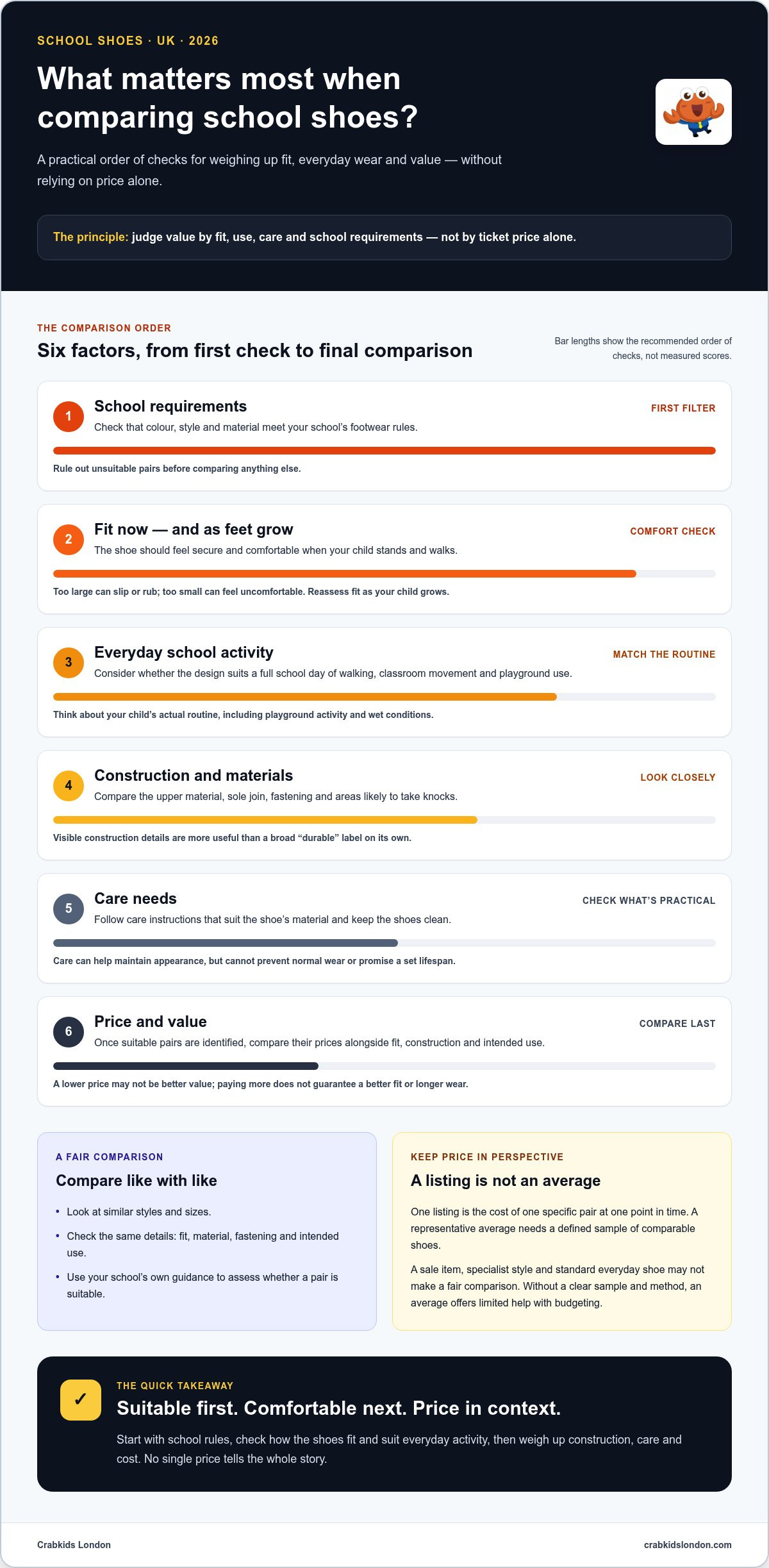
A consistent checklist makes different listings easier to judge. Start by removing any shoes that don’t meet the school’s requirements, then compare the remaining options using the same criteria. The table below separates details you can check from preferences that depend on your child.
A practical checklist for comparing school-shoe options
Check the uniform policy first, then compare shoes that meet it. Use the same checklist for each option, and make sure you’re comparing the same size and a similar style. A formal shoe and a more practical everyday design may have different features, so their listings aren’t automatically like-for-like. Also weigh up your child’s routine: a long walk to school can place different demands on footwear than mostly indoor use.
How to judge durability claims fairly
Look for details you can assess, such as the materials, sole construction and care instructions. Treat broad claims as a starting point, not a promise that a shoe will last for a set time. Fit, activity and maintenance all affect how long footwear remains comfortable and suitable. The lowest listed price won’t be the right choice for every child if the shoe doesn’t fit properly or meet school rules.
Keep objective details separate from personal priorities. Material, fastening and stated care guidance are features to compare; ease of fastening and appearance are preferences that may matter more to one child than another. This gives the average cost of school shoes UK 2026 a more practical context: use price as one part of the comparison, then choose from options that suit your child’s fit, school and everyday wear.
How should UK families plan a school-shoe budget for 2026?
A useful plan gives you room to respond as your child grows, without assuming shoes need replacing on a set date. School rules and family routines differ across the UK, so start with your own requirements and review fit and condition as the school year progresses. The phrase average cost of school shoes UK 2026 can offer context, but your budget is more useful when it reflects the pair your child actually needs.
A simple school-shoe planning routine
Use these four steps to make a considered choice and keep track of changing needs:
- Check requirements: Note the school’s rules for footwear, including any stated colour, style or material expectations.
- Assess fit: Check how the current pair feels and whether it remains comfortable. Use the children’s shoe size guide as a sizing reference.
- Compare suitable pairs: Once you’ve narrowed the options to shoes that meet the rules, record size, material, fastening and care details. This helps you make a like-for-like comparison.
- Review fit and wear: Reassess during the school year, especially as your child grows or their routine changes.
This approach helps you plan around school terms without tying a purchase to a fixed replacement date. A child who walks more or spends breaktimes outdoors may put different demands on their shoes from one whose day is mostly indoors.
When might shoes need replacing?
Look at fit and condition together. A pair may need attention if it no longer feels comfortable, appears too small, has visible damage or shows wear that affects how it feels to walk in. Check the fastening, upper and sole, and notice whether the shoe stays secure during normal movement. These are practical cues, not a universal timetable. Growth and everyday activity vary, so a particular age, distance or school term can’t determine the right replacement point for every child.
Keep a simple note of when you checked the fit and what you noticed. That can help you spot changes over time and avoid relying on memory alone. If the shoes still feel comfortable and suitable for school, there’s no need to replace them solely because a calendar date has arrived. If fit or condition has changed, reassess the options against the school’s requirements before choosing a new pair.
Ready to compare suitable options? Explore children’s school shoes and use your checklist to guide the next step.
Choosing school shoes that balance cost, comfort and durability
A straightforward decision rule keeps the choice manageable: find a suitable fit first, then compare practical value. Price matters, but it can’t tell you whether a shoe meets school requirements, feels comfortable through the day or suits your child’s routine. Nor does a higher price guarantee a particular lifespan.
Instead, weigh together the fit, fastening, material, care instructions and the kind of wear the shoes will face. This approach makes the average cost of school shoes UK 2026 a starting point for comparison, rather than the sole test of a good purchase.
Which school-shoe priorities matter most for your child?
Start with the school’s uniform rules. Once you’ve narrowed the choice to acceptable styles, think about your child’s day: walking, classroom use and active breaktimes can all shape what feels suitable. A secure fastening can help keep a shoe in place, whilst an easy-to-manage fastening may matter if your child is learning to dress independently. Choose according to their needs, not a general claim about which design is best.
- Fit: Does the shoe feel comfortable and secure now?
- School suitability: Does its style meet the school’s requirements?
- Everyday use: Does the design suit your child’s routine?
- Care: Are the instructions practical for your household?
A useful next step after comparing options
With those priorities in mind, explore the boys’ school shoes or consider the girls’ school-shoe range if that better suits your child. Before choosing a size, use the shoe-size guide to check fit and reduce the chance of selecting a pair that feels unsuitable. Reassess as your child grows, and follow care guidance appropriate to the footwear.
There’s no need to chase the lowest listing or assume a particular pair will last for a set period. A well-considered choice balances comfort, school rules, useful construction details and manageable care. Explore children’s school shoes and compare options with your child’s needs in mind.
Choose school shoes with confidence
The average cost of school shoes UK 2026 is useful as context, but a single figure can’t account for every child’s size, school rules or daily routine. Start with a comfortable, suitable fit, then weigh up fastening, materials, care and the wear your child’s school day brings. Review fit and condition as they grow rather than relying on a fixed replacement date.
Crabkids London designs boys’ and girls’ school shoes for active school life, with delivery available across the United Kingdom. Use your checklist to find a pair that suits your child’s needs and your school’s requirements.
Explore durable school shoes for children and take the next step towards a considered choice for busy school days.
Frequently Asked Questions
What is the average cost of school shoes in the UK in 2026?
There isn’t one average that can reliably represent what every UK family will pay. The average cost of school shoes UK 2026 depends on which children’s shoes, sizes, materials and retailers are included in the sample, and when the prices were recorded. Treat any figure as a summary of that sample, not a guaranteed price for your child. Check how an average was calculated before using it to plan.
How much should I budget for children’s school shoes in 2026?
Set a budget around your child’s needs rather than relying on one figure for all families. First check the school’s footwear rules and your child’s current fit. Then compare suitable pairs by size, material, fastening, care needs and intended use. Leave room in your plans to reassess fit and condition as your child grows. That gives you a practical basis for choosing without assuming a fixed replacement date.
Why do children’s school shoe prices vary so much?
Listings can differ because they cover different sizes, shoe styles, materials, construction and retailers. A sale listing is one offer, not a representative sample of the UK market. School requirements also affect which shoes are suitable, so two listings may not be comparable even if both are described as school shoes. For a fairer comparison, narrow the options to pairs that meet the same school rules and suit similar needs.
Are more expensive school shoes better value?
Not necessarily. A higher price doesn’t guarantee a better fit, greater comfort or a longer useful life. Look at the details you can assess, such as the fastening, materials, construction and care instructions, then consider how the shoes match your child’s routine. A less expensive pair may suit one child, whilst another may need different features. Compare suitable options on practical value, not price alone.
How long should a pair of children’s school shoes last?
There’s no dependable lifespan that applies to every child or pair. How long shoes remain suitable depends on fit, growth, daily activity, wear and care. A child who is growing quickly may outgrow a pair before it shows much wear; another pair may become uncomfortable or damaged sooner through everyday use. Check fit and condition regularly instead of treating a particular number of months or school terms as a rule.
When should I replace my child’s school shoes?
Consider replacing them when they no longer fit comfortably, don’t feel secure, or show damage that affects their use. Check the upper, fastening and sole, and notice whether your child seems uncomfortable whilst walking. Growth and wear vary, so a calendar date alone isn’t a reliable guide. If the shoes still fit, feel comfortable and meet school requirements, review them as needed rather than replacing them automatically.
How can I make school shoes last longer?
Start with a suitable fit and choose shoes that meet school rules and your child’s everyday needs. Follow the care instructions for the material, remove dirt in a suitable way and check the shoes regularly for wear or damage. Avoid assuming that care can prevent normal wear or extend every pair by a set amount. Crabkids London’s school shoes are designed for active school life, and shoe-care products are available to help with routine maintenance.